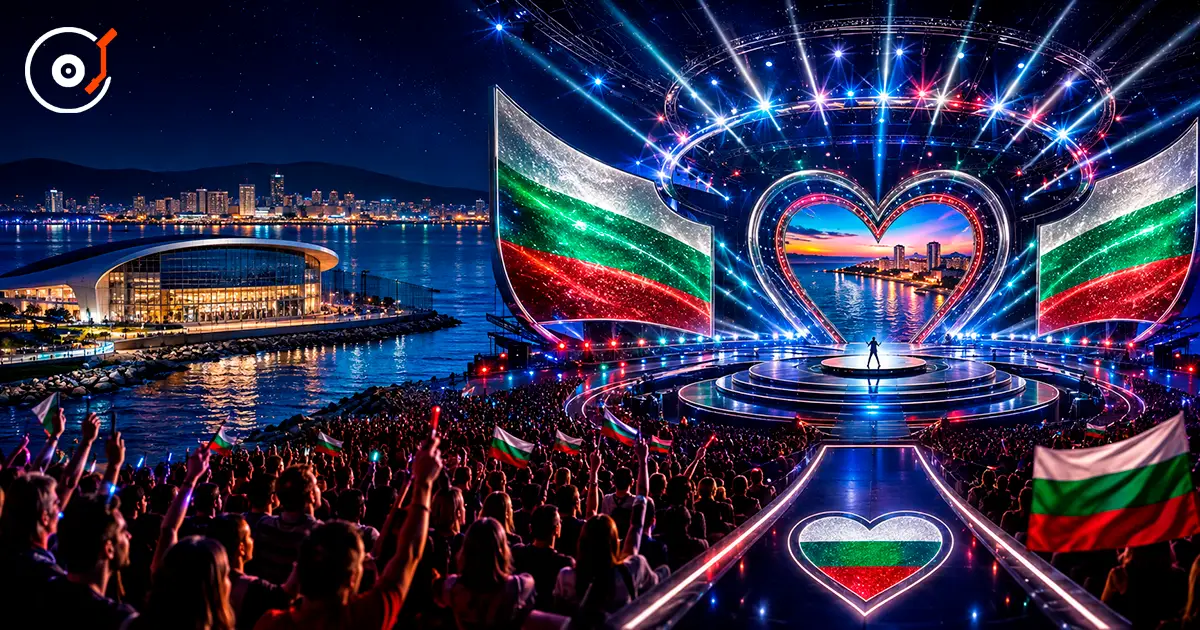
Eurovision 2027 will take place in Burgas on May 11, 13 and 15. Arena Burgas, DARA’s victory, Canada’s debut, new EBU rules, voting and tickets.
Eurovision 2027 is officially heading to the Black Sea coast. The European Broadcasting Union and Bulgarian National Television have selected Burgas as the host city of the 71st Eurovision Song Contest. The first semi-final will take place on 11 May, the second on 13 May, and Europe will discover the new winner in the grand final on 15 May 2027. At the same time, the EBU has significantly updated the contest rules: the minimum age for performers has been raised to 18, live-vocal requirements have been strengthened, and under certain circumstances the winning country may now lose the right to host the following contest.
The decision to select Burgas was officially announced on 13 August 2026. All three televised shows will take place at Arena Burgas — a multifunctional venue opened in 2023. This will be the first Eurovision Song Contest in history to be hosted by Bulgaria.
Key confirmed information as of today:
- host city: Burgas, Bulgaria;
- venue: Arena Burgas;
- first semi-final: 11 May 2027;
- second semi-final: 13 May 2027;
- grand final: 15 May 2027;
- organisers: European Broadcasting Union and Bulgarian National Television;
- new participating country: Canada;
- the full list of countries and participants has not yet been announced.
Why Eurovision 2027 is taking place in Bulgaria
Bulgaria earned the right to host the contest thanks to the historic victory of DARA at the 70th anniversary Eurovision Song Contest, held in Vienna on 16 May 2026.
The Bulgarian singer performed the energetic pop track Bangaranga and scored 516 points: 204 from the professional juries and another 312 from viewers. Moreover, Bulgaria finished first in both the jury vote and the public vote. It was the first time in almost a decade that both voting groups had chosen the same winner.
For Bulgaria, this was its first Eurovision victory in history. The country debuted in the contest in 2005, while one of its biggest previous achievements had been Kristian Kostov’s second place with Beautiful Mess in 2017.
DARA’s winning margin was impressive: she finished the contest 173 points ahead of second place, which the EBU describes as the largest winning margin in the history of the contest.
After the final, Bangaranga also developed a commercial life of its own. The song topped Spotify’s daily charts in several European countries and was streamed more than three million times on Spotify on the day of the final. It is a strong example of how Eurovision today functions not only as a television show, but also as a global mechanism for launching streaming hits.
Why Burgas was chosen instead of Sofia
After DARA’s victory, four Bulgarian cities — Burgas, Sofia, Plovdiv and Varna competed for the right to host Eurovision 2027. At the final stage, the main contest was between Burgas and Sofia.
The EBU and BNT created a separate international working group that analysed the bids, visited potential venues and assessed the technical, logistical and infrastructure capabilities of the cities.
Ultimately, Burgas was selected. The organisers highlighted the combination of Arena Burgas, hotel infrastructure, transport and international accessibility, as well as the municipality’s readiness to turn Eurovision into a city-wide event.
At the same time, Sofia, Plovdiv and Varna will not disappear from the project entirely. BNT plans to involve them in the accompanying cultural programme so that Bulgaria’s first Eurovision is perceived not only as an event for Burgas, but as a national project.
For Eurovision itself, the choice of a coastal city is unusual and potentially interesting in terms of the contest atmosphere. Burgas is located on the Black Sea and is known for its beaches, parks, festivals and summer cultural life. Details about the Eurovision Village, EuroClub, opening ceremony and city programme are expected to be revealed gradually by the organisers.
New rule: winning no longer guarantees the right to host Eurovision
One of the most significant changes comes into force specifically with the 2027 contest.
Previously, there was a tradition under which the winning country hosted the following Eurovision if its broadcaster was able to organise the event. The conditions are now set out much more strictly.
Under the updated rules, the broadcaster of the winning country may be declared ineligible to host the following contest if an armed conflict, serious geopolitical situation or other circumstances significantly affect the safety or stability of the country or the surrounding region.
The EBU has the right to commission an independent security assessment. A decision on whether the contest can be held will then be made after consultation with the Reference Group.
If the winning country cannot become the host, the EBU will appoint another Host Broadcaster. The new organiser will then stage the contest in its own name, assuming all rights and obligations, rather than formally organising Eurovision “on behalf of” the winning country.
It is important not to attribute an official motivation to this rule that the EBU itself has not stated. The changes followed the annual review of the regulations and feedback from national broadcasters after Vienna 2026. However, they come into force after several years in which war, security and geopolitics have increasingly affected the organisation of the contest.
Minimum age for Eurovision participants raised to 18
Another notable change directly concerns the performers.
Until now, artists could take part in the adult Eurovision from the age of 16. Starting from 2027, a performer must be at least 18 years old by the day of their first rehearsal.
The EBU explains the decision as an effort to strengthen the protection of young performers from psychological pressure and the enormous media attention that accompanies participation in the world’s largest televised music competition.
In this way, Eurovision is drawing an even clearer line between the adult contest and Junior Eurovision, not only conceptually but also through a stricter age threshold.
EBU tightens live-vocal requirements
After years of debate over how much of a Eurovision performance is actually performed live, the 2027 regulations introduce more precise wording.
The lead vocalist must perform the main melody live.
Pre-recorded elements and backing vocals are still permitted, but they may not replace the main voice or reinforce it to such an extent that they effectively perform the principal vocal part instead of the artist. Lip-syncing is prohibited.
In addition, the rules explicitly prohibit pitch correction and Auto-Tune on the live lead vocal during the competitive performance.
For the music industry, this is a significant clarification. Since pre-recorded backing vocals were permitted, the boundary between live performance and studio playback had gradually become less obvious. The new wording effectively establishes the principle that a technologically complex show is possible, but the voice carrying the song’s main melody must remain genuinely live.
The main traditional restrictions also remain in place: a competing song may not exceed three minutes, and no more than six performers may be on stage at the same time.
How voting will work at Eurovision 2027
There is an important detail here that can easily be misrepresented at the moment.
The final version of all voting parameters has not yet been fully confirmed.
The published EBU regulations provide for national professional juries of seven members, national televoting and a separate aggregated Rest of the World vote for viewers in non-participating countries.
In the grand final, the result will be formed from the points of professional juries and viewers, but the exact weighting of these components is determined by the EBU with the approval of the Reference Group.
The situation with the semi-finals is particularly interesting. The current version of the rules states that qualification should be determined primarily by the public vote, including the Rest of the World vote. At the same time, the EBU retains the option of including professional jury points in the result, with the ratio to be determined later.
This is an important nuance after Eurovision 2026, when professional juries were brought back into the semi-finals at approximately a 50/50 ratio with viewers. It is therefore premature to say that the 2027 semi-finals will definitely be televote-only or definitely 50/50.
The fight against artificial influence on voting continues
Another line of reform concerns not the music itself, but the promotion of participants.
The rules prohibit disproportionate advertising campaigns, including large-scale activity or activity supported by state structures that could influence voting. Artists and broadcasters may encourage audiences to vote, but attempts to turn voting into an organised external campaign are treated as a threat to the integrity of the contest.
This policy continues reforms introduced for Eurovision 2026 following debates over televote transparency. At that time, the EBU, among other measures, reduced the maximum number of votes per payment method from 20 to 10 and strengthened the rules governing third-party promotional campaigns.
Canada to debut at Eurovision 2027
One of the most unexpected developments of the new season is the official debut of Canada.
On 1 July, the EBU and CBC/Radio-Canada confirmed that the country would send its own participant to the Eurovision Song Contest for the first time. Canada became a full EBU member, opening the way for its public broadcaster to participate in the contest.
It is the first new Eurovision country since Australia joined in 2015.
Canada will compete in a semi-final and will not receive an automatic place in the grand final. CBC/Radio-Canada has promised to reveal later in 2026 how its artist and song will be selected.
Canada’s connection with Eurovision, however, existed long before the country’s official debut. The best-known example is Canadian singer Céline Dion, who won the contest in 1988 while representing Switzerland.
Canada’s arrival itself demonstrates an important strategic transformation of Eurovision. Participation has never formally been determined exclusively by Europe’s geographical borders — the key factor is a broadcaster’s status within the EBU. However, after Australia, the appearance of another major non-European country significantly strengthens the global character of the contest.
Which countries will participate
As of 13 August 2026, the final list of Eurovision 2027 participants has not yet been announced.
Under the regulations, up to 44 broadcasters may take part in the contest, while the grand final may feature a maximum of 26 countries. The host country and the Big Five — France, Germany, Italy, Spain and the United Kingdom — traditionally receive guaranteed places in the final if their broadcasters participate in the contest. Ten participants qualify from each semi-final.
Canada’s debut is already confirmed. National broadcasters are also gradually launching their own selection seasons: for example, Latvia has scheduled the Supernova 2027 final for 6 February and will move its national selection to a large arena in Riga for the first time.
However, the EBU will publish the full list of countries later, so any “final Eurovision 2027 participant lists” currently circulating online should be treated with caution.
What happened around Eurovision 2026 and why the 2027 season matters so much
The previous contest was one of the most tense in recent years.
Vienna 2026 featured 35 broadcasters. Spain, the Netherlands, Ireland, Iceland and Slovenia withdrew amid the dispute over Israel’s participation and the war in Gaza. The EBU later explicitly noted that the absence of five members had affected television figures and said it intended to look for ways to bring them back in 2027.
At the same time, it would be too simplistic to speak of an audience-interest crisis. Eurovision 2026 reached around 131 million people across 35 measured television markets, while the viewing share for the final among audiences aged 15–24 reached 54.8%. Official Eurovision content on YouTube, TikTok, Instagram and Facebook generated more than 2.75 billion views over the season.
In other words, Eurovision enters the 2027 season in two states at once: as an exceptionally strong global music and media brand, and as a contest that is having to seriously redesign its rules around safety, voting, promotion and artist protection.
When Eurovision 2027 tickets will go on sale
At the time of publication, official ticket sales have not yet started.
The EBU says that anyone wishing to buy tickets must register with the free official Eurofan community, through which access to ticket sales will be provided once they launch. The organisers will announce the start dates and prices later.
In addition to the three televised shows, audiences will also be offered tickets for six Preview Shows. They will take place between 10 and 15 May, meaning the programme inside Arena Burgas will cover virtually the entire Eurovision week.
What is still unknown about Eurovision 2027
Despite the announcement of Burgas and the publication of the updated regulations, the season is only beginning.
The hosts have not yet been named, the Arena Burgas stage design has not been revealed, details of Eurovision Village and EuroClub remain unknown, most national representatives and songs have not been announced, ticket prices have not been published, and the final list of participating broadcasters is still unavailable.
It also remains to be determined exactly what share professional juries will have in the semi-finals.
For this reason, 13 August 2026 can be considered the true starting point of Eurovision 2027: the country, city, arena and dates are already known, but the main part of the music season — national selections, artists, songs and the battle of the favourites — is still ahead.
Why Eurovision 2027 could become one of the most important contests in recent years
The upcoming contest is interesting for far more than just a change of scenery.
Eurovision will be held in Bulgaria for the first time. Canada will appear on the Eurovision stage for the first time. The minimum age threshold will be 18 for the first time. And for the first time, the rules set out in such detail the geopolitical and security circumstances under which the winner may not receive the right to host the following contest.
At the same time, the EBU is trying to draw a clearer line between modern television production and genuine musical performance by reinforcing the central role of the live lead vocal.
As a result, the Eurovision Song Contest 2027 in Burgas is becoming not simply the next annual edition, but the first contest after a noticeable recalibration of the Eurovision model itself.
Music is still supposed to determine the winner on 15 May 2027. But the rules under which that winner will be chosen and will receive — or not receive — the right to host the next contest are already noticeably different from those audiences were used to before.