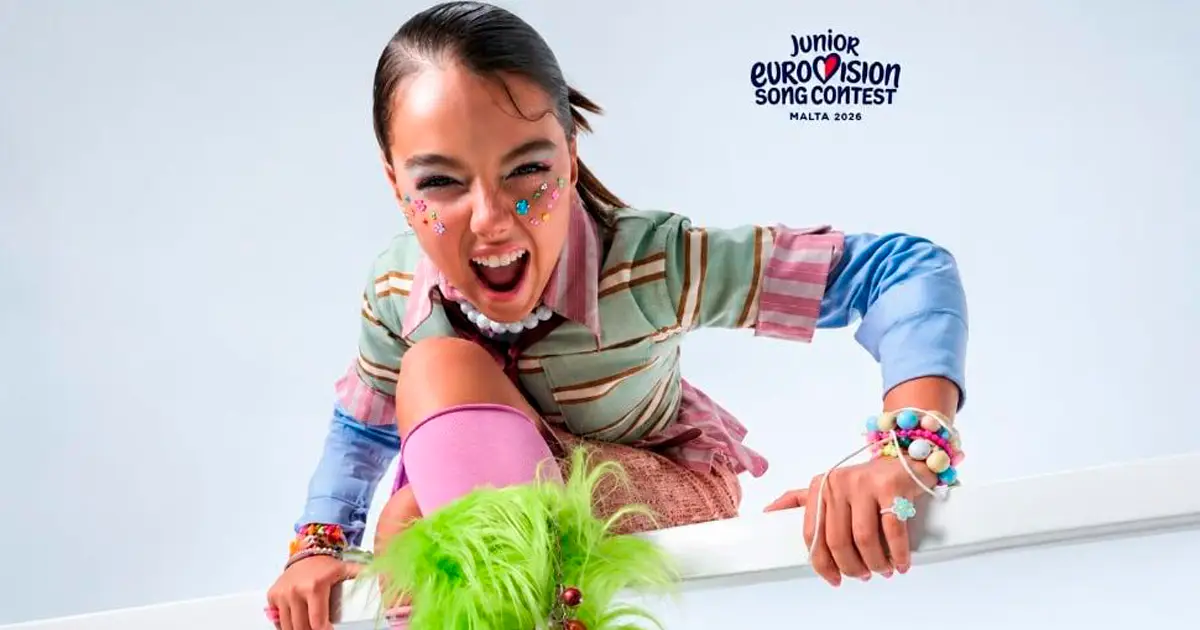
Junior Eurovision 2026 ended with Armenia’s victory. Voting results, all 16 contestants, Ukraine’s result, Naré’s performance and the key moments from the final in Malta.
On October 24, 2026, Malta hosted the final of the 24th Junior Eurovision Song Contest. The winner was 13-year-old Armenian representative Naré with the song BOO!. After combining the votes of the national juries and the public, she finished with 202 points, ahead of the entries from Spain and France.
The final took place at the Malta Fairs & Conventions Centre (MFCC) in Ta’ Qali. Sixteen countries competed for the title, with Armenia’s third victory in the history of the contest becoming the defining result of the night.
Ukraine was represented by 12-year-old Erika Kolesnichenko from Bila Tserkva with the song NOT A LULLABY («НЕ колискова»). She finished ninth with 106 points.
Armenia’s third victory: who is Naré and what made BOO! stand out?
Armenian singer Naré comes from Yerevan. She has been involved in music from an early age and has appeared in musicals, television programmes and national music projects. She earned the right to represent Armenia after a selection process involving more than 100 candidates.
The winning song BOO! was created by a songwriting team consisting of Lilit Navasardyan, Grigor Kyokchyan, Nick Egibyan, Martin Mirzoyan and Anush Ter-Ghukasyan.
The song is about overcoming fear and finding the courage to move forward. Its energetic production, memorable chorus and colourful stage presentation helped Naré capture the attention of the international audience.
In the final vote, Naré received 103 points from the national juries and another 99 points from the online public vote. Armenia topped the audience vote, which ultimately secured the overall victory.
It was the country’s third Junior Eurovision win, following earlier victories in 2010 and 2021. The result further strengthened Armenia’s position as one of the most successful countries in the contest’s history.
Spain and France complete the top three
Second place went to 10-year-old Lucas Paulano, who represented Spain with Cuore Bello (Te Quiero, Te Quiero). He received 108 points from the juries and 76 from the public, finishing with a total of 184 points.
France’s 12-year-old representative Alec scored 165 points with Comment Tu Vas ?. His performance received the highest jury score of the entire contest — 114 points. However, he collected only 51 points in the online vote, leaving France in third place overall.
The final highlighted a clear difference between professional jury assessments and audience preferences. France led the national jury vote, while Armenia received the strongest support from viewers and won the contest on combined points.
Full Junior Eurovision 2026 results
San Marino finished fourth with Violamarie, while Georgia completed the top five. The final results for all 16 countries were:
| Place | Country and artist | Points |
|---|---|---|
| 1 | Armenia — Naré | 202 |
| 2 | Spain — Lucas Paulano | 184 |
| 3 | France — Alec | 165 |
| 4 | San Marino — Violamarie | 148 |
| 5 | Georgia — Davit Lomidze | 145 |
| 6 | Poland — Wiktor Sas | 144 |
| 7 | Malta — Beppe | 136 |
| 8 | Netherlands — Maria | 126 |
| 9 | Ukraine — Erika Kolesnichenko | 106 |
| 10 | Cyprus — Harry Georgiou | 98 |
| 11 | Italy — Matteo Trullu | 87 |
| 12 | Montenegro — Mija Vujović | 68 |
| 13 | Portugal — Salvador Rio | 64 |
| 14 | Ireland — Caleb Kirwan and Naomi Gribben | 64 |
| 15 | Albania — Eslin Kurti | 62 |
| 16 | North Macedonia — Ana Stojanoska | 57 |
Ukraine at Junior Eurovision 2026: Erika Kolesnichenko and NOT A LULLABY
Ukraine was represented by 12-year-old Erika Kolesnichenko from Bila Tserkva. Performing 11th in the running order, she took to the stage with NOT A LULLABY, originally presented to the Ukrainian audience under the title «НЕ колискова».
The song was written by Ukrainian singer and songwriter TARABAROVA. Its message centres on individuality, inner strength and the desire to realise one’s own potential.
The Ukrainian performance was staged by Lesia Podolianko and Illia Osiadlyi, with choreography by Danylo Demekhin. The performance combined the song’s message of self-belief with a visual concept created specifically for the international competition.
After the performance, Erika addressed the audience with the words:
«Thank you! This is for the children of Ukraine and the whole world!»
Ukraine’s preparations for the contest took place under difficult circumstances. The national selection final had originally been scheduled for September 13, but worsening security conditions forced organisers to postpone it until September 26. Additional safety measures were also introduced for the contestants and production crew.
Six performers took part in the final stage of the national selection. The winner was chosen through a combined jury and public vote, with viewers voting via the Diia app.
In the international final, Erika received 106 points and finished ninth. The Ukrainian performance was rated more highly by viewers than by the national juries, receiving 68 public points compared with 38 jury points.
A year earlier, Ukraine had won silver: Sofiia Nersesian finished second at Junior Eurovision 2025 with MOTANKA.
In 2026, Sofiia Nersesian returned to the contest as Ukraine’s national spokesperson. She announced the Ukrainian jury points, including the maximum 12 points awarded to Poland.
The adult members of Ukraine’s national jury were musician and composer Philipp Koliadenko, singer Kazhanna and choreographer Anna Bondarenko. The remaining two seats were occupied by children, whose names were not disclosed under the contest’s updated rules.
San Marino sets a historic record as viewers reshape the scoreboard
One of the biggest surprises of the final came from San Marino. Violamarie finished fourth with Ruota Panoramica, scoring 148 points.
It was San Marino’s best result in the history of its participation across the Eurovision family of contests. Online voters provided particularly strong support: Violamarie received 78 public points, second only to Armenia’s winner.
Notably, San Marino had been placed considerably lower by the national juries. The professionals awarded the performance 70 points, but the public vote lifted the country to fourth place in the final standings.
A similar pattern could be seen at the top of the scoreboard. Had the winner been decided solely by the national juries, France would have finished first. In the online vote, however, Armenia received almost twice as many points as the French entry — 99 compared with 51.
The results demonstrated how important it is for a Junior Eurovision song to connect with a broad audience. With juries and viewers carrying equal weight, public preferences can significantly reshape the final ranking.
Malta turns Junior Eurovision into The Festa music festival
In 2026, Malta hosted Junior Eurovision for the third time, following the 2014 and 2016 editions.
The event was organised by national broadcaster Public Broadcasting Services (PBS), which developed the artistic concept The Festa. It drew inspiration from traditional Maltese celebrations, known for decorated streets, musical processions, brass bands and colourful light displays.
These elements were reflected in the stage design. The venue was transformed into a festival-style setting known as the Eurovision Festa Village. The stage, lighting and decorative elements all referenced the festive atmosphere traditionally found in Maltese towns and villages.
Another notable feature of the 2026 edition was the broadcast time: the final began at 21:00 Central European Summer Time. This gave the junior contest the feel of a prime-time evening television show similar to the adult Eurovision Song Contest.
Former winners return as hosts
The show was hosted by Gaia Cauchi, Destiny and television presenter Keane Cutajar.
The involvement of the two singers carried particular significance for the host country. Gaia Cauchi delivered Malta’s first Junior Eurovision victory in 2013, while Destiny repeated the achievement in 2015. Destiny later went on to represent Malta at the adult Eurovision Song Contest in 2021.
Years later, both artists returned to the Junior Eurovision stage as hosts, creating a symbolic link between different generations of contestants.
Special performances and a meeting of two Eurovision winners
The musical programme extended beyond the competing entries. During the voting interval, Eurovision 2026 winner DARA performed Bangaranga, while Junior Eurovision 2025 winner Lou Deleuze of France returned with Ce Monde.
The 2026 contestants also performed the joint song Join the Festa, while the hosts opened the show with the musical number RamDamDiriDam.
These performances linked the current competition with the wider history of Eurovision and gave viewers another opportunity to see artists who had already achieved success on the international stage.
Voting from 194 countries and territories and a large-scale television production
According to the European Broadcasting Union (EBU), online voting for Junior Eurovision 2026 reached 194 countries and territories — six more than the previous year.
The winner was determined through two equally weighted components:
- 50% of the result came from the national juries. In each participating country, the performances were assessed by three music industry professionals and two children aged between 10 and 15.
- 50% of the result came from international online voting. Viewers could select up to three favourite songs, including the entry representing their own country. Voting took place in two stages: before the live broadcast and again after all competing performances had concluded.
A total of 48 young performers took part in the show, including singers and dancers. Around 4,000 spectators attended the event in person, while the television and online audience numbered in the millions.
The scale of Junior Eurovision 2026 production
Staging the international final required substantial technical resources. According to the EBU, the production used:
- 18 television cameras;
- around 750 lighting fixtures;
- 700 m² of LED screens;
- 2.5 kilometres of dynamic LED lighting;
- 80 microphones;
- more than 200 kilometres of cabling;
- over 250 members of the technical and production team.
In addition, more than 22 tonnes of equipment were suspended above the stage, while the power supply system included generators with a combined capacity of 3.5 MW.
The show lasted approximately two and a half hours. In terms of television production, Junior Eurovision is increasingly approaching the scale of the world’s major international music events while retaining its own identity as a competition for young performers.
Where will Junior Eurovision 2027 be held?
Despite Armenia’s victory, the host location for the next contest has not yet been determined.
Unlike the adult Eurovision Song Contest, winning Junior Eurovision does not automatically oblige a national broadcaster to host the following edition. The European Broadcasting Union selects the host separately in cooperation with interested broadcasters.
The next contest will mark a major anniversary: the 25th edition of Junior Eurovision. As a result, the choice of host country and the overall concept of the show will carry particular significance.
Armenia has already hosted the contest in Yerevan in 2011 and 2022. The possibility of staging the anniversary edition in the country therefore remains open, although no official decision had been announced as of October 25, 2026.
What made Junior Eurovision 2026 memorable?
The final in Malta was marked by Armenia’s third victory, San Marino’s best-ever result across the Eurovision family of competitions and a noticeable divide between professional jury scores and public preferences.
For Ukraine, Erika Kolesnichenko’s performance continued the country’s long-standing participation in the international children’s music competition. Despite challenging preparation conditions, the Ukrainian team delivered a fully developed stage performance and finished inside the top ten.
The scale of the television production, the diversity of musical styles and the international reach of the voting once again demonstrated Junior Eurovision’s importance as a platform for young performers.
For many contestants, Junior Eurovision becomes their first major international appearance, giving them valuable stage experience and an opportunity to introduce their music to audiences beyond their home country. For 2026 winner Naré, the victory represents a significant early milestone in her musical career.