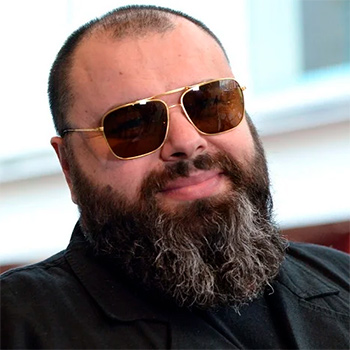
Maxim Alexandrovich Fadeev (born 6 May 1968, Kurgan) — is a Russian composer, music producer, songwriter, arranger and performer. He has worked in the music industry since the late 1980s. At different stages of his career, he has collaborated with Linda, Gluk'oZa, Total, Monokini, Yulia Savicheva, SEREBRO, Nargiz and other artists, managed production companies and participated in television music projects. He also writes and records his own music and composes soundtracks. In 2022, he was awarded the honorary title of Honored Art Worker of the Russian Federation.
Childhood and musical education
Maxim Fadeev was born on 6 May 1968 in Kurgan into a musical family. His father, Alexander Fadeev, worked at a music college, while his mother, Svetlana Fadeeva, was involved in vocal and choral work.
Fadeev began studying at music school at the age of five. As a teenager, he learned to play bass guitar, and at 15 he entered the Kurgan Music College, where he studied piano as well as choral conducting. His musical education gave him a foundation in harmony, arrangement, vocals and ensemble work.
In his youth, Fadeev played in local bands, including «Конвой», where he worked as a musician and backing vocalist before later performing as the lead singer. In 1990, he took part in the all-Union competition for young performers «Yalta-90», where he finished in third place.
In the early 1990s, Fadeev worked on musical production, advertising jingles and arrangements. In 1993, he moved to Moscow and continued working in the studio industry, primarily as a composer, arranger and music producer.
Collaboration with Linda
Fadeev’s first major production project was singer Linda — Svetlana Geiman. Their collaboration began in the first half of the 1990s. Fadeev worked as a composer, arranger and sound producer and was directly involved in creating the singer’s repertoire and studio sound.
In 1994, Linda released the album «Песни тибетских лам». Fadeev contributed to it as a composer, arranger, musician and vocalist. In 1996, the album «Ворона» was released, featuring the title track, for which Maxim Fadeev wrote both the music and lyrics.
Linda’s recordings from this period combined pop songwriting with electronic music, elements of alternative rock, multilayered vocal arrangements, unconventional timbres and complex studio processing. Fadeev also took part in shaping the project’s overall concept, bringing together music, vocal style, music videos and the singer’s visual image.
The collaboration with Linda continued until the end of the 1990s and became one of the key stages in Fadeev’s professional development as a music producer.
Solo music and the album «Ножницы»
Alongside his production work, Fadeev recorded his own music. In 1997, he released the solo album «Ножницы», which included «Акула», «Сестричка», «Тихо несёт вода», «Беги по небу», «Кусай свои губы» and other tracks.
Fadeev’s solo work featured electronic arrangements, rock-influenced rhythms, extended melodic lines and his own vocals. «Беги по небу» became one of the best-known songs in his solo repertoire.
Fadeev’s own recordings developed in parallel with his work for other performers. As a songwriter and producer, he used different musical forms depending on the specific project, while his solo material allowed him to determine the structure of the compositions, vocal delivery and character of the arrangements himself.
Total, Monokini and Gluk'oZa
At the turn of the 1990s and 2000s, Fadeev expanded the number of projects he produced. Among those associated with him were Total and Monokini, whose music incorporated elements of pop rock, electronic and dance music.
In the early 2000s, Fadeev created the project Gluk'oZa. During its first stage, the concept was built around a virtual female character: songs were released without publicly revealing the performer, while the music videos featured a computer-animated character. Natalia Ionova later became the public face of the project.
In 2003, the debut album «Глюк’oZa Nostra» was released. The project’s music was combined with computer animation, a recognisable graphic identity and a series of music videos, allowing Gluk'oZa to develop simultaneously as a musical and visual brand.
«Fabrika Zvyozd — 2»
In 2003, Maxim Fadeev became the music producer of the second season of the television project «Fabrika Zvyozd» on Channel One. The season premiered on 7 March 2003.
Participants included Yulia Savicheva, Elena Temnikova, Elena Terleeva, Pierre Narcisse, Irakli Pirtskhalava, Polina Gagarina and other performers. Fadeev was involved in selecting and creating repertoire, studio work and preparing concert performances.
After the project ended, he continued working with some of its participants. In particular, Fadeev collaborated with Yulia Savicheva and Elena Temnikova.
In 2004, Yulia Savicheva represented Russia at the Eurovision Song Contest with the song Believe Me. The music was written by Maxim Fadeev, while the English lyrics were written by Brenda Loring. Savicheva finished 11th in the final in Istanbul.
SEREBRO and Eurovision 2007
In the mid-2000s, Maxim Fadeev created the group SEREBRO. The original line-up consisted of Elena Temnikova, Olga Seryabkina and Marina Lizorkina.
The group’s first major public appearance came when it represented Russia at the Eurovision Song Contest 2007 in Helsinki. SEREBRO performed the English-language song Song #1. The music was written by Maxim Fadeev and the lyrics by Daniil Babichev.
SEREBRO finished third in the final with 207 points. After Eurovision, the group continued releasing both Russian-language and English-language recordings and became one of Fadeev’s longest-running production projects.
Fadeev also contributed to other Eurovision entries. In addition to Yulia Savicheva’s Believe Me, he was one of the writers of Butterflies, performed by the Belarusian group 3+2 at the 2010 contest in Oslo. Belarus finished 24th in the final.
MALFA and work with artists in the 2010s
During the 2010s, Fadeev’s production activities were centred around the company MALFA. At various times, its artists included SEREBRO, Olga Seryabkina under the name MOLLY, Nargiz, Yulia Savicheva, Oleg Miami and other performers.
One of the notable projects of this period was his collaboration with Nargiz Zakirova. Fadeev worked with the singer as a producer and songwriter. Their collaboration lasted around five years and ended in 2019 when her contract with MALFA was terminated.
On 30 October 2019, Fadeev announced the termination of contracts with MALFA artists and the restructuring of the company. According to him, the organisation was working with more than 30 performers by that point, leading him to abandon the large-scale production-centre model and move toward working with a limited number of projects.
In July 2021, Fadeev announced that he had sold the rights to music, visual identities and other elements of several projects created with his involvement. Among those named were Gluk'oZa, SEREBRO and Total.
Television work
In addition to «Fabrika Zvyozd», Maxim Fadeev participated in several other television music projects.
In 2014 and 2015, he served as a coach on the first two seasons of «The Voice Kids» on Channel One. The winner of the first season was Alisa Kozhikina, who competed as a member of Fadeev’s team.
In 2018, Fadeev and Timati took part as producers and mentors in the music show «Песни» on TNT.
Television projects allowed Fadeev to work with emerging performers, select repertoire and prepare live performances within a competitive format.
Film and animation
Fadeev’s work is not limited to pop and mainstream music. In 2015, the feature-length animated film «Савва. Сердце воина», directed by Maxim Fadeev, was released. The project continued his work with computer animation, which had previously been used in Gluk'oZa music videos.
Fadeev also composes music for film. In 2025, Yegor Konchalovsky’s film «Авиатор», based on the novel by Eugene Vodolazkin, was released with a score composed by Fadeev.
The score combines symphony orchestra, electronic elements and sound design. In December 2025, music from the film was released as a separate digital soundtrack containing 19 compositions.
SEREBRO relaunch and further work
In May 2024, Maxim Fadeev announced the relaunch of SEREBRO. The project was formed with a new line-up and continued independently of the members of the original version of the group.
In the following years, Fadeev continued composing his own music, making new recordings and working on film scores. In a 2025 interview, he spoke about his intention to reduce the number of artists he produced and devote more attention to his own music and music education.
On 30 December 2022, Maxim Fadeev was awarded the honorary title «Honored Art Worker of the Russian Federation» for his contribution to the development of Russian culture and the arts.
Musical style
Maxim Fadeev’s work spans pop music, electronic music, pop rock, alternative pop, dance styles and orchestral compositions. The stylistic direction of his work has varied depending on the artist and period.
Linda’s recordings from the 1990s combined electronics, alternative music, complex vocal layering and pop melodies. The Gluk'oZa project in the early 2000s was oriented toward a more direct pop and dance sound. SEREBRO’s repertoire developed mainly within contemporary pop and electronic dance music. In Fadeev’s solo work, rock elements, electronic arrangements and extended melodic lines play a prominent role.
In his film work, Fadeev also uses symphonic music. The soundtrack to «Авиатор» is built around a combination of orchestral scoring, electronic textures and sound design.
Production approach
In most of the projects he created, Fadeev combined several professional roles: he wrote music, worked on arrangements, participated in studio recording and shaped the performer’s musical concept.
When working with Linda, the musical material was developed alongside her distinctive vocal style and visual aesthetic. The Gluk'oZa project was initially presented to the public through songs and a computer-generated character. SEREBRO was created as a pop group with both Russian-language and English-language repertoire and received its first major international exposure at Eurovision.
Fadeev’s working model evolved along with the scale of his production activities. In the 1990s, he focused on individual artists and studio work; in the 2000s, he developed several projects simultaneously; and by the 2010s, MALFA brought together several dozen artists. After restructuring the company in 2019, Fadeev returned to working with a limited number of music projects.
Maxim Fadeev as a composer and music producer
Maxim Fadeev’s professional career spans more than three decades of the Russian music industry. In the 1990s, his name was associated primarily with Linda’s recordings and his own solo music. In the early 2000s, he created the Gluk'oZa project and participated in «Fabrika Zvyozd — 2». In 2007, SEREBRO, the group he created, finished third at Eurovision.
In the years that followed, Fadeev developed his own production company, worked with new performers, participated in television shows, became involved in animation and composed music for film.
The foundation of his professional activity is direct work with musical material. In many projects, Fadeev acts simultaneously as a composer, songwriter, arranger and sound producer, participating in the creation of a work from the initial composition through to the final studio recording.