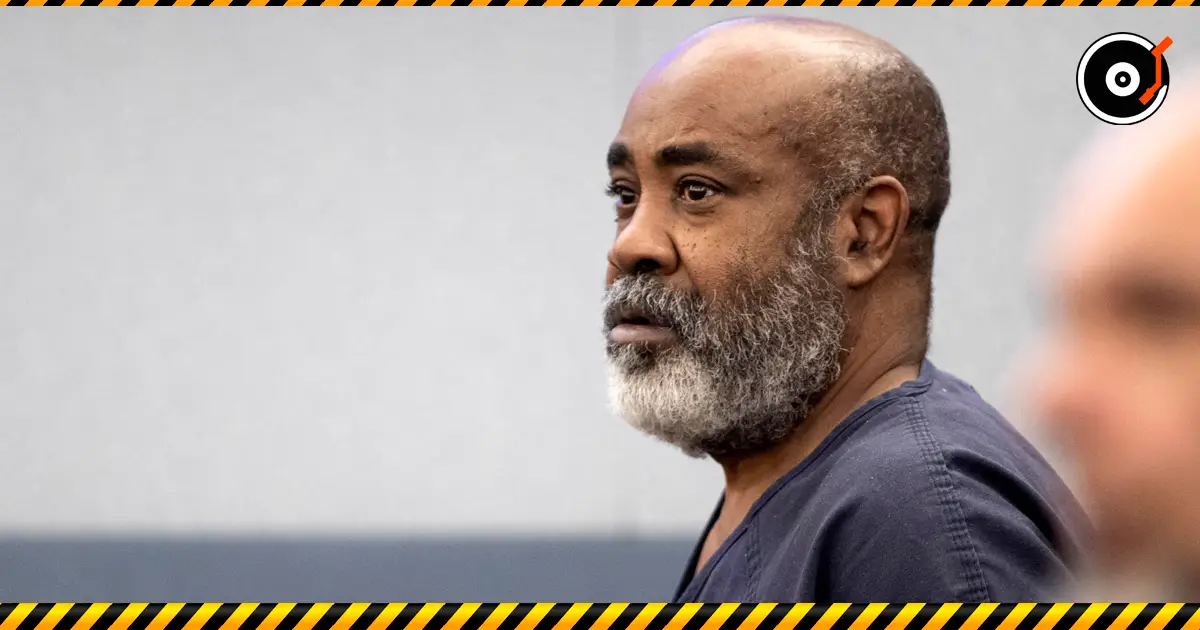
30 years after Tupac Shakur’s murder, Duane Davis was sentenced to 40 years in prison, with the possibility of a life sentence. Details of the high-profile case.
A U.S. court has handed down a sentence in one of the most notorious unsolved murders in music history. Duane “Keffe D” Davis, 63, a former leader of the South Side Compton Crips gang, has been sentenced to 40 years to life in prison for orchestrating the murder of rapper Tupac Shakur. The sentence was announced on October 13, 2026, in Las Vegas — three decades after the musician’s death.
Davis became the first and, so far, only person convicted in connection with Tupac’s murder. Although investigators do not consider him the actual gunman, the jury found that he played a key role in planning the attack. According to prosecutors, Davis supplied the weapon used in the crime and organized the pursuit of the vehicle carrying the rapper.
Sentence handed down three decades later
The sentence was imposed by Clark County District Court Judge Carli Kierny. On August 31, the jury found Davis guilty of first-degree murder involving the use of a firearm. The punishment consists of two consecutive sentences, each ranging from 20 years to life in prison.
This means the minimum term is 40 years. The court also ordered that Davis receive credit for the time he has already spent in custody since his arrest in September 2023. Given his current age, the sentence effectively means that he is likely to spend the rest of his life in prison.
During sentencing, the judge addressed Davis directly, stressing that changes he may have made later in life do not erase responsibility for the crime.
“You cannot take a person’s life, take away their entire future and simply walk away from responsibility.”
Kierny emphasized that Shakur’s death was an irreparable loss not only for his family, but also for millions of people who were influenced by his music.
Members of the rapper’s family spoke during the hearing. His sister Sekyiwa Shakur described the long-term psychological consequences of the tragedy, including depression and post-traumatic stress disorder. Family members asked the court to impose the harshest possible punishment on Davis.
Davis continues to deny criminal responsibility for the murder. His attorney, Michael Sanft, intends to appeal the verdict and sentence.
What happened in Las Vegas on September 7, 1996
On the evening of September 7, 1996, Tupac Shakur attended the boxing match between Mike Tyson and Bruce Seldon at the MGM Grand in Las Vegas. He was accompanied by members of Death Row Records, including label executive Marion “Suge” Knight.
After the fight, a confrontation took place inside the hotel between Shakur’s entourage and Orlando Anderson, also known as Baby Lane. Anderson was Duane Davis’s nephew and had ties to the South Side Compton Crips.
According to prosecutors, the assault on Anderson became the immediate trigger for the retaliation that followed. Davis decided to seek revenge, obtained a firearm and joined several associates in searching for Shakur and Knight.
Later that evening, Tupac was riding in the passenger seat of a BMW driven by Suge Knight. When the car stopped at a red light near the intersection of Flamingo Road and Koval Lane, a white Cadillac pulled alongside it. Gunfire was opened from the vehicle.
Shakur suffered multiple gunshot wounds, while Knight was also wounded but survived. The rapper was taken to University Medical Center of Southern Nevada. Despite doctors’ efforts, Tupac Shakur died on September 13, 1996, at the age of 25, six days after the shooting.
Investigators were unable to establish the identity of the gunman at the time. For decades, no one was charged in the case despite numerous witness accounts, police inquiries and public statements by people believed to have been involved.
How Davis’s own admissions helped revive the case
One of the most unusual aspects of the investigation was that some of the key evidence against Davis came from his own accounts of what happened.
In 2008, the former gang member discussed the circumstances of the murder in detail with investigators. According to Davis, Orlando Anderson fired the shots while sitting in the back seat of the Cadillac.
Davis believed that the terms of his agreement with law enforcement would protect him from prosecution. The legal force and scope of those arrangements later became the subject of court proceedings.
Even greater attention followed the publication of Davis’s 2019 memoir, Compton Street Legend. In the book, he described the events of the night of the shooting, confirmed that he had been inside the Cadillac and recounted the search for Shakur after the confrontation at the MGM Grand.
Prosecutors used those statements as an important part of their case. Investigators also relied on witness testimony and evidence gathered over the many years of the investigation.
The defense argued that Davis had exaggerated his accounts in order to attract publicity and increase the commercial appeal of his memoir. His attorneys also pointed to the absence of direct physical evidence linking their client to the gunfire.
The jury, however, accepted the prosecution’s argument that even if Davis had not personally fired the weapon, his actions were sufficient to hold him legally responsible for the murder.
He was arrested in Las Vegas in September 2023. Nearly three years later, following a lengthy court process, the jury returned a guilty verdict.
Tupac’s murder and the East Coast-West Coast rivalry
Tupac Shakur’s death occurred during a period of intense rivalry between the two largest centers of American hip-hop — New York and Los Angeles.
On the West Coast, Death Row Records played a major role and worked with artists including Tupac, Dr. Dre and Snoop Dogg. One of the most influential East Coast figures was Christopher Wallace, better known as The Notorious B.I.G., who was associated with Bad Boy Records.
The personal feud between Shakur and Wallace, conflicts between their entourages and an increasingly aggressive media climate intensified tensions across the hip-hop community.
On March 9, 1997, less than six months after Tupac’s death, The Notorious B.I.G. was also shot and killed — this time in Los Angeles. The two murders became symbols of one of the darkest chapters in the history of American rap.
At the same time, Davis’s court case helped establish a more specific immediate motive for the attack on Shakur. According to prosecutors, the killing was carried out in retaliation for the assault on Orlando Anderson, rather than as the result of a proven conspiracy involving rival record labels.
This distinction is important: the long-running conflict between the two music scenes created the broader background, but by itself did not prove that specific artists or label executives were involved in the murder.
Tupac Shakur’s legacy
By the time of his death, Tupac Shakur was far more than one of the most popular rappers in the United States. His music combined personal experience, social criticism, accounts of violence and poverty, and reflections on racial inequality and life in American urban communities.
In February 1996, he released the double album All Eyez on Me, which became one of the defining works in the history of gangsta rap. Tracks such as “California Love,” “Ambitionz Az a Ridah” and “2 of Amerikaz Most Wanted” cemented his status as a superstar.
That same year, Shakur recorded the material for The Don Killuminati: The 7 Day Theory, which was released after his death under the alias Makaveli.
His discography continued to expand through posthumous releases, while songs such as “Changes,” “Dear Mama” and “Keep Ya Head Up” remained relevant far beyond the traditional hip-hop audience.
In 2017, Tupac Shakur was posthumously inducted into the Rock & Roll Hall of Fame. His work continues to influence new generations of rap artists, for whom Shakur remains an example of how commercial success, personal openness and social commentary can coexist in the same body of work.
What the verdict means for hip-hop history
The conviction of Duane Davis represents the most significant legal outcome in an investigation that for nearly 30 years remained one of the most discussed unsolved crimes in the music industry.
The case demonstrated that prosecution can still be possible decades after a crime and that public statements made by alleged participants can ultimately become critical evidence.
At the same time, the verdict does not mean that every aspect of the murder has now been definitively established. The court held Davis responsible as an organizer of the attack, while the identity of the actual gunman remains tied to a separate history of witness testimony. Davis intends to continue challenging his conviction.
For the musician’s family, the ruling became a long-awaited acknowledgment of responsibility for a death whose impact has been felt for three decades. For hip-hop history, it placed a legal marker at the end of one of the darkest chapters of the era, even though it did not answer every question raised by the events of September 1996.