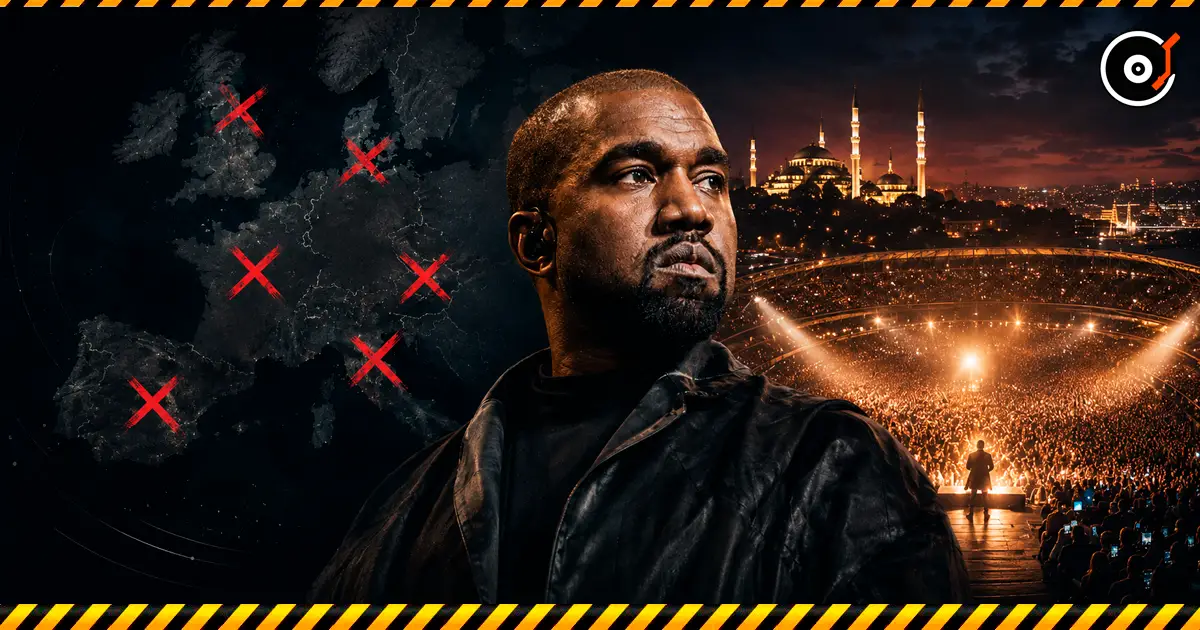
The disruption of Ye’s European tour, concert cancellations in Poland, Italy and other countries, the scandal surrounding the artist, and a record-breaking show in Turkey with 118,000 spectators.
American rapper Ye, formerly known as Kanye West, found himself at the center of one of the biggest music scandals of early summer 2026. The European leg of his world tour faced a series of bans, postponements and cancellations linked to his previous antisemitic remarks and use of Nazi symbolism. Yet after a string of setbacks across Europe, the artist unexpectedly turned his Istanbul concert into a massive demonstration of his still enormous international audience.
The scandal reached its peak with Ye’s performance on May 30 at Atatürk Olympic Stadium in Istanbul. According to Reuters, citing Turkey’s Anadolu agency, the concert drew 118,000 spectators and marked the artist’s first performance in Turkey, as well as his first European appearance since 2014. The show lasted around two hours, and the crowd reportedly included fans from the United Kingdom, Germany, France, the Netherlands, Italy, Poland, Russia and countries across the Middle East.
On stage, Ye called the Istanbul concert “the biggest stadium performance of all time” and personally reinforced the record-breaking narrative that was later picked up by Turkish and international music media.
“We just broke the record — 118,000 people. The biggest stadium performance of all time.”
Ye, speaking on stage in Istanbul
At the same time, it is more accurate to describe it as a claimed stadium concert attendance record, since independent official verification of world-record status does not yet appear to have been conclusively established. LOS40 also notes that the record claim comes from the artist himself and is tied to the reported figure of 118,000 attendees.
The strongest political backlash unfolded in Poland. Ye’s concert was scheduled to take place on June 19, 2026, at Silesian Stadium in Chorzów, but the venue announced that the event would not go ahead due to “formal and legal reasons.” Poland’s Minister of Culture, Marta Cienkowska, strongly opposed the show, pointing to the artist’s public antisemitic statements, the relativization of crimes and the commercialization of symbols of hatred.
“The decision to organize a Kanye West concert in Poland is unacceptable.”
Marta Cienkowska, Poland’s Minister of Culture
Poland was not the only country where Ye’s performances came under scrutiny. Earlier, the United Kingdom barred the rapper from entering the country, leading to the cancellation of his appearance at Wireless Festival. In France, a concert in Marseille was postponed following reports of a possible attempt by authorities to block the show. In Switzerland, FC Basel refused to host a concert at St. Jakob-Park, explaining that the event was not in line with the club’s values.
In Italy, the issue moved beyond ethics into the realm of public security: authorities banned July concerts involving Ye and Travis Scott in Reggio Emilia over concerns related to public order and safety, including the risk of possible protests. The decision also took into account appeals from the consumer organization CODACONS and the Jewish community of Modena and Reggio Emilia.
At the same time, Ye’s European route cannot be described as completely derailed. The Netherlands adopted a more legally cautious position: despite pressure from members of parliament, authorities said they had not found sufficient legal grounds to ban Ye from entering the country.
“There need to be compelling grounds to ban people from entering. We did not find them in the analysis we conducted.”
Bart van den Brink, Dutch Minister for Migration
As a result, the concerts at GelreDome in Arnhem on June 6 and 8 remained on the schedule at the time of the latest reports. This episode showed that even within Europe, the response to Ye was not uniform: some countries and venues emphasized reputational and public risks, while others focused primarily on the legal grounds required for a possible ban.
The situation surrounding Ye has become a revealing conflict between an artist’s cultural capital and the new reputational boundaries of the live music industry. On one hand, authorities and venues are increasingly treating a major artist’s performance not only as a commercial event, but also as a political and social risk. On the other, the Istanbul concert showed that institutional bans do not necessarily erase demand: they can simply redirect the audience to countries where the show is still allowed to go ahead.
That is why Ye’s story in 2026 looks less like a routine tour cancellation and more like a new case study for the entire music industry. In Europe, the artist is facing venue refusals, visa barriers and pressure from public organizations. In Turkey, he is drawing a stadium-sized audience on a scale only a handful of global performers can command. That contrast is what made the scandal around Ye one of the most talked-about music stories of the summer.