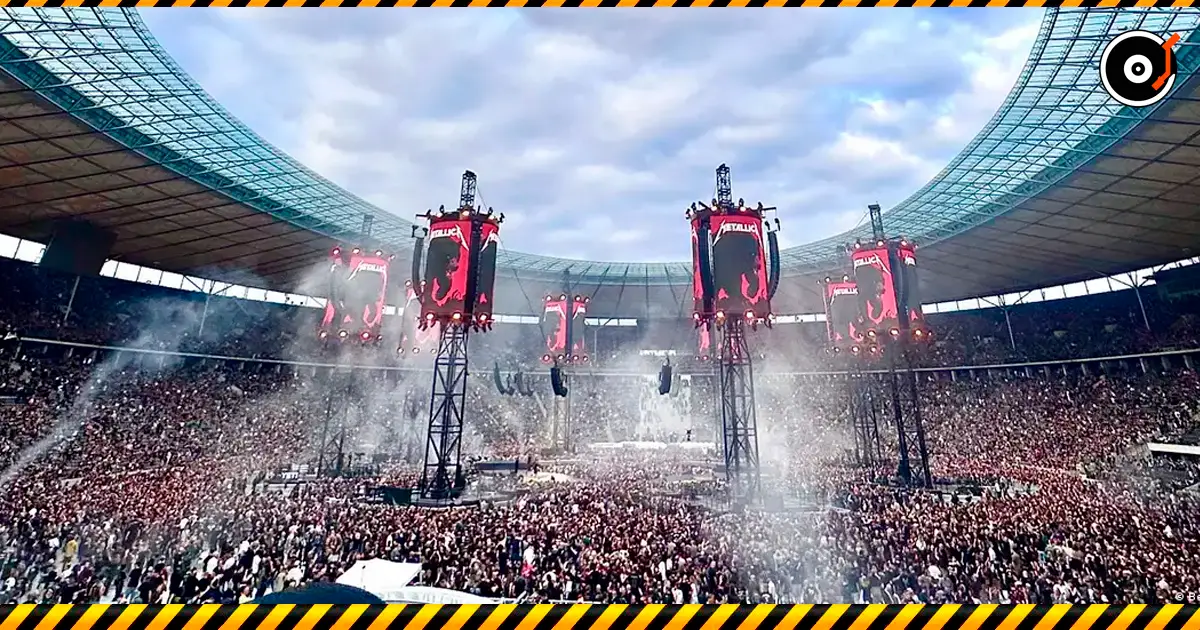
Metallica drew around 94,000 fans to Berlin’s Olympic Stadium and set a new attendance record for the venue.
On May 30, 2026, Metallica drew around 94,000 fans to Berlin’s Olympic Stadium. The concert became the largest show in the venue’s history and, according to German media reports, one of the biggest rock events ever staged in Germany.
American heavy music titans Metallica once again proved that, more than four decades into their career, they remain not merely a cult band, but a true global stadium force. The performance at Berlin’s Olympiastadion formed part of the M72 World Tour In The Round — a production built around a circular stage positioned in the centre of the stadium. Officially, the concert was billed as Metallica with special guests Gojira and Knocked Loose.
It was the “in the round” stage concept that became the key to the record. Unlike a traditional concert layout, where part of the stands is blocked by the stage and backstage area, the central construction made it possible to use almost the entire stadium. According to rbb24, a sold-out concert at the Olympic Stadium usually means around 72,000 spectators, while the arena’s football capacity is approximately 73,856. For Metallica, the pitch and running tracks were covered, and the area around the stage was transformed into a vast fan zone.
The previous concert attendance record at Berlin’s Olympiastadion belonged to U2: in 2009, the Irish band attracted just over 90,000 people to the venue during their celebrated 360° Tour. Metallica have now raised the bar even higher, taking the stadium rock-show format to a new level and effectively turning the historic sports arena into a giant metal amphitheatre.
One of the evening’s most symbolic moments was Metallica’s nod to German rock culture. During the Berlin show, Kirk Hammett and Robert Trujillo performed a fragment of “Sonne” by Rammstein — one of the most recognisable German-language rock hits of the 21st century. The crowd sang along in German, turning the cover into a local gesture of respect and one of the most talked-about highlights of the night.
The concert setlist brought together different eras of Metallica: from the early heaviness of “Creeping Death” and “For Whom the Bell Tolls” to stadium anthems such as “Nothing Else Matters”, “Enter Sandman” and material from “72 Seasons”. That balance has become a crucial part of the tour’s success: the band does not rely solely on nostalgia, yet it also does not turn away from the songs that made Metallica one of the defining rock acts on the planet.
For Metallica themselves, this record feels like a natural continuation of a long-running story. Formed in 1981 by James Hetfield and Lars Ulrich, the band evolved from underground thrash metal origins into a global phenomenon, while preserving its signature heaviness, discipline and direct connection with fans. According to the Recording Academy, Metallica have sold more than 125 million albums worldwide, while the band’s official website specifically notes that they were born in Los Angeles on October 28, 1981.
The Berlin record matters not only as a number. It shows that in the era of streaming, short-form media and fragmented attention, live rock can still gather audiences on the scale of major national sporting events. Metallica in Berlin became a powerful example of how classic heavy music, ambitious stage design and fan culture can create an event that reaches far beyond the boundaries of an ordinary concert.