Why did Afro House grow by 778% while Hard Techno became mainstream in 2026? Trend analysis, track selection, and tips for producers.
While theorists continued to debate the “death of genres” and the blurring of musical boundaries, the electronic music industry in 2026 made a sharp—and in many ways unexpected—turn. We are witnessing a rare paradox for the modern scene: two diametrically opposed directions have simultaneously secured their place at the top of streaming charts, Beatport categories, and major festival lineups.
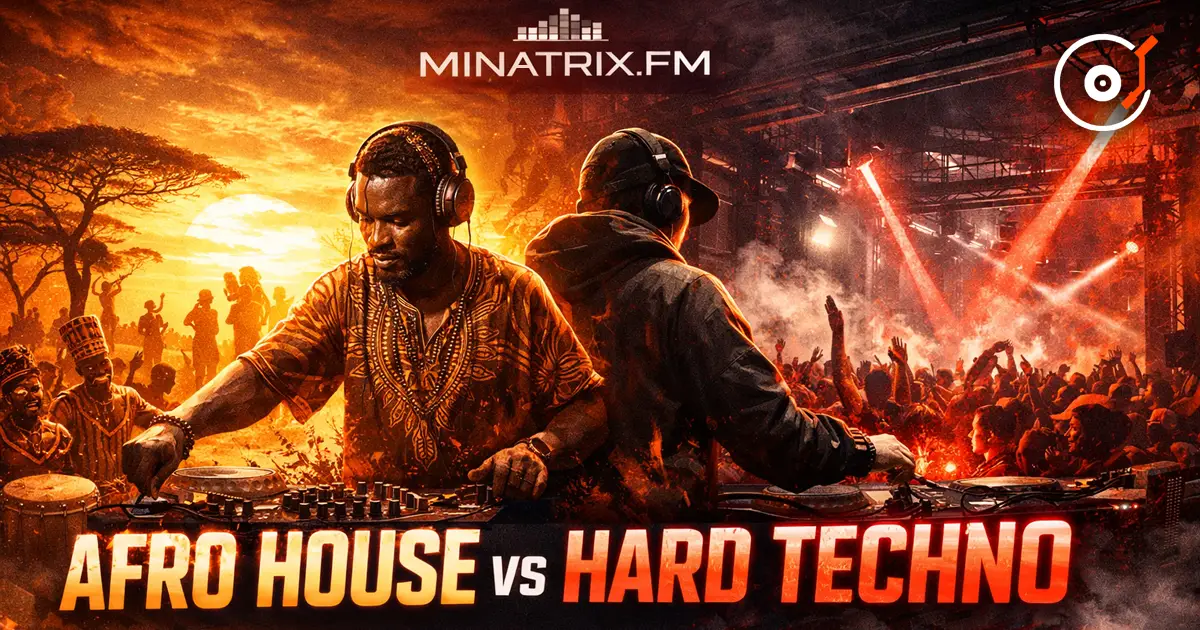
On one side — the spiritual, atmospheric Afro House, showing growth of over 778% according to aggregated analytics from streaming platforms and DJ pools. On the other — the raw, industrial Hard Techno, which has fully emerged from the underground and established itself as a mainstream force, including at major festivals such as Tomorrowland and Awakenings Festival.
The Minatrix.FM editorial team explores why these extremes not only coexist, but actively reinforce each other, shaping a new landscape for the electronic music scene.
Global context: fatigue from the “middle ground”
The musical pendulum, which between 2018 and 2023 stabilized around Melodic Techno, Progressive House, and EDM hybrids, has fully swung out of balance in 2026.
The reason is clear: audience fatigue with “universal” sound—designed for mass appeal but lacking emotional extremes.
Today’s listener no longer wants “comfortable background music.” Instead, they choose:
- either a deep, almost meditative immersion (Afro House),
- or maximum intensity and physical impact (Hard Techno).
This is also reflected in audience behavior: average listening duration has increased specifically for tracks with strong dynamics and a distinct sonic identity.
1. The dictatorship of algorithms and “clip-based” thinking
Platforms like TikTok and Instagram (Reels) have not just influenced music — they have rewritten the very logic of how it is consumed.
Afro House:
- perfectly aligns with “luxury lifestyle” visual content
- thrives on hypnotic groove and repetition
- easily scales into viral snippets
Hard Techno:
- syncs with fast-paced editing
- amplifies visual aggression
- creates a “peak moment” effect within seconds
Algorithms no longer promote the “average” — they amplify extreme emotional states.
2. The economy of contrasts: a new festival logic
The modern festival is no longer a linear lineup, but a curated emotional journey.
A clear structure has emerged:
- daytime and sunset stages → Afro House / Organic
- nighttime and warehouse settings → Hard Techno / Industrial
This is evident even in the curation of stages at Burning Man and across European techno festivals.
These genres do not compete for the same audience — they divide time and emotional states.
Afro House: new spirituality, global luxury, and cultural code
In 2026, Afro House has fully transcended its status as an “ethnic subgenre” and become a universal language of global club culture.
Sonic code:
- 120–124 BPM
- polyrhythms and complex percussion
- vocal elements with African and Middle Eastern influences
- organic, “live” texture
Key growth drivers:
- strong support from artists like Black Coffee
- integration into high-end club ecosystems (Ibiza, Dubai, Tulum)
- synergy with fashion and luxury industries
Afro House is no longer just a genre — it is a soundtrack of status, travel, and lifestyle.
It doesn’t sell a track — it sells a feeling of life itself.
Hard Techno: industrial mainstream and the return of rave
Hard Techno has taken a path that took classic techno decades to complete — from underground to global mainstream in just a few years.
Sonic code:
- 140–160 BPM
- distortion and heavily saturated kicks
- minimalism in melody
- maximalism in energy
Proven growth drivers:
- the rise of artists like Amelie Lens and I Hate Models
- revival of 90s rave aesthetics
- growth of warehouse scenes across Europe
Hard Techno is music of physical experience, where narrative is secondary to impact, rhythm, and sonic pressure.
Hybridization: the defining vector of 2026
The most interesting developments are happening at the intersection of genres.
2026 cements the trend:
- Afro Tech
- Tribal Techno
- Hard Groove
Hard Groove, notably, is not a new genre, but a reinvention of 90s groove techno, adapted to modern BPM ranges and sound design.
How independent producers can “hack” 2026
The window of opportunity is still open — but not for long.
1. Hybridization as a strategy
Pure genres are oversaturated. What works now:
- Afro + Hard
- Organic + Industrial
- Groove + Peak Techno
2. Speed as a competitive advantage
The industry has shifted to a fast-cycle model:
- trends last 2–3 months
- a track must be released within 7–14 days
3. DJ-first approach
Streaming is secondary.
The priority: getting into the set of an artist like Charlotte de Witte
4. SEO and catalog platforms
Platforms like Minatrix.FM provide:
- precise genre indexing
- organic search traffic
- a long-tail listening effect
Voice of the Scene: Artists Confirm the Trend
Interestingly, artists themselves are not just sensing the shift — they are clearly articulating the processes that define the industry today.
Adam Beyer, one of the key architects of the modern techno scene, openly speaks about the crisis of “universal sound”:
“Today in electronic music, there’s a feeling that everything has become too formulaic — and it’s starting to get exhausting.”
This idea perfectly captures the turning point of 2026: the scene is tired of predictability — and is therefore moving toward extremes.
In contrast, Black Coffee consistently promotes a completely different philosophy:
“Music is not just sound — it’s energy and culture.”
This approach lies at the core of the explosive rise of Afro House — a genre that offers not just tracks, but a full emotional and cultural experience.
Representatives of the new techno wave, such as Amelie Lens, push the focus even further — toward physical perception:
“I want people to feel music with their bodies, not just hear it.”
This is essentially the manifesto of Hard Techno: music as impact, not background.
And artists like I Hate Models take this idea to the extreme:
“Music is a way to release everything that’s inside.”
This shapes the key logic of 2026: Afro House works with mood and atmosphere, while Hard Techno operates with tension and release.
And it is precisely within this contrast that a new reality of the electronic scene is born.
Conclusion
The electronic scene in 2026 is not about compromise — it is about polarization.
Afro House delivers: depth, atmosphere, state.
Hard Techno delivers: energy, catharsis, physicality.
At their intersection, a new kind of honesty in music emerges — without filters, without a “universal format,” without the need to please everyone.
Minatrix.FM editorial opinion
2026 marks the moment when the industry stopped fearing extremes.
Today, an artist can play Afro House at sunset and close the night with a Hard Techno set.
And this is no longer an experiment — it is the new norm.
Listen, explore, and discover new forms of sound in the Minatrix.FM catalog — where genres don’t end, they only begin.