Underworld is a British electronic project led by Karl Hyde (Karl Hyde; born May 10, 1957, Worcester, England) and Rick Smith (Rick Smith; born May 25, 1959, Ammanford, Wales). Their creative partnership began in the late 1970s, long before the techno-oriented version of Underworld emerged. Over several decades, Hyde and Smith moved through new wave, synth-pop and funk-rock before completely rebuilding the project around club-oriented electronic music in the early 1990s together with DJ Darren Emerson.
Among Underworld's best-known works are Rez, Cowgirl, Dark & Long, Mmm... Skyscraper I Love You, Born Slippy .NUXX, Pearl's Girl, Jumbo, Push Upstairs, King of Snake, Two Months Off, Beautiful Burnout, Always Loved a Film, Scribble, I Exhale, Denver Luna and Techno Shinkansen. The group's music combines trance, techno, progressive house, ambient, breakbeat, dub, rock and experimental electronic music.
Underworld's most famous track remains Born Slippy .NUXX. After appearing at the end of Danny Boyle's film Trainspotting, it was reissued in 1996 and reached No. 2 on the UK Singles Chart. However, the foundation of the group's reputation extends far beyond one hit: the albums dubnobasswithmyheadman, Second Toughest in the Infants and Beaucoup Fish are regarded as key British electronic releases of the 1990s.
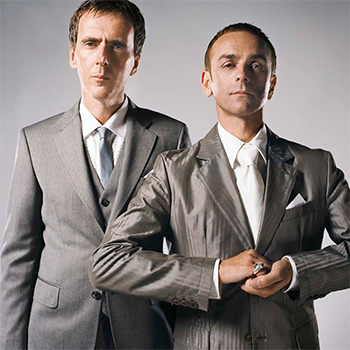
Karl Hyde and Rick Smith
Hyde and Smith met in Cardiff in 1979. Hyde was studying art, while Smith was studying electronic and electrical engineering. Soon afterward, they began playing together in the band Screen Gemz.
The division of roles that developed during those early years remained in place in the mature Underworld. Hyde works with vocals, lyrics, guitar, photography and visual imagery; Smith focuses on composition, synthesizers, rhythm, studio architecture and production.
Freur and the emergence of the Underworld name
In the early 1980s, Hyde and Smith formed Freur. The group also included Alfie Thomas, Bryn Burrows and John Warwicker. Their debut album Doot-Doot was released in 1983, and its title track became the project's best-known recording.
Freur worked in the fields of new wave and synth-pop and sounded very different from the later electronic Underworld. In the middle of the decade, the band recorded music for the British film Underworld, whose screenplay was connected with Clive Barker. After Freur came to an end, Hyde and Smith adopted the film's title as the name of their new project.
Underworld Mk1
The first version of Underworld appeared in 1987. Its music was closer to funk-rock, synth-pop and alternative pop-rock than to club-oriented electronic music.
The album Underneath the Radar was released in 1988, followed by Change the Weather in 1989. The project had a deal with Sire Records and toured the United States, but no commercial breakthrough followed. By 1990, this lineup had dissolved, leaving Hyde and Smith with debts and the need to redefine the direction of their music.
Darren Emerson and the new version of Underworld
After the breakup of the first lineup, Rick Smith became increasingly immersed in electronic music. Through mutual contacts, he met the young DJ Darren Emerson, who was connected with the British house and techno scene. In the early 1990s, Emerson became the third member of the new Underworld.
The first recordings by this lineup were also released under the name Lemon Interupt. Junior Boy's Own issued Dirty, Minneapolis, Bigmouth and Eclipse. The musicians then returned to the Underworld name and released Rez and Mmm... Skyscraper I Love You.
Electronic music was no longer an addition to a rock band but the foundation of the entire project. Hyde's guitar and voice now existed inside long club compositions alongside synthesizers, drum machines and samples.
dubnobasswithmyheadman
In 1994, dubnobasswithmyheadman was released — the first album by the classic Hyde–Smith–Emerson lineup. If the two records by the earlier version of Underworld are included, it was the group's third studio album, but it marked the beginning of its main electronic era.
The album included Dark & Long, Mmm... Skyscraper I Love You, Surfboy, Spoonman, Tongue, Dirty Epic, Cowgirl and River of Bass. It reached No. 12 on the UK Albums Chart.
The defining characteristics of Underworld were already fully formed here: long-form track development, transitions between techno, house, ambient and dub, fragments of guitar, and Hyde's voice, which does not so much tell a story as assemble one from brief observations and repeated phrases.
Karl Hyde's lyrics
Hyde rarely writes traditional verses and choruses. For years, he has filled notebooks with overheard conversations, signs, place names, advertising phrases and random observations, later using them as raw material for songs.
Lou Reed's album New York and Sam Shepard's book Motel Chronicles had a noticeable influence on his approach. In the studio, individual lines could be moved from one composition to another, repeated, cut apart and transformed almost into rhythmic elements.
As a result, Underworld's lyrics often sound like a stream of urban memory: streets, transport, late-night conversations, alcohol, light, random people and fragments of inner monologue exist side by side without a conventional linear narrative.
Second Toughest in the Infants
Second Toughest in the Infants was released in 1996. The title has nothing to do with the idea of a “second debut,” as is sometimes incorrectly claimed. It came from a phrase used by Rick Smith's six-year-old nephew while describing his status among the children at primary school.
The album included Juanita: Kiteless: To Dream of Love, Banstyle/Sappys Curry, Confusion the Waitress, Rowla, Pearl's Girl, Air Towel, Blueski and Stagger. It reached No. 9 in the UK chart and was shortlisted for the 1996 Mercury Prize.
Compared with dubnobasswithmyheadman, the music became freer in form. Long compositions could move from ambient to breakbeat or techno without a clear boundary between separate sections.
Born Slippy .NUXX
In May 1995, Underworld released the single Born Slippy. Its B-side featured Born Slippy .NUXX. Despite the similar title, it is not a conventional remix: the two tracks have different musical foundations.
Danny Boyle used Born Slippy .NUXX at the end of the 1996 film Trainspotting. After the film's release, the track was reissued as a standalone single and reached No. 2 on the UK Singles Chart.
Its euphoric sound long obscured the meaning of the lyrics for part of the audience. Karl Hyde wrote them during a period of alcohol addiction following a difficult night in London's Soho. He later said directly that the song was not an anthem to drinking but a cry for help.
Underworld on stage
Underworld's live versions have never been exact copies of the album recordings. Smith and Emerson worked with prepared rhythmic and synthesizer elements that could be combined and altered during the performance itself.
Hyde, meanwhile, behaves like a frontman: he sings, speaks, dances, plays guitar and reacts to the audience. This system allowed the group to combine electronic improvisation with the energy of a live concert.
During the 1990s, Underworld became regular performers at major festivals and, together with The Prodigy, The Chemical Brothers, Orbital and Leftfield, helped move British electronic music from clubs onto large concert stages.
Beaucoup Fish
In 1999, Beaucoup Fish was released — the third and final studio album by the classic Hyde–Smith–Emerson lineup.
It included Cups, Push Upstairs, Jumbo, Shudder/King of Snake, Winjer, Skym, Bruce Lee, Kittens, Push Downstairs and Moaner. The album reached No. 3 on the UK Albums Chart, the best result Underworld ever achieved on the main British album chart.
King of Snake and Kittens represent the harder club side of the group, while Jumbo is built around a softer melody and calmer vocals. This contrast within a single album became characteristic of Underworld's later discography.
Everything, Everything and Darren Emerson's departure
In 2000, the live album and film Everything, Everything were released, compiling material from concerts at the end of the 1990s. In these live versions, tracks flow into one another and differ noticeably in length and structure from their studio originals.
That same year, Darren Emerson left Underworld and focused on his own DJ and production career. Karl Hyde and Rick Smith once again became the permanent core of the project.
A Hundred Days Off
The duo's first studio album after Emerson's departure was A Hundred Days Off, released in 2002. It included Mo Move, Two Months Off, Twist, Sola Sistim, Little Speaker, Trim, Ess Gee, Dinosaur Adventure 3D, Ballet Lane and Luetin.
The period's main hit was Two Months Off — one of the most melodic and uplifting tracks in Underworld's catalogue. The album preserved the group's recognizable approach without a permanent third member.
Riverrun and digital releases
In the mid-2000s, Underworld began experimenting with the way they released music. The Riverrun series was distributed online and consisted of long musical sequences that were not tied to the conventional structure of a studio album.
This format allowed the group to publish new material more quickly and work more freely with track length. The concept was later developed on a much larger scale through the DRIFT project.
Oblivion with Bells and Barking
In 2007, Oblivion with Bells was released, featuring Crocodile, Beautiful Burnout, Holding the Moth, Ring Road, Glam Bucket and other tracks. The album combined club rhythms with calmer, more atmospheric electronic music.
Barking followed in 2010. While making it, Hyde and Smith collaborated with other electronic producers more actively than usual. The album included Bird 1, Always Loved a Film, Scribble, Hamburg Hotel, Grace, Between Stars, Diamond Jigsaw, Moon in Water and Louisiana.
Danny Boyle and the 2012 Olympics
Underworld's collaboration with Danny Boyle did not end after Trainspotting. Rick Smith worked on music for the stage production Frankenstein and the film Trance, while Underworld were also involved in music connected with T2 Trainspotting.
Their largest joint project was the opening ceremony of the 2012 Olympic Games in London. Underworld were appointed music directors for Boyle's production, with Rick Smith responsible for the overall musical structure of the ceremony.
For the show, Hyde and Smith wrote, among other pieces, And I Will Kiss and Caliban's Dream. The first accompanied the industrial Pandemonium sequence, while the second was used during one of the central moments of the Olympic cauldron lighting.
Barbara Barbara, we face a shining future
After a six-year gap between conventional studio albums, Barbara Barbara, we face a shining future was released in 2016.
It included I Exhale, If Rah, Low Burn, Santiago Cuatro, Motorhome, Ova Nova and Nylon Strung. The title comes from words spoken by Rick Smith's father to his wife Barbara near the end of his life.
The album reached No. 10 in the UK and received a Grammy nomination in the Best Dance/Electronic Album category.
Teatime Dub Encounters with Iggy Pop
In 2018, Underworld and Iggy Pop released the collaborative EP Teatime Dub Encounters. Their connection with Danny Boyle's cinematic world was obvious: Iggy Pop's Lust for Life opened Trainspotting, while Born Slippy .NUXX played at the end.
Instead of conventional vocal parts, Iggy Pop used spoken delivery and long monologues, which fit naturally into Smith and Hyde's electronic structures.
DRIFT
In November 2018, Underworld launched DRIFT — a year-long project in which new music, videos and texts were published almost every week.
The experiment continued for 52 weeks. Its result was DRIFT Series 1 in 2019 — a large collection of material including Another Silent Way, Dexters Chalk, Appleshine, This Must Be Drum Street, Listen to Their No, Border Country and other works.
DRIFT returned the group to a model of continuous creative work without waiting years for the next album and developed ideas Underworld had previously explored through the online Riverrun series.
Strawberry Hotel
In 2024, Underworld released Strawberry Hotel — officially the group's eleventh studio album.
The 15-track record included Black Poppies, Denver Luna, Techno Shinkansen, And the Colour Red, Sweet Lands Experience, Lewis in Pomona, Hilo Sky, Burst of Laughter, King of Haarlem, Ottavia, Gene Pool, Oh Thorn!, Iron Bones and Stick Man Test.
The album moves freely from direct techno into acoustic and almost formless atmospheric passages. Denver Luna represents the more emotional side of Underworld, Techno Shinkansen the club-oriented side, while Black Poppies moves almost completely away from dance structure.
Strawberry Hotel reached No. 43 on the UK Albums Chart and topped the UK Dance Albums Chart.
Tomato and the visual language
The visual side of Underworld is closely connected with the design collective Tomato, founded in 1991. Its co-founders included Karl Hyde, Rick Smith, John Warwicker and other designers and artists.
Tomato worked on Underworld's graphics, typography, photography, video and concert projections. Album covers and stage visuals are built according to the same principle as Hyde's lyrics: layers of phrases, photographs, random details and urban observations.
Underworld's musical style
Underworld are usually associated with techno and progressive house, but no single genre definition is sufficient for their catalogue. House, ambient, trance, dub, breakbeat, rock and experimental electronic music constantly intersect within it.
The group's main distinguishing feature is form. Many compositions develop for much longer than a conventional pop song: rhythms and synthesizer sequences change gradually, the voice can disappear for several minutes, and individual sections are not always separated by obvious transitions.
At the same time, Hyde and Smith's experience in rock and pop bands never disappeared. Vocals, guitar, melody and a recognizable frontman presence remain in the music, allowing Underworld to exist just as naturally in a club, at a rock festival or in a concert hall.
Main Underworld studio albums
- Underneath the Radar — 1988;
- Change the Weather — 1989;
- dubnobasswithmyheadman — 1994;
- Second Toughest in the Infants — 1996;
- Beaucoup Fish — 1999;
- A Hundred Days Off — 2002;
- Oblivion with Bells — 2007;
- Barking — 2010;
- Barbara Barbara, we face a shining future — 2016;
- DRIFT Series 1 — 2019;
- Strawberry Hotel — 2024.
Other important releases
Other important parts of the catalogue include the 2000 live release Everything, Everything, the online Riverrun series and the 2018 collaborative EP with Iggy Pop, Teatime Dub Encounters.
Key Underworld tracks
Among the key works from different periods are Rez, Dark & Long, Mmm... Skyscraper I Love You, Cowgirl, Dirty Epic, Born Slippy .NUXX, Pearl's Girl, Juanita: Kiteless: To Dream of Love, Jumbo, Push Upstairs, King of Snake, Moaner, Two Months Off, Beautiful Burnout, Always Loved a Film, Scribble, I Exhale, If Rah, Nylon Strung, Denver Luna, Techno Shinkansen and And the Colour Red.
Underworld's place in electronic music
By the time the classic electronic lineup emerged, Hyde and Smith had already been working together for more than a decade and had gone through several unsuccessful attempts to build a conventional rock and pop career. Darren Emerson connected their studio experience with the British club culture of the early 1990s, and the classic Underworld sound grew out of that combination.
dubnobasswithmyheadman established this musical language, Second Toughest in the Infants developed it in a freer form, Born Slippy .NUXX carried the group into mass culture, and Beaucoup Fish became their most successful studio album on the main UK chart.
After Emerson's departure, the duo did not try to endlessly repeat the formula of the 1990s. Two Months Off, Beautiful Burnout, the Olympic music, Barbara Barbara, we face a shining future, DRIFT and Strawberry Hotel belong to different stages of the group's history, but they preserve one common principle: for Underworld, an electronic composition remains a living form that can be changed in the studio and rebuilt again on stage.