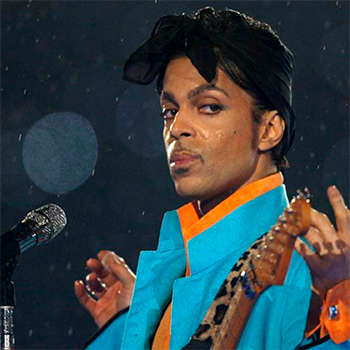
Prince (full name — Prince Rogers Nelson; June 7, 1958, Minneapolis, Minnesota — April 21, 2016, Chanhassen, Minnesota) was an American singer, songwriter, producer, multi-instrumentalist, arranger and actor, and one of the most influential musicians in popular culture from the second half of the 20th century into the early 21st century. His work cannot be reduced to a single genre: Prince freely combined funk, R&B, soul, rock, pop, jazz, psychedelia, electronic music, new wave and gospel, often playing most of the instrumental parts himself and maintaining complete control over the recording process. The Rock & Roll Hall of Fame describes him as an artist who changed the understanding of what a songwriter and performer could do through his fusion of numerous genres and exceptional command of multiple instruments.
His best-known songs include Purple Rain, When Doves Cry, Kiss, 1999, Little Red Corvette, Let's Go Crazy, Raspberry Beret, Sign o' the Times, I Would Die 4 U, U Got the Look, I Wanna Be Your Lover, Cream, Diamonds and Pearls, Gett Off, The Most Beautiful Girl in the World, Gold, Musicology, Black Sweat and many others. But Prince’s importance cannot be measured by hits alone. He helped create the Minneapolis Sound, turned the studio into a fully fledged musical instrument, wrote and produced material for other performers, built the Paisley Park complex, became one of the first major artists to distribute music directly through the internet, and fought one of the most principled battles in music-industry history over an artist’s right to control their recordings.
During his career, Prince won seven Grammy Awards from 38 nominations, received an Academy Award for the music of Purple Rain, and was inducted into the Rock & Roll Hall of Fame in 2004.
A musical childhood in Minneapolis
Prince Rogers Nelson was born on June 7, 1958, in Minneapolis. Both of his parents were musicians: his father, John Lewis Nelson, played piano and led the jazz group Prince Rogers Trio, while his mother, Mattie Della Shaw, was a singer. The child received the name Prince Rogers from his father’s stage name.
His musical abilities emerged very early. Prince did not limit himself to one instrument and taught himself to play piano, guitar, bass and drums. The Minnesota Historical Society identifies him as one of the principal creators of the Minneapolis Sound — a distinctive blend of R&B, funk, rock, pop, punk and new wave.
An important early relationship was with André Anderson, later known as André Cymone. Together they listened to Joni Mitchell, Santana, funk, soul and rock, rehearsed for hours and gradually formed their own bands. Prince avoided traditional music education: he was far more interested in taking records apart by ear and immediately applying what he heard in practice.
By his teenage years, it was already clear that musicians of his generation were dealing with an unusual all-round talent. Prince could come up with a song, record the vocals, play keyboards, guitar, bass and drums, and then handle the arrangement himself.
That ability would become the foundation of his entire career.
First contract and complete control over recording
Manager Owen Husney became interested in Prince after hearing a demo by the young musician. What impressed him most was that music sounding like a full band had effectively been recorded by one person.
After negotiations, Prince secured a contract with Warner Bros. Records. For the young artist, one of the key conditions was the right to produce his own material — an unusual privilege for a 19-year-old musician with no established commercial success.
His debut album For You was released in 1978.
The creative method of the future star could almost have been summed up in one line on the sleeve: Prince served as writer, arranger, producer and performer for most of the material. Prince Estate’s official discography emphasizes that such a degree of independence made the debut unusual for a young artist signed to a major record company.
The most noticeable song was Soft and Wet, but the first album did not yet bring true mass success.
That arrived very quickly afterward.
I Wanna Be Your Lover and the album Prince
The second album, Prince, appeared as early as 1979.
Its key song was I Wanna Be Your Lover — the first major recording to move Prince from the category of promising newcomer into national radio and the charts.
The same album also featured Why You Wanna Treat Me So Bad?, Sexy Dancer, Bambi and the original version of I Feel for You. A few years later, the latter would become a major international hit in Chaka Khan’s version.
Even at this early stage, it was difficult to determine exactly where Prince belonged.
He used R&B and funk, but could suddenly shift into heavy rock guitar. A high falsetto could sit alongside an almost conversational delivery. Explicit sexual themes coexisted with religious and spiritual imagery.
This was the beginning of the systematic destruction of genre boundaries that would later become one of the defining features of his music.
Dirty Mind: Prince stops following the rules
The 1980 album Dirty Mind became the first major artistic turning point.
If the first two records could still be viewed within the framework of late-1970s R&B and funk, the new album introduced minimalist synthesizers, rock, new wave, punk and significantly more provocative lyrics.
The title track Dirty Mind, along with When You Were Mine, Uptown, Head and Sister, established a new version of Prince — far more daring and sexually liberated.
His appearance was equally important.
High heels, underwear worn as stage clothing, makeup, capes, and combinations of masculine and feminine fashion elements disrupted the traditional image of an American rock or R&B performer.
For Prince, visual androgyny was not a separate promotional gimmick. It matched the music itself, where styles that the industry usually separated by radio format and audience were blended just as freely.
Controversy
In 1981, Controversy appeared.
The title track directly engages with the questions already surrounding the performer about race, sexuality, religion and public identity. Instead of trying to answer them, Prince uses the questions themselves as the material of the song.
The album also included Do Me, Baby, Sexuality, Let's Work, Private Joy and the politically charged Ronnie, Talk to Russia.
Here Prince’s signature synthesizer funk fully takes shape: hard drum-machine patterns, dry bass, keyboards and rhythm guitar create a space that works simultaneously for rock concerts, R&B radio and the dance floor.
It was on this foundation that the Minneapolis Sound would soon flourish.
1999 and the rise to major stardom
The double album 1999, released in 1982, became Prince’s first true mass-market breakthrough.
The title track 1999 turned anxiety about the possible end of the world into a dance party. Little Red Corvette demonstrated how naturally Prince could work not only with funk, but with broad American pop-rock as well. Alongside them were Delirious, Let's Pretend We're Married, D.M.S.R., Automatic, Something in the Water (Does Not Compute) and Lady Cab Driver.
This is where the Minneapolis Sound can be heard especially clearly.
Instead of traditional funk horn sections, Prince could use synthesizers. Live drums could sit beside drum machines. Rock guitar did not stand in opposition to R&B, but became part of the same composition.
His group gradually took the name The Revolution. Wendy Melvoin, Lisa Coleman, Bobby Z., BrownMark and Matt Fink would become an important part of the next — and most famous — period.
Purple Rain
In 1984, the project that transformed an already successful artist into a global star appeared: the film and album Purple Rain.
The album contains only nine songs, yet almost every one became part of Prince’s classic repertoire: Let's Go Crazy, Take Me with U, The Beautiful Ones, Computer Blue, Darling Nikki, When Doves Cry, I Would Die 4 U, Baby I'm a Star and Purple Rain.
Some recordings originated directly from a live performance by Prince and the Revolution at First Avenue in Minneapolis on August 3, 1983. That was where the audience first heard Purple Rain, Baby I'm a Star and I Would Die 4 U. The concert recordings were later substantially reworked in the studio, but the live energy remained in the final versions.
When Doves Cry
When Doves Cry is especially unusual.
Prince deliberately removed the bass line — a decision that seemed almost absurd for an early-1980s dance-pop and funk track. Yet the resulting emptiness between the drums, synthesizer, voice and guitar gave the song its distinctive tension.
The single reached No. 1 on the Billboard Hot 100.
Let's Go Crazy followed it to the top spot, while Purple Rain itself peaked at No. 2. The soundtrack remained at No. 1 on the Billboard 200 for 24 weeks and, according to Prince’s official discography, sold more than 25 million copies worldwide.
The film Purple Rain was also a major commercial success, and Prince received the Academy Award for Best Original Song Score.
But the greater achievement was something else: Prince managed to create a work that functioned simultaneously as a rock album, a funk record, a pop blockbuster, a film and a concert spectacle.
Darling Nikki and the censorship debate
Purple Rain also contained Darling Nikki — a song that would play an unexpected role in the American music industry.
Its explicit lyrics became one of the works cited by Tipper Gore in arguments surrounding the formation of the Parents Music Resource Center. The debate ultimately contributed to the introduction of the familiar Parental Advisory warnings on music releases in the United States.
Prince thus found himself at the center of a public debate over sexuality, artistic freedom and the regulation of popular-music lyrics.
It was a natural continuation of his whole career: sex in Prince’s songs almost never existed separately from questions of power, faith, shame, love and spirituality.
After Purple Rain: refusing to repeat his own success
The most predictable decision after Purple Rain would have been to record another similar album.
Prince did the opposite.
Around the World in a Day was released in 1985, while the public was still listening to the previous record. In fact, Prince had begun working on it even before Purple Rain had fully become a worldwide phenomenon.
The new music was more psychedelic and experimental. Raspberry Beret, Pop Life, Paisley Park, Condition of the Heart and the title track used an entirely different palette.
The official discography highlights an important idea expressed by Prince himself: he considered one of his best decisions to have been recording the new material without waiting for the reaction to Purple Rain. That meant he never felt compelled to artificially reproduce a formula he had already discovered.
Parade and Kiss
In 1986, Parade was released. It served as music for the film Under the Cherry Moon and was also Prince’s final full album with The Revolution.
The biggest hit was Kiss.
The track is almost demonstratively sparse: dry guitar, a minimal rhythmic foundation and Prince’s high voice. Rather than building up the sound, the song works through the absence of unnecessary elements.
Alongside it are Girls & Boys, Mountains, Anotherloverholenyohead and one of the most beautiful ballads in his catalog — Sometimes It Snows in April.
By the end of this period, relationships within The Revolution were changing, and in 1986 Prince dissolved the classic lineup.
Sign o' the Times
After the breakup of The Revolution, a huge amount of recorded material passed through several different concepts — Dream Factory, Camille and Crystal Ball.
Eventually, that mass of music became the double album Sign o' the Times, released in 1987.
It is one of Prince’s most diverse works.
The title track Sign o' the Times addresses social fear, drugs, the AIDS epidemic and the threat of nuclear war with almost none of the rhetoric of a conventional protest song. Housequake returns to heavy funk. The Ballad of Dorothy Parker plays like an eccentric domestic miniature. If I Was Your Girlfriend blurs the gender perspective of the lyrics. U Got the Look becomes a vivid pop duet, The Cross approaches rock anthem territory, and Adore closes the record with slow soul.
This diversity does not feel like a collection of unrelated experiments because one constant element holds everything together — Prince himself.
His voice, rhythmic thinking and arranging principles unify music that, in other hands, might have belonged to several entirely different genres.
Lovesexy and The Black Album
At the end of 1987, Prince prepared The Black Album, but cancelled its official release immediately before it was due to appear. Thanks to bootlegs and leaked copies, the album became one of the most famous “forbidden” projects of its era.
Instead, the bright and spiritually oriented Lovesexy was released in 1988, featuring Alphabet St., Glam Slam and I Wish U Heaven.
The Black Album was officially released only in 1994, by which time Prince’s relationship with Warner had entered an entirely different phase.
The contrast between the dark, sexually aggressive Black Album and the almost religious Lovesexy illustrates the author’s internal duality particularly well.
For Prince, the physical and the spiritual were rarely opposites. They existed within the same system and continually transformed into one another.
Batman
In 1989, Prince created music connected with Tim Burton’s film Batman.
The album Batman became another commercial success and topped the Billboard 200. Its biggest single was Batdance, which combined funk, electronic music, dialogue from the film and an almost collage-like structure.
Other notable songs included Partyman, The Arms of Orion, Scandalous and Electric Chair.
The project once again demonstrated Prince’s ability to work within a major commercial assignment while still transforming the result into his own artistic territory.
Paisley Park
After the success of Purple Rain, Prince began constructing his own creative complex, Paisley Park, in Chanhassen near Minneapolis.
The building officially opened on September 11, 1987, and included recording studios, a concert space, rehearsal rooms, filming facilities and areas for other forms of creative work. Paisley Park later also became Prince’s home.
For him, it was more than an expensive private studio.
Paisley Park embodied his idea of independence: music, concerts, films, photography or videos could all be created inside his own space without needing to adapt to someone else’s schedule.
After Prince’s death, the complex became a museum while continuing to function as a studio and music venue.
Graffiti Bridge and New Power Generation
In 1990, the film and album Graffiti Bridge appeared, conceived as a kind of continuation of the world of Purple Rain.
The film itself did not repeat the success of its predecessor, but the music included Thieves in the Temple, New Power Generation, The Question of U and other important works.
The name New Power Generation soon acquired a much more specific meaning.
In 1991, Prince introduced a new permanent band, The New Power Generation, or NPG.
Its first major result was Diamonds and Pearls.
Diamonds and Pearls
After several years of more experimental music, Prince unexpectedly recorded one of the most accessible pop albums of his career.
Diamonds and Pearls included Gett Off, Cream, Diamonds and Pearls, Money Don't Matter 2 Night, Insatiable and Thunder.
The music showed a noticeable influence from new jack swing and contemporary hip-hop, while NPG gave the recordings a more collective and live-band character. The official discography notes that the album reached No. 3 on the Billboard 200 and that Cream became a No. 1 single in the United States.
Gett Off is especially significant — one of the most physical and aggressive funk tracks of his later period.
Diamonds and Pearls demonstrated that after nearly a decade of constant experimentation, Prince could still create major pop hits without returning to the sound of Purple Rain.
Love Symbol and a new name
In 1992, Prince released an album officially titled with an unpronounceable symbol combining traditional male and female symbols. It is commonly referred to as the Love Symbol Album.
The record included My Name Is Prince, Sexy MF, 7, The Morning Papers and other songs.
A year later came one of the most famous gestures in music-business history: Prince officially stopped using the name Prince as his stage identity and began using the same unpronounceable symbol.
Because journalists could neither pronounce nor easily print the new name, the phrase The Artist Formerly Known as Prince came into use.
But the name change was about more than eccentricity.
The conflict with Warner Bros.
Two issues lay at the heart of the dispute.
Prince recorded music far faster than Warner was prepared to release it and regarded the conventional album schedule as an artificial restriction. Even more important to him was ownership: the master recordings created under his contract belonged to the record company. The official history of Come directly connects his dissatisfaction with Warner to his desire to release new music immediately and gain control over his own masters.
During public appearances, Prince began writing the word SLAVE on his face.
To him, the record contract had become a symbol of a larger problem: a performer could write a song, play every part and build a career around promoting it, yet still not own the principal recording of their own work.
It was during this period that albums such as Come, the Warner-released The Black Album, and later The Gold Experience existed side by side.
The Most Beautiful Girl in the World
Amid the conflict, Prince achieved one of his biggest individual successes of the 1990s.
The Most Beautiful Girl in the World was released in 1994 through an independent distribution arrangement and became a major international hit.
The track later appeared on The Gold Experience in 1995 alongside Gold, Dolphin, Endorphinmachine, P Control and Eye Hate U.
The Gold Experience is often regarded as one of the strongest albums of the symbol era: modern electronic production sits alongside heavy guitar, ballads and characteristic funk.
Chaos and Disorder and Emancipation
In 1996, Chaos and Disorder was released, one of the final albums connected with Prince’s remaining contractual obligations to Warner.
It was followed by a project whose title described his emotional state more clearly than any press conference could have done — Emancipation.
The triple album runs for around three hours and became the first large-scale project of Prince’s new independent period.
For Prince, “emancipation” meant above all the ability to control the pace of releases and his own business decisions.
The conflict had an impact far beyond his own discography. Questions of songwriting, masters and artists’ rights that would become central to the music business decades later had already been turned into a public issue by Prince in the 1990s.
In 2014, his relationship with Warner changed definitively: a new agreement granted Prince ownership of the master recordings of his classic catalog while preserving cooperation with the company on licensing and reissues.
The internet long before streaming services
Once freed from the traditional major-label system, Prince began experimenting with distribution.
He sold recordings directly, created his own websites and, in the early 2000s, launched the NPG Music Club, through which fans received songs and albums directly over the internet.
Prince Estate’s official catalog emphasizes that during this period he released music almost continuously to his online audience, long before such direct digital models became standard practice for major artists.
Projects distributed within this ecosystem included The Rainbow Children, One Nite Alone..., Xpectation, N.E.W.S., The Chocolate Invasion and The Slaughterhouse.
N.E.W.S. from 2003 is especially experimental: four instrumental compositions — North, East, West, South — each run exactly 14 minutes. The album was recorded in a single day and later received a Grammy nomination in a contemporary instrumental category.
Musicology and the return to the mass audience
In 2004, Prince released Musicology.
The press frequently described it as a “comeback,” even though he had never actually stopped recording music. A large amount of his previous material had simply been distributed outside the traditional major-label system. Prince Estate’s official catalog specifically draws attention to that distinction.
The title track Musicology brought back dense live funk, while the album also contained Call My Name, Cinnamon Girl, A Million Days and Dear Mr. Man.
The distribution method was equally interesting: a copy of the album was included in the price of a ticket for the Musicology Tour.
It was also in 2004 that Prince was inducted into the Rock & Roll Hall of Fame — in the first year he became eligible.
The ceremony is remembered not only for the formal recognition, but also for his participation in a performance of While My Guitar Gently Weeps honoring George Harrison, during which Prince played the now-famous guitar solo.
3121
The album 3121 was released in 2006.
It debuted directly at No. 1 on the Billboard 200 — the first Prince album to enter the chart at the top. His albums had reached No. 1 before, but only after debuting lower.
The main songs included Black Sweat, Te Amo Corazón, Fury, Lolita and the title track 3121.
The album is a strong example of late-period Prince as an artist who did not need to imitate his classics. Black Sweat returns to minimalist synthesizer funk, but does so in the language of the mid-2000s.
Super Bowl XLI
On February 4, 2007, Prince performed during the halftime show of Super Bowl XLI in Miami.
The performance entered history partly because of the conditions: heavy rain fell throughout the show, while the climax of the set was Purple Rain. The NFL confirms that rain continued through the game and that the famous song was indeed performed during Prince’s halftime show.
The set also included Let's Go Crazy, Baby I'm a Star and cover versions of other songs.
What was especially striking was that the bad weather did not cause Prince to reduce his stage activity: he played electric guitar practically under a downpour.
The performance became one of the most enduring elements of his late concert reputation.
Planet Earth and new distribution models
Later that same 2007, Planet Earth was released.
Prince once again experimented with distribution: in the United Kingdom and Ireland, the album CD was distributed with the newspaper The Mail on Sunday. The official discography notes that a similar method was later repeated with 20Ten.
Planet Earth contains Guitar, Chelsea Rodgers, Future Baby Mama and the title track.
Future Baby Mama earned Prince another Grammy — for male R&B vocal performance. The Recording Academy counts seven wins in total.
3RDEYEGIRL
In the early 2010s, Prince formed a new group, 3RDEYEGIRL, with guitarist Donna Grantis, bassist Ida Nielsen and drummer Hannah Ford-Welton.
Together they recorded PLECTRUMELECTRUM, released in 2014 simultaneously with Prince’s solo album ART OFFICIAL AGE.
The two records illustrate opposite sides of his late-period work.
PLECTRUMELECTRUM is primarily a live, guitar-driven rock recording made with an analog-minded band approach. The official discography describes it as one of Prince’s hardest-rocking works.
ART OFFICIAL AGE, by contrast, uses complex electronic production, R&B and a futuristic concept.
Releasing both records at the same time was a highly characteristic Prince decision: once again, he refused to choose what exactly he was supposed to be.
HITnRUN
The final studio albums released during Prince’s lifetime were HITnRUN Phase One and HITnRUN Phase Two in 2015.
Phase One was created in close collaboration with Joshua Welton and deliberately used more contemporary electronic production. Prince himself said the record was supposed to sound like “today.”
Phase Two was closer to live funk, soul and large horn arrangements.
Even his final two albums moved in completely different directions — further confirmation that changing sound was a normal condition for Prince, not a rare experiment.
Piano & A Microphone
His final concert period was unusual as well.
Instead of performing with a large band, Prince took the stage with little more than a piano and his voice as part of the Piano & A Microphone Tour.
For someone associated for decades with powerful bands, guitar solos, elaborate lighting and dance-heavy stage shows, this amounted to an almost complete dismantling of his own performance image.
What remained were melody, harmony, voice and the ability to reshape a song freely during the performance itself.
It made especially clear just how strong Prince’s compositions were outside their familiar studio arrangements.
Death
On April 21, 2016, Prince was found dead at Paisley Park. He was 57 years old.
A medical examination determined the cause of death to be an accidental fentanyl overdose.
His death was especially unexpected because he had appeared in public only days earlier and had performed concerts just a few weeks before.
Paisley Park was later transformed into a museum while preserving its functions as a studio and venue for musical events.
Prince as a multi-instrumentalist
The phrase “Prince played many instruments” does not fully explain his method.
It was not simply a matter of being able to produce sound on guitar, bass or keyboards. On many recordings, he personally created almost the entire rhythmic and harmonic architecture of the song.
On For You, Prince served as producer, arranger, writer and performer. Variations of this model continued throughout his career.
His guitar playing developed a particularly strong reputation.
Prince had a powerful feel for blues and rock phrasing, but rarely built songs around displays of technical virtuosity. The guitar might play only a few dry rhythmic chords in Kiss, create chaotic tension, or expand into a long emotional solo during a live version of Purple Rain.
He worked just as freely with keyboards, drums and bass.
In the end, his most important instrument was the studio itself.
Drum machines and the Minneapolis Sound
Prince had a particularly significant influence on the use of electronic drums.
During the first half of the 1980s, he worked extensively with Linn LM-1 drum machines, often processing their sounds in ways that turned standard samples into an instantly recognizable rhythmic language.
This dry, synthetic percussion foundation became one of the central elements of the Minneapolis Sound.
Instead of using a huge live funk ensemble with horns and complex percussion, a composition could be built from a drum machine, synthesizer, a single bass pattern and guitar.
This principle had a major influence on R&B, pop and electronic music in the decades that followed.
Falsetto, low registers and stage personas
Prince’s voice is equally difficult to reduce to a single style.
He used high falsetto, traditional soul singing, rock screams, almost conversational recitation and very low registers.
At times, a change of voice became a separate character.
The most famous example is Camille, an alter ego for whom Prince’s voice was sped up and raised in pitch. Material recorded as Camille was intended to form a separate album, but the project was not officially released in its original form during Prince’s lifetime; some of the songs later appeared on Sign o' the Times and other releases.
Recording technology thus became a way of exploring not merely sound, but identity itself.
Songs for other artists
The volume of music Prince created is far larger than his own official discography.
He wrote and produced material for The Time, Vanity 6, Apollonia 6, Sheila E., The Family, Jill Jones and other associated projects. Many original demos were performed almost entirely by Prince himself, after which his vocal was replaced by that of another artist. Prince Estate specifically emphasizes this behind-the-scenes role in the story of the album Originals.
Some songs became enormous hits specifically through other performers.
I Feel for You first appeared on Prince’s 1979 album Prince, but Chaka Khan turned it into a worldwide hit in 1984.
Manic Monday, written by Prince, became one of the biggest hits of The Bangles.
Nothing Compares 2 U was originally intended for his project The Family, but became an international classic through Sinéad O'Connor’s version.
His songwriting credits also include The Glamorous Life, Love... Thy Will Be Done and numerous other recordings.
That is why Prince’s actual influence on pop music extends far beyond the catalog released directly under his own name.
Prince and artists’ rights
At first, many people viewed Prince’s struggle with Warner as an eccentric clash between an extraordinarily prolific star and a large corporation.
Over time, its significance became far clearer.
Prince insisted that an artist should understand who owns their master recordings, publishing rights and the means by which music is distributed.
That is why the symbol in place of his name, the word SLAVE on his face, his own NPG Records, the internet club and experiments with free album distribution all belong to the same story.
It was not simply a battle for the ability to release more records.
Prince wanted performers to become owners and managers of their own creative production.
In 2014, the agreement with Warner finally gave him ownership of the master recordings of his classic works.
Main studio discography
Prince Estate’s official annotated discography includes both solo releases and certain group-based or experimental projects closely connected with Prince. The main sequence is as follows:
- For You — 1978
- Prince — 1979
- Dirty Mind — 1980
- Controversy — 1981
- 1999 — 1982
- Purple Rain — 1984
- Around the World in a Day — 1985
- Parade — 1986
- Sign o' the Times — 1987
- Lovesexy — 1988
- Batman — 1989
- Graffiti Bridge — 1990
- Diamonds and Pearls — 1991
- Love Symbol Album — 1992
- Come — 1994
- The Black Album — 1994
- The Gold Experience — 1995
- Chaos and Disorder — 1996
- Emancipation — 1996
- Crystal Ball / The Truth / Kamasutra — 1998
- Newpower Soul — 1998, released under the name The New Power Generation
- The Vault: Old Friends 4 Sale — 1999
- Rave Un2 the Joy Fantastic — 1999
- The Rainbow Children — 2001
- One Nite Alone... — 2002
- Xpectation — 2003
- N.E.W.S. — 2003
- Musicology — 2004
- The Chocolate Invasion — 2004
- The Slaughterhouse — 2004
- 3121 — 2006
- Planet Earth — 2007
- Lotusflow3r — 2009
- MPLSound — 2009
- 20Ten — 2010
- PLECTRUMELECTRUM — 2014, Prince & 3RDEYEGIRL
- ART OFFICIAL AGE — 2014
- HITnRUN Phase One — 2015
- HITnRUN Phase Two — 2015.
This list still does not reflect the enormous volume of live recordings, compilations, internet releases, music created for other artists and material that remained in the archive.
The Vault
The legendary Vault — Prince’s archive — occupies a special place in his legacy.
Prince recorded music almost continuously and often created far more material than he could officially release. The archive contained completed albums, alternate versions, concert recordings, demos and hundreds of unreleased songs.
After his death, Prince Estate began systematic work with this material.
In 2018, Piano & A Microphone 1983 was released, built around a home rehearsal recording of Prince alone at the piano.
In 2019, Originals appeared, containing Prince’s own versions of songs that had previously become famous through other performers. Fourteen of its fifteen recordings had never been officially released before.
The expanded 1999 Super Deluxe added a large amount of archival material from that period.
In 2020, the extensive Sign o' the Times Super Deluxe allowed listeners to hear a significant portion of the material surrounding the Dream Factory, Camille and Crystal Ball projects.
In 2021, the previously unreleased full album Welcome 2 America, originally recorded in 2010, was issued.
And the expanded Diamonds and Pearls Super Deluxe presented dozens of archival tracks: the edition contains 75 audio recordings, including 47 previously unreleased tracks, 33 of them studio recordings from the Vault.
These releases have gradually confirmed what musicians around Prince had said for decades: the official discography represents only part of the true volume of his work.
Essential albums
If one were to choose the albums that most fully reveal the different sides of Prince, the central works would remain Dirty Mind, 1999, Purple Rain, Parade, Sign o' the Times, Diamonds and Pearls, The Gold Experience, Emancipation, Musicology and 3121.
Yet even such a selection inevitably oversimplifies his story.
Purple Rain presents Prince as a rock and pop star. Sign o' the Times shows him as an almost limitless studio creator. Dirty Mind presents him as a breaker of R&B rules. Diamonds and Pearls shows him leading a large funk band. The Rainbow Children reveals a musician willing to place jazz and a spiritual concept above commercial expectations.
That is the difficulty of his discography: there is no single album that completely explains Prince.
Essential songs
The most recognizable part of his catalog includes Purple Rain, When Doves Cry, Kiss, 1999, Little Red Corvette, Let's Go Crazy, Raspberry Beret, Sign o' the Times, I Wanna Be Your Lover, I Would Die 4 U, U Got the Look, Pop Life, Cream, Diamonds and Pearls, Gett Off, The Most Beautiful Girl in the World, Gold, 7, Thieves in the Temple, Batdance, Alphabet St., Sometimes It Snows in April, Adore, Nothing Compares 2 U, Musicology and Black Sweat.
But one of the peculiarities of Prince fandom is that lists of his best songs rarely agree.
The catalog is simply too large, and many of his strongest works were never major singles.
Prince’s legacy
Prince is often called a musical genius, but the phrase can easily become a compliment that explains very little.
What matters more is understanding exactly what he changed.
He demonstrated that one person could simultaneously be a songwriter, performer, arranger, producer and owner of an entire artistic concept. At 19, while making For You, he secured the right to produce his own album. Within a few years, he was already combining rock, R&B, electronic music and pop into a form for which the industry constantly struggled to find a convenient category.
He changed the perception of a Black artist within American rock. Rock guitar in Prince’s music was never an attempt to enter someone else’s genre — it existed beside James Brown, Parliament-Funkadelic, soul, new wave and synthesizers as a natural part of one musical tradition.
He also changed the image of the male pop star. High heels, makeup, lace, bright suits and experimentation with gender codes did not prevent him from simultaneously presenting himself as a virtuoso guitarist and the leader of a powerful live band.
He made sexuality a central artistic language, but almost never separated it from love, power and spirituality.
He became one of the most visible defenders of artistic control long before ownership of master recordings became a regular public issue among musicians.
And finally, Prince resisted the very idea that his own past should become an obligatory formula.
After 1999, he made Purple Rain. After Purple Rain, the psychedelic Around the World in a Day. After The Revolution, the largely self-assembled Sign o' the Times. After the conflict with Warner, the three-hour Emancipation. After years of independent digital distribution, the mass-audience Musicology. In his final years, he could release the electronic ART OFFICIAL AGE and the guitar-driven PLECTRUMELECTRUM at the same time.
That is why Prince’s most enduring legacy cannot be found in one style.
His defining style was freedom.
The Rock & Roll Hall of Fame describes him as a musician who continually changed, broke genre rules and inspired later generations of artists to take risks and follow their own artistic vision.
From his earliest home recordings in Minneapolis to 1999, Purple Rain, Sign o' the Times, Paisley Park, New Power Generation, the struggle for control of his master recordings, Musicology and the final Piano & A Microphone concerts, Prince built one of the most unusual careers in the history of popular music — the career of an artist for whom the freedom to create by his own rules mattered more than preserving any success he had already achieved.