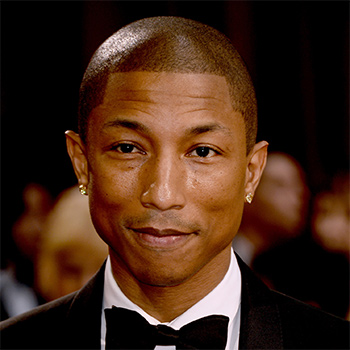
Pharrell Williams is an American producer, songwriter, singer, rapper, and designer, and one of the defining figures in popular music at the turn of the 20th and 21st centuries. His career has developed along several parallel paths: as one half of the production duo The Neptunes alongside Chad Hugo, as a member of the experimental group N.E.R.D., as a solo artist, and as a songwriter and producer for other performers and film projects. His studio work has encompassed hip-hop, R&B, funk, pop, and electronic music, while The Neptunes' distinctive minimalist production style became one of the most recognizable sonic aesthetics of the early 2000s.
Pharrell was born on April 5, 1973, in Virginia Beach, Virginia. He became involved in music while still at school, playing drums and meeting his future longtime creative partner Chad Hugo, who played saxophone. Williams has also frequently spoken about having synesthesia — the ability to perceive music through associations with colors — which has become part of his own explanation of how he hears and visualizes sound.
Virginia Beach and the beginnings of The Neptunes
Pharrell's development as a musician was closely connected to the musical environment of Virginia Beach and the wider Hampton Roads area. Timbaland, Missy Elliott, Magoo, and brothers Gene and Terrence Thornton, who later became known as Clipse, also emerged from the same regional scene. Williams and Hugo were already recording their own material and performing with friends as teenagers; an early incarnation of The Neptunes existed as a group that also included Shay Haley and Mike Etheridge. The name later became primarily associated with the production partnership of Williams and Hugo.
A decisive connection for the young musicians was Teddy Riley, the architect of new jack swing and a member of Guy and Blackstreet. His studio was located near Princess Anne High School. Riley organized a talent competition in which Williams, Hugo, and their friends performed, and he subsequently began working with them. One of Pharrell's earliest notable professional credits came through the 1992 Wreckx-n-Effect hit Rump Shaker, for which Williams wrote Riley's rap verse.
The Neptunes did not become one of the industry's leading production teams overnight. Throughout much of the 1990s, Williams and Hugo accumulated studio experience and gradually began receiving production assignments of their own. A major breakthrough came with N.O.R.E.'s Superthug in 1998. Its abrasive synthesizer motif, unusual rhythmic structure, and generous space between elements of the arrangement already contained many of the traits that would later define The Neptunes' sound.
The Neptunes and a new sound for American pop music
At the turn of the millennium, The Neptunes were working simultaneously across hip-hop, R&B, and mainstream pop. Williams and Hugo produced a substantial part of Kelis's early catalog, including the albums Kaleidoscope and Wanderland, followed by recordings for Jay-Z, Mystikal, Britney Spears, Nelly, Clipse, Snoop Dogg, Justin Timberlake, Gwen Stefani, and many other artists.
Among The Neptunes' most important productions from this period were I Just Wanna Love U (Give It 2 Me) by Jay-Z, Shake Ya Ass by Mystikal, I'm a Slave 4 U by Britney Spears, Hot in Herre by Nelly, and Grindin' by Clipse. The production duo played an especially prominent role in shaping Justin Timberlake's early solo sound: The Neptunes wrote and produced several key tracks on his debut album Justified, including Like I Love You, Rock Your Body, and Señorita.
The Neptunes' style is difficult to reduce to a single set of instruments. Some recordings relied on dry electronic drums and an almost empty sonic landscape, while others featured bright keyboards, guitars, funk elements, or unconventional percussion. The underlying principle was economical arrangement: Williams and Hugo often left considerably more room for vocals than was common in the densely layered production of the late 1990s. As a result, their records could sound both unusual and highly radio-friendly.
In 2003, the compilation The Neptunes Present... Clones was released, bringing together artists and collaborators connected to their creative circle and Star Trak label. At the 2004 Grammy Awards, The Neptunes won Producer of the Year, Non-Classical. Williams would later return to the same category several times as an individual producer.
N.E.R.D.: music that could not be given to another artist
Alongside the commercial production work of The Neptunes, Pharrell, Chad Hugo, and Shay Haley created N.E.R.D., a project that allowed them to move beyond the role of studio producers. The name stands for No One Ever Really Dies. Here, Williams was no longer simply the person behind the console but the frontman, while the group's sound incorporated funk rock, alternative rock, hip-hop, psychedelia, and elements of punk.
The debut album In Search Of... exists in two substantially different versions. The first electronic version was released in Europe in 2001, after which the material was almost entirely re-recorded with live instrumentation by the band Spymob. It was this more rock-oriented version that received an international release in 2002. The album included Lapdance, Rock Star, and Provider. The unusual release history clearly illustrates the distinction between The Neptunes and N.E.R.D.: Williams and Hugo deliberately wanted the band to function as an independent artistic project rather than another extension of their established production sound.
The next album, Fly or Die, arrived in 2004 and produced one of N.E.R.D.'s best-known songs, She Wants to Move. It was followed by Seeing Sounds in 2008 and Nothing in 2010. After a lengthy hiatus, the group returned with the album No One Ever Really Dies in 2017. Its most prominent single was Lemon, featuring Rihanna. Unlike the core output of The Neptunes, N.E.R.D.'s discography has always retained a deliberate stylistic instability, with individual albums combining rock-band instrumentation, rap, funk, electronic music, and pop within the same record.
Frontin' and the transition to a solo career
By the early 2000s, Pharrell's voice was already appearing regularly on other artists' songs, but his development as a solo performer was gradual. A crucial turning point came with the 2003 single Frontin', featuring Jay-Z. The song reached number five on the US Billboard Hot 100 and introduced Williams to a wider audience not primarily as a producer, but as a singer and the central figure on his own recording.
His debut solo album, In My Mind, was released in 2006. Pharrell handled the production himself, while featured guests included Jay-Z, Kanye West, Gwen Stefani, Snoop Dogg, Pusha T, and other longtime collaborators. The album combined two sides of his musical identity — melodic R&B and rap — and debuted at number three on the Billboard 200. Its tracks included Can I Have It Like That, Angel, Number One, and That Girl.
Despite launching a solo career, Williams never fully transformed into a conventional singer. Production remained at the core of his professional identity: his own recordings appeared between sessions for other artists, while his voice was frequently used almost as another instrument within songs that formally belonged to someone else.
2013: Get Lucky, Blurred Lines, and Happy
2013 was an exceptional year even by Pharrell's standards. He first appeared on Get Lucky by Daft Punk alongside Nile Rodgers. The song became one of the central singles from the album Random Access Memories and later won Grammy Awards for Record of the Year and Best Pop Duo/Group Performance. At almost the same time, Williams was a songwriter, producer, and featured performer on Robin Thicke's Blurred Lines, another global hit of the same period.
Blurred Lines later became the subject of one of the most widely discussed copyright cases in modern pop music. A jury found Williams and Robin Thicke liable for infringing the copyrights of Marvin Gaye's heirs because of similarities between the song and Got to Give It Up; a substantial part of the ruling was upheld by an appeals court in 2018. Williams denied intentionally copying the song.
The biggest solo success of this period was Happy. Williams wrote and produced the song for the animated film Despicable Me 2. It was originally part of the film project, but after being released as a standalone single, the track became an international hit and topped the Billboard Hot 100. Happy received an Academy Award nomination for Best Original Song and became the centerpiece of Williams' second solo album.
G I R L and a new phase of Pharrell's solo sound
The album G I R L was released in March 2014, nearly eight years after In My Mind. Instead of the more overt rap-oriented approach of his debut, Williams focused on melodic funk, soul, R&B, and pop. In addition to Happy, the album included Marilyn Monroe, Come Get It Bae, and Gust of Wind. The record reached number three on the Billboard 200 and won a Grammy, while Williams firmly established himself during this period as an artist capable of succeeding at the highest level of the pop market independently of any featured performer's name.
At the same time, Pharrell's solo discography remains unusually compact for an artist with such a long career. His main body of work has been shaped not only by his own albums, but also by hundreds of songwriting and production credits for other performers. Evaluating his influence solely through In My Mind and G I R L would therefore exclude much of the music on which his reputation was built.
Film, Hidden Figures, and work with Hans Zimmer
Film has become another enduring area of Williams' career. In addition to the Despicable Me franchise, one of his most significant projects was Hidden Figures, a film about Black female mathematicians at NASA. Pharrell served as one of the film's producers and contributed to its music, working on the score with Hans Zimmer and Benjamin Wallfisch. His production work on the film earned Williams his second Academy Award nomination when Hidden Figures was nominated for Best Picture.
This combination of popular songwriting, instrumental music, and film production reflects the broader pattern of his career. Williams has rarely confined himself to the role of a creator within any single musical genre and has repeatedly extended his production-driven approach into adjacent fields, from soundtracks and visual culture to design.
Producing after The Neptunes' peak era
The Neptunes' commercial peak in the early 2000s did not mark the end of Pharrell's production career. In later years he worked on music for Madonna, Beyoncé, Kendrick Lamar, Frank Ocean, Ariana Grande, Ed Sheeran, Miley Cyrus, and other artists. Williams contributed to Kendrick Lamar's Alright and received a songwriting credit on the track; Ariana Grande's album Sweetener, on which he worked extensively as a producer and songwriter, later brought him another Grammy. In 2019, the Recording Academy once again named Pharrell Producer of the Year, Non-Classical.
Clipse holds a particularly important place in his career. Williams' connection with Pusha T and Malice began in Virginia long before the duo achieved widespread recognition, and The Neptunes completely shaped the sound of their debut album Lord Willin'. Decades later, that relationship continued when Williams produced the entirety of Clipse's comeback album Let God Sort Em Out, released in 2025. The project once again placed him at the center of contemporary rap production and brought further Grammy nominations.
Piece by Piece — a biography told as a LEGO film
In 2024, Pharrell's life story became the basis for Piece by Piece, a film directed by documentary filmmaker Morgan Neville. Instead of conventional live-action footage, the biographical story was visualized entirely through LEGO animation. In the film, Williams recounts his upbringing in Virginia Beach, his meeting with Chad Hugo, The Neptunes, N.E.R.D., and his solo career; the narrative also features LEGO versions of many of his collaborators, including Jay-Z, Gwen Stefani, Kendrick Lamar, and Snoop Dogg. Pharrell also wrote new music for the project and served as one of the film's producers.
Piece by Piece received a Grammy nomination in the music film category. The project became a characteristic extension of Williams' approach to his own biography: instead of presenting a conventional retrospective, he transformed the story of a producer into an independent visual and musical concept.
Pharrell and fashion
Pharrell's connection with fashion began long before major fashion houses regularly invited musicians to work on collections. In 2003, together with Japanese designer Nigo, he founded Billionaire Boys Club and ICECREAM. The aesthetic of these brands combined hip-hop, skate culture, Japanese streetwear, and luxury materials, while the clothing itself became an important part of Williams' visual identity.
In February 2023, Louis Vuitton appointed Pharrell creative director of its menswear line. His first collection was presented in Paris that summer. For Williams, the role was not an abrupt career change but a continuation of decades of work at the intersection of music and design: before joining Louis Vuitton, he had already collaborated with Adidas, Chanel, Moncler, and other brands.
Music has remained an integral part of his design work. Williams regularly uses Louis Vuitton shows as a platform for new recordings and collaborations. In 2025, Bad Influence, written and produced by him for members of SEVENTEEN, was featured during one of the brand's menswear shows, while the Fall/Winter presentation in early 2026 included then-unreleased material by Pusha T, A$AP Rocky, Quavo, and other artists.
Relationship with Chad Hugo and the status of The Neptunes
The longstanding creative partnership between Pharrell Williams and Chad Hugo later became complicated by serious business disputes. In 2024, Hugo challenged trademark applications filed by Williams' company for the The Neptunes name, arguing that rights to the name should belong jointly to both partners. Williams' representatives stated that the intention was to preserve joint control and that Hugo had been offered shared ownership of the trademarks.
In 2026, Hugo also filed a lawsuit concerning alleged unpaid revenue connected with N.E.R.D. and The Neptunes, including the album No One Ever Really Dies. Williams' representatives said that the accounting was being reviewed and that any amounts owed would be paid if a debt was confirmed. The dispute has left the status of one of the most famous production partnerships of its generation uncertain, although the historical catalog of Williams and Hugo continues to be regarded as the shared legacy of The Neptunes.
Awards and professional recognition
Pharrell Williams belongs to a rare category of artists who have received major music awards as a performer, songwriter, and producer. The Recording Academy credits him with 14 Grammy wins. They include awards connected with The Neptunes, Get Lucky, Happy, G I R L, Ariana Grande's album Sweetener, and multiple victories in the Producer of the Year category. In 2026, the Recording Academy's Black Music Collective also honored Williams with the Dr. Dre Global Impact Award for his broader influence on music and culture.
Williams and Chad Hugo were elected to the Songwriters Hall of Fame as The Neptunes as part of the Class of 2020; because the ceremony was postponed, their formal induction took place at the 2022 gala. For Pharrell, this recognition is particularly significant: much of his most important legacy exists not under his own name, but within songs recorded by other artists.
Pharrell Williams discography
Solo studio albums:
- In My Mind — 2006;
- G I R L — 2014.
Other major works include music for Despicable Me 2, the album Hidden Figures: The Album, and Piece by Piece: Music from the Motion Picture.
With N.E.R.D.:
- In Search Of... — 2001; internationally released re-recorded version — 2002;
- Fly or Die — 2004;
- Seeing Sounds — 2008;
- Nothing — 2010;
- No One Ever Really Dies — 2017.
Under the The Neptunes name, Williams and Chad Hugo released the compilation album The Neptunes Present... Clones in 2003, although the duo's primary discography consists of production work for other artists rather than their own full-length releases.
Pharrell Williams' musical significance
What sets Pharrell Williams apart from most pop stars of his generation is that his public fame emerged as a consequence of his production work rather than serving as its starting point. By the time Happy turned him into one of the world's most recognizable solo singers, Williams had already spent more than a decade reshaping the sound of other artists' albums and singles.
The Neptunes demonstrated that a hip-hop producer could work just as convincingly with a rapper, an R&B vocalist, or a major pop star without sacrificing a recognizable creative identity. N.E.R.D. allowed Williams to transfer those same ideas into a band format and combine hip-hop with rock and funk. His solo recordings revealed his strengths as a melodist and vocalist, while his work in film and fashion expanded his creative system far beyond the recording studio.
That is why Pharrell's legacy cannot be defined by a single hit or a single musical direction. His influence can be heard in the very construction of modern popular recordings — in rhythm, the use of negative space, the blending of genres, and the understanding of the producer as a fully fledged author of the work. From Superthug and Grindin' to Get Lucky, Happy, and his later work with Clipse, his career spans several generations of artists while remaining connected by one consistent idea: distinctive music should emerge not from repeating a proven formula, but from developing an unmistakable sonic language.