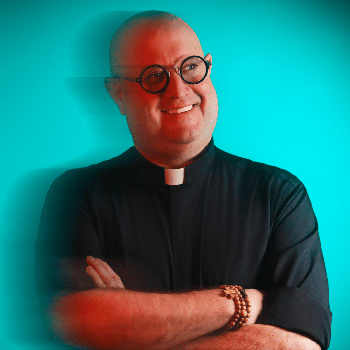
Padre Guilherme (full name — Guilherme Guimarães Peixoto; born July 31, 1974, in Guimarães, Portugal) — is a Portuguese Catholic priest, military chaplain, DJ and electronic music producer. In his performances, he combines techno, melodic techno and house with choral singing, church bells, liturgical motifs and excerpts from speeches by Popes John Paul II, Francis and Leo XIV.
Padre Guilherme reached a broad international audience after his performance at World Youth Day in Lisbon in August 2023. Early in the morning before Pope Francis' closing Mass, he played an electronic set for approximately 1.5 million pilgrims. In the years that followed, the priest performed at Afterlife at Hï Ibiza, Medusa Festival, Zamna, beside the Christ the Redeemer statue in Rio de Janeiro, and at other electronic music and youth events.
At the same time, Guilherme Peixoto has not abandoned the priesthood for a music career. He remains a priest of the Archdiocese of Braga and a military chaplain in the Portuguese Army. The musician himself emphasizes that DJ sets and Catholic liturgy are separate forms of activity for him: he does not turn Mass into an electronic show, while club music serves as an independent way of communicating with an audience.
Childhood in Guimarães
Guilherme Guimarães Peixoto was born in the northern Portuguese city of Guimarães. The future priest spent his childhood in the Azurém area.
His birth is connected to a family story that Peixoto later recounted in interviews. Newborn Guilherme had serious health problems, and his relatives were told that his condition was extremely critical. According to the priest, his mother prayed for his recovery and promised to dedicate her child to God if he survived.
Guilherme himself only learned about this story after becoming a priest. He has specifically stressed that his family did not pressure him into choosing a religious path: his desire to enter the seminary developed independently.
A priest from his home parish, Monsignor José Maria, made a strong impression on him as a boy. Peixoto paid attention not so much to the service itself as to the way the parish priest spoke with people, appeared in the streets of the city and took part in the life of the local community.
Seminary and Music
At around the age of thirteen, Guilherme entered the seminary.
After finishing secondary school, he continued his preparation for the priesthood in Braga and studied theology. Music, meanwhile, was already a constant part of his life.
During his seminary years, Peixoto played in a pop-rock band, listened to contemporary music and did not view attending ordinary concerts, bars or clubs as incompatible with preparing for the priesthood.
That musical environment later proved important: his path toward electronic music did not begin with a professional club career, but with a habit of using music as part of communication within a community.
Ordination
On July 11, 1999, Guilherme Peixoto was ordained a priest of the Archdiocese of Braga.
In the early 2000s, he received a parish assignment in the Póvoa de Varzim area. From 2001, his ministry was connected with the parish of Amorim, and later also with Laúndos.
Alongside regular church services and pastoral work, Peixoto was involved in youth and music projects. In Amorim, together with Manuel Gesteira, he helped establish the children's choir Pequenos Cantores de Amorim, founded in 2002.
Ar de Rock and the First DJ Sets
Padre Guilherme's story as a DJ effectively began in 2006.
At the time, the parish of Laúndos was facing financial difficulties: completed construction work had to be paid for and parish infrastructure needed further development. To raise funds and bring local residents together, a summer community project called Ar de Rock Laúndos was created next to the church.
It was not a conventional nightclub. Parish volunteers organized gatherings, karaoke, concerts and other events for residents of different ages.
During breaks, Guilherme would play music from a laptop. At first, this mostly consisted of rock, pop, hip-hop and popular Portuguese songs — electronic music in the modern DJ-set sense was still largely absent.
The audience responded positively, and the priest gradually became interested in DJ technique itself: mixing software, mixers, set construction and working with a crowd.
Military Chaplain
Alongside his parish ministry, Peixoto became a military chaplain in the Portuguese Army.
He took part in overseas missions, including in Afghanistan and Kosovo. His military service was not merely symbolic: Guilherme was stationed alongside Portuguese service members during international operations.
In 2010, he spent around six months in Kabul. The military command knew that the chaplain organized music events in his parish, so Peixoto was asked to arrange evenings for soldiers serving far from their families.
It was in Afghanistan that electronic music began to play a more prominent role in his sets.
Guilherme Peixoto later attained the rank of lieutenant colonel in Portugal's Armed Forces Religious Assistance Service.
Training at ProDJ
After returning to Portugal, Peixoto realized that his self-taught knowledge of DJ equipment was no longer sufficient. He enrolled at the professional ProDJ school in Porto.
He has named DJ Miss Blondie as his teacher.
The priest later recalled that the training felt like a kind of «reset»: despite several years of performing on his own, he had to abandon many incorrect technical habits and relearn how to work with the equipment.
At the same time, he continued playing at Ar de Rock and occasionally accepted invitations to student events. Early on, Peixoto even asked organizers not to use his name or photographs in promotional materials because he was still unsure how his DJ activity would be received within church circles.
From Amateur Sets to Techno
Padre Guilherme's musical preferences gradually changed. While his early performances centered on rock, pop and commercial dance music, professional training led him toward the electronic scene.
Melodic techno became particularly important — music built on a steady club rhythm, extended harmonic development and emotionally charged climaxes.
This format also proved well suited to Peixoto's own creative approach: choral singing, prayer excerpts, church bells and recorded human speech could be integrated naturally into long-form electronic arrangements.
Pope Francis and the Blessed Headphones
In 2019, Guilherme Peixoto visited the Vatican and met Pope Francis.
The priest brought his DJ headphones with him and asked the pontiff to bless them. Francis agreed.
The story later became one of the most frequently mentioned details of his public biography, although at that time Padre Guilherme was not yet internationally known as an electronic artist.
The Pandemic and «Sozinho em Casa»
The COVID-19 pandemic became a decisive stage in the development of the modern project.
When ordinary public events stopped, Padre Guilherme began hosting livestreams online. The series was titled «Sozinho em Casa» — «Home Alone».
During the broadcasts, he spoke with invited guests, discussed current events and played music. Gradually, the final sections of the streams became increasingly electronic.
Musician friends encouraged him to move away from cautiously blending commercial dance with other styles and instead perform full-fledged techno sessions.
The experiment sharply expanded his audience. Videos of a priest in a clerical collar playing melodic techno from nearly empty spaces began circulating far beyond his parish.
It was during this period that the modern musical identity of the Padre Guilherme project took shape.
Why a Priest Performs in Clubs
His growing profile also generated criticism — both from people within Catholic circles and from club audiences who viewed the sight of a priest behind DJ decks as a marketing gimmick.
Peixoto himself explains his musical activity primarily as a way of entering spaces where the Church is usually almost entirely absent.
At the same time, he deliberately performs wearing his clerical collar. For him, it is not a stage costume but a direct expression of identity: at festivals or club shows, he does not hide the fact that he is a Catholic priest.
At the same time, Padre Guilherme clearly separates concerts from liturgy. His parish Masses follow the ordinary Catholic form and are not turned into techno shows.
Ave Maria and Karetus
The Portuguese electronic duo Karetus played an important role in Padre Guilherme's transition toward the professional electronic scene.
The musicians helped Guilherme structure his electronic stage project and invited him to collaborate.
In 2022, an electronic version of «Ave Maria» was released by Karetus featuring Padre Guilherme and Ricardo Luís Campos.
The project became one of the first official releases to present the priest directly as a participant in the contemporary electronic music scene.
MEO Sudoeste
In the summer of 2022, Padre Guilherme performed at the Portuguese festival MEO Sudoeste.
The festival set was a significantly larger-scale event than his previous parish and small-club appearances.
As the festival industry returned to normal operations, Padre Guilherme began building a professional live team — management, technical specialists, visual production and preparation of his own stage materials.
Póvoa Bendita
In June 2023, the EP Póvoa Bendita was released.
The release was directly connected with the Póvoa de Varzim region, where Peixoto had served as a priest for many years. Susana da Costa also took part in the recording.
The project revealed a direction that would become characteristic of his later discography: local and spiritual motifs reworked into the form of contemporary electronic music.
World Youth Day 2023
The main turning point in his career came with Jornada Mundial da Juventude Lisboa 2023 — the Catholic Church's World Youth Day in Lisbon.
On August 6, 2023, Padre Guilherme was given an unusual task: early in the morning, he was to musically «wake up» pilgrims who had stayed overnight in Parque Tejo after the evening prayer vigil ahead of Pope Francis' closing Mass.
He was facing an audience of approximately 1.5 million people.
The set began with George Frideric Handel's famous «Hallelujah», gradually transitioning into an electronic arrangement. The program also featured religious choral excerpts, well-known electronic music and recordings of the voices of Pope Francis and Saint John Paul II.
Videos of the performance spread quickly across social media and international media outlets. For someone who had spent many years known primarily as a parish priest in northern Portugal, it amounted to an almost instant arrival on the international electronic music scene.
TODOS TODOS TODOS
After World Youth Day, the EP TODOS TODOS TODOS was released on September 6, 2023.
The title refers to the phrase frequently repeated by Pope Francis in his speeches, «todos, todos, todos» — «everyone, everyone, everyone».
The release included four tracks:
- «TODOS TODOS TODOS»;
- «El único momento»;
- «Somos amados como somos»;
- «El amor de Jesús».
The recordings were released through Lux Aeterna Records.
Lux Aeterna Records
As he developed his own music, Padre Guilherme founded the label Lux Aeterna Records.
The name comes from the Latin expression meaning «eternal light». The label is used for the musician's own recordings and projects by his regular collaborators.
Unlike a conventional religious music label, Lux Aeterna is directly oriented toward the electronic scene: its releases include radio edits and extended mixes designed in part for professional DJ sets.
Afterlife at Hï Ibiza
Following his success in Lisbon, Padre Guilherme began receiving invitations not only to religious or youth events, but also to mainstream electronic festivals and club series.
On July 11, 2024, he performed at Afterlife at Hï Ibiza. The series, created by Tale Of Us, was one of the world's most prominent melodic techno platforms at the time.
Padre Guilherme played in the Club Room alongside artists from the international techno scene.
A recording of the performance was later officially released as Live at Hï Ibiza: Jul 11, 2024.
«CITADEL»
On July 12, 2024, Padre Guilherme and Irish producer Ginchy released the collaborative track «CITADEL».
The track falls within techno and became one of Padre Guilherme's first releases to gain independent traction within the club-oriented electronic scene outside an exclusively religious context.
«The Church Bells»
Another important 2024 release was «The Church Bells», created with Ebmath.
Here, church bells function as a full musical element: the traditional sound used to call people to worship is transferred into the structure of electronic dance music.
Padre Guilherme later described «The Church Bells» as one of the key works in his project — one that expresses particularly clearly his idea of connecting the sonic space of the Church with the dancefloor.
Christ the Redeemer and International Performances
In the years that followed, the geographical scope of his performances expanded rapidly.
Padre Guilherme played an electronic set beside the famous Christ the Redeemer statue in Rio de Janeiro and also performed in Spain, Italy, France, Belgium, Mexico and other countries.
He appeared at Medusa Festival in Spain and other major electronic events, no longer as a novelty guest priest but as part of standard festival lineups alongside professional DJs.
Zamna Chile
On March 15, 2025, Padre Guilherme performed at Zamna Festival in Santiago, Chile.
His nearly two-hour set featured melodic techno and house, his own compositions and special religious edits.
These included remixes of «Hallelujah», excerpts from speeches by Pope Francis and John Paul II, «The Church Bells», «CITADEL» and a new version of «Ave Maria».
Notably, organizers also invited Peixoto to bless the festival grounds — the religious and musical sides of his work appeared side by side, but were not merged into a single ceremony.
Veneremur Et Adoremus
In 2025, Padre Guilherme and Ebmath released the project Veneremur Et Adoremus.
The recording featured Liliana Sofia Coelho and the children's choir Pequenos Cantores de Amorim e Laúndos, directly connected with Guilherme Peixoto's parish work.
The project included «Adoramus» and a new electronic version of «Ave Maria».
Integral Ecology
Another 2025 release was Integral Ecology.
It included the tracks «Lift Up the Fallen» and «Infinite Light», recorded with Alba, Ricardo Luís Campos and Susana da Costa.
The title is connected with the concept of «integral ecology», an important part of Pope Francis' social teaching and his encyclical Laudato si'.
Si Tuvieras Fe
That same year saw the release of the Si Tuvieras Fe series, in which Padre Guilherme and KYD3N reworked music by Carlos Anderson, known as «El Obama».
The series includes electronic versions of «El Grano de Mostaza» and «Protégeme Señor».
Such releases demonstrate another recurring element of Peixoto's approach — using existing religious material as the basis for a club remix.
Košice and Pope Leo XIV
On November 8, 2025, Padre Guilherme performed in front of St. Elisabeth Cathedral in Košice, Slovakia.
The event was organized to mark the 75th birthday of Archbishop Bernard Bober.
During the electronic show, a pre-recorded message from Pope Leo XIV to young people appeared on the large screen. The pontiff's words were then incorporated into the musical program.
Video from the event once again spread widely through international media. Pope Leo XIV, however, was not personally present at the venue — his participation consisted of a video message.
We Want an Unarmed and Disarming Peace
On January 1, 2026, the project We Want an Unarmed and Disarming Peace was released.
The title was inspired by Pope Leo XIV's message for the World Day of Peace.
The release included two tracks:
- «We Want Peace» — Padre Guilherme and Diego Miranda featuring Liah Barrett;
- «Instrumento de Paz» — Padre Guilherme and Dre Guazzelli featuring Liah Barrett.
Both recordings were released in shorter radio versions as well as extended mixes for DJ sets.
In Memory of Pope Francis in Buenos Aires
In April 2026, Padre Guilherme performed at Plaza de Mayo in Buenos Aires as part of an event marking the first anniversary of Pope Francis' death.
The square in front of the cathedral, where Jorge Mario Bergoglio served before being elected pope, became a space combining electronic music, video material and recorded statements by Francis.
The event was titled «Francisco vive en el encuentro».
Musical Style
The foundation of Padre Guilherme's current sets is melodic techno, techno and house.
The most distinctive part of his musical language is the use of sources rarely heard in club-oriented electronic music:
- church bells;
- choral singing;
- excerpts from classical sacred music;
- Catholic prayers;
- recordings of speeches by popes;
- Portuguese folk and religious music.
At the same time, he does not create a separate closed genre of «Catholic techno». Padre Guilherme's sets also include tracks by conventional electronic producers, spanning melodic techno, progressive house and festival-oriented music.
The religious elements primarily serve a dramatic function and reflect the artist's personal identity.
Major Releases
- 2022 — «Ave Maria» — Karetus featuring Padre Guilherme and Ricardo Luís Campos;
- 2023 — Póvoa Bendita — EP;
- 2023 — TODOS TODOS TODOS — EP;
- 2024 — «CITADEL» — with Ginchy;
- 2024 — «The Church Bells» — with Ebmath;
- 2024 — «Selfish Love II» — Padre Guilherme Remix;
- 2024 — Live at Hï Ibiza: Jul 11, 2024 — DJ mix;
- 2025 — Veneremur Et Adoremus — with Ebmath;
- 2025 — Integral Ecology;
- 2025 — Si Tuvieras Fe;
- 2026 — We Want an Unarmed and Disarming Peace.
Priest, Soldier and Musician
Musical fame has not replaced the central part of Guilherme Peixoto's biography. Official church directories continue to list him as a priest of the Archdiocese of Braga and a military chaplain in the Portuguese Armed Forces.
In the military, he holds the rank of lieutenant colonel in the Religious Assistance Service. His military experience includes international missions in Afghanistan and Kosovo.
It is precisely this combination of roles that helps explain many of the themes in his music. For Peixoto, messages of peace, solidarity and reconciliation are connected not only with his religious ministry, but also with his direct experience working among military personnel.
Creative Journey
Padre Guilherme's story developed in almost the reverse order of most electronic artists' careers. He did not begin as a young club DJ who later discovered an unusual stage identity. By the time Guilherme Peixoto developed a professional music project, he had already spent many years as a Catholic priest, parish organizer and military chaplain.
His DJ career grew out of a specific parish need: bringing people together and raising funds for the local community. From playing music on a laptop at Ar de Rock, he moved on to professional training, electronic sets, pandemic-era livestreams and eventually major festival stages.
World Youth Day 2023 dramatically increased the scale of this activity, but the underlying principle remained the same. Padre Guilherme uses contemporary electronic music not as a replacement for his priestly ministry, but as a parallel language of communication with an audience that usually exists outside the church environment.