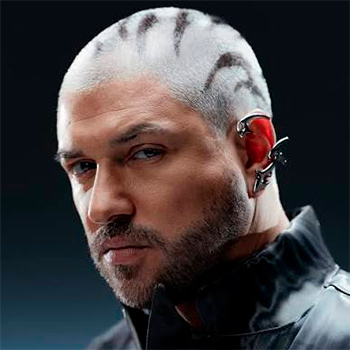
Mosimann (real name: Quentin Gérard John Mosimann) is a French-Swiss DJ, producer, composer, singer and multi-instrumentalist. He was born on February 14, 1988, in Geneva. A wider audience discovered him after he won the seventh season of the French Star Academy in 2008, although Mosimann had already been DJing before his television career. He later moved from electro-pop and festival EDM toward house and tech house, appeared in the DJ Mag Top 100 DJs four years in a row from 2012 to 2015, and returned to the ranking in 2026. In parallel, Mosimann became an in-demand composer and producer for other artists, while the Dream Track series brought him a new wave of international attention.
Quentin was born in Switzerland to a Swiss father and a French mother, and grew up mainly in France, in Haute-Savoie and in the south of the country. His interest in electronic music began during his teenage years. At around fifteen, he started closely observing DJ John Revox at work, later describing him as the person who introduced him to the fundamentals of the profession.
By the time Mosimann appeared on television, he already had practical experience behind the decks. He performed in the south of France and played in Ibiza, combining DJ mixing with his own vocals. This fusion of DJing, singing and live performance would later become one of the most recognisable features of his stage format.
Star Academy and mainstream recognition
In 2007, Mosimann became a contestant on the seventh season of the French Star Academy. The final took place on February 15, 2008 — one day after his twentieth birthday — and ended with Quentin winning the competition.
The television show immediately made him known to a broad French-speaking audience, although his first releases differed significantly from the music he would later make as a club artist.
In August 2008, he released his debut album Duel. Its concept was built around reinterpreting well-known songs in two contrasting musical settings — one more acoustic and jazz-oriented, the other more electronic. The album included versions of Cherchez le garçon, C'est la ouate, Cargo, Such a Shame, L'Aventurier and other songs.
In 2009, the material was reissued in an expanded form under the title Il y a je t'aime et je t'aime. It was not a separate full-length studio album, but a new edition of Duel with additional material.
His second standalone album, Exhibition, arrived in 2010. The jazz component became less prominent, while electro-pop, synthesizers and dance-oriented rhythms moved to the foreground.
Return to DJing
Despite the success of his pop career, Mosimann never abandoned his interest in club music. In the early 2010s, he gradually made DJing and electronic production the central focus of his work.
The transition was not simple: television fame gave him a large audience, but at the same time forced him to prove his professional credibility again within the international electronic music scene.
Mosimann toured extensively, released electro house and progressive house, and developed his own hybrid performance format. Behind the decks, he used not only standard DJ equipment but also keyboards, electronic drums and vocals.
One of the notable tracks from this period was All Alone, recorded with British singer Tara McDonald.
DJ Mag Top 100 DJs
In 2012, Mosimann entered the international DJ Mag Top 100 DJs ranking for the first time, debuting at No. 74. In 2013 he climbed to No. 69, placed No. 72 in 2014, and No. 93 in 2015.
After a long absence, Mosimann returned to the ranking in 2026, reaching No. 85. His appearances in the Top 100 DJs therefore span two noticeably different periods of his career: the electro house and festival EDM era of the early 2010s, and a later phase associated with house, tech house, live performance and the growing popularity of the Dream Track project.
His first appearances in the ranking were especially important for an artist who had initially become widely known through television: Mosimann succeeded in building an independent reputation within the international electronic scene. During this period, he toured actively, developed the House Bless You radio project and worked as a coach on the French-speaking The Voice Belgique.
The 8 Deadly Sins
In 2013, Mosimann released his third studio album, The 8 Deadly Sins.
The record reflected the club side of Mosimann far more strongly than his previous albums. Electro house, progressive house and vocal electronic music formed its core, in line with the festival sound of the early 2010s.
The album became an important transitional point: while Duel and Exhibition were still directly connected to his television pop career, The 8 Deadly Sins was much more closely associated with Mosimann’s identity as an international DJ and electronic producer.
From EDM to a broader house sound
During the second half of the 2010s, Mosimann gradually began moving away from the characteristic festival EDM formula.
This period brought tracks such as TI89, Forever with David Taylor, Cali, Horizon with Leandro Da Silva, Mon Amour and others. House, vocal electronic music and more restrained club rhythms became increasingly prominent.
Instead of constantly pushing toward the biggest possible drop, Mosimann increasingly focused on groove, melody and song structure.
Outside The Box
The idea of refusing to remain within a single genre format was further developed through the Outside The Box series.
The first part of the project appeared in 2020, the second in 2021, and the third in 2023. The title itself accurately describes Mosimann’s approach during this period: electronic music was no longer divided into rigidly separated categories for him.
Across the different instalments, house and club music sit alongside more melodic, vocal and experimental compositions.
This period is particularly important for understanding the mature Mosimann: rather than following another scene trend, he began using his accumulated experience as a singer, instrumentalist, DJ and studio producer all at once.
Work with Grand Corps Malade
One of Mosimann’s most significant projects outside his own discography was his collaboration with French songwriter and performer Grand Corps Malade.
In 2020, Mosimann contributed to the album Mesdames as a composer, producer, instrumentalist and backing vocalist.
One particularly notable track was Derrière le brouillard, recorded by Grand Corps Malade with Louane: Mosimann wrote the music, and his voice also appears in the backing vocals.
He also contributed to other songs on the album, including Mesdames and Pendant 24h.
The project revealed another side of his musical thinking. Instead of club drops and dancefloor functionality, the central elements became lyrics, the performer’s voice, harmony and song dramaturgy.
Mosimann later worked as a composer and producer with Louane, Patrick Bruel, Slimane, Suzane, Pierre Garnier and other French-speaking artists.
Producer for other artists
Work outside his own artist project gradually developed into an independent part of Mosimann’s career.
He writes music and works on arrangements, programming, keyboards and production. As a result, his professional activity extends far beyond the conventional DJ/producer model.
His experience as a singer allows him to work directly with vocal parts, while his skills as an instrumentalist enable him to build compositions not only inside a digital audio workstation, but also through live keyboards, drums and other instruments.
This versatility eventually became the foundation of the Dream Track project.
Dream Track
In January 2024, Mosimann launched the Dream Track series, which brought him a new surge of popularity on social media.
The format revolves around an invited guest. The guest describes the track of their dreams — its genre, mood, instruments, vocal timbre or an unusual combination of sounds — after which Mosimann turns those ideas into a finished musical concept directly in the studio.
The project proved particularly well suited to his range of skills. In a single video, Mosimann can simultaneously act as composer, arranger, keyboardist, drummer, vocalist, sound engineer and producer.
Dream Track grew from an experiment with friends into a regular series featuring major musicians, actors and other public figures. Its popularity is not explained only by the names of the guests: viewers are able to watch the actual process of creating music, from a few words to a finished arrangement.
Modern live format
Mosimann’s concert performances sit somewhere between a traditional DJ set and a full live show.
He uses DJ equipment, synthesizers and keyboards, plays electronic drums and sings. Individual parts and transitions are created directly during the performance.
This format cannot be considered a late addition to his image. Even before appearing on Star Academy, Mosimann combined DJing with live vocals; as his career developed, he simply expanded the range of instruments available to him on stage.
A new phase in the mid-2020s
In Mosimann’s mature discography, club house and tech house increasingly coexist with fully developed vocal tracks.
Notable works from this period include Dancing On My Own, Sin amor with Cecilia Krull, Save Your Money, Don't Say Goodbye, Wish Me Well, Underneath The Blue with Joe Cleere, Ghosts with Skip The Use and Soon with Gaëtan Roussel.
These releases do not form one narrow genre line. Some are aimed at the dancefloor, while others are built around vocals and song form, reflecting the principle that had already taken shape during the Outside The Box series.
Star Academy 2026
In 2026, Mosimann’s story with Star Academy continued when TF1 announced him as the director of the new season.
For the musician, this represents an unusual full-circle moment. In 2008, he entered the academy as a contestant and won the competition; eighteen years later, he was given the task of helping a new generation of artists shape their own stage and musical identities.
The appointment also reflects the change in his professional status. Mosimann returned to the project not simply as a former winner, but as a DJ, composer, studio producer, singer and musician with many years of experience across different areas of the industry.
Musical style
Mosimann’s music has passed through several distinctly different periods.
At the turn of the late 2000s and early 2010s, pop, jazz and electro-pop were central. Electro house, progressive house and festival EDM then became his main directions. Later, his sound shifted toward house and tech house while simultaneously becoming more open to song-oriented and melodic electronic music.
Despite these changes, several elements have remained constant.
The first is rhythmic thinking. Even when working on a pop song, Mosimann often approaches structure like a DJ and electronic music producer.
The second is live instrumentation. Keyboards and drums remain an integral part of both his studio language and his live performances.
The third is vocals. Mosimann does not use his voice merely as an additional stage effect; he is capable of performing complete vocal parts himself and building compositions around them.
For that reason, the most accurate way to describe Mosimann is not through a single genre, but through the combination of several professional roles: DJ, composer, vocalist, arranger, instrumentalist and music producer.
Discography
Studio albums and major original projects
- Duel — 2008
- Exhibition — 2010
- The 8 Deadly Sins — 2013
- Outside The Box, Pt. 1 — 2020
- Outside The Box, Pt. 2 — 2021
- Outside The Box, Pt. 3 — 2023
Reissues
- Il y a je t'aime et je t'aime — 2009, expanded reissue of Duel
Selected singles and tracks
- Cherchez le garçon
- Il y a je t'aime et je t'aime
- Gimme a Break
- All Alone — with Tara McDonald
- Psyké Underground
- Never Let You Go — featuring Joe Cleere
- TI89
- Forever — featuring David Taylor
- Cali
- Horizon — with Leandro Da Silva
- Mon Amour
- I Hate Me
- Comment te dire adieu
- Dancing On My Own
- Sin amor — with Cecilia Krull
- Save Your Money
- Don't Say Goodbye
- Wish Me Well
- Underneath The Blue — featuring Joe Cleere
- Ghosts — with Skip The Use
- Soon — featuring Gaëtan Roussel
Mosimann has followed an unusual path from teenage DJing and a television pop career to the international electronic scene, studio production and his own educational music-creation format. Star Academy brought him mainstream recognition, but his later career was built on constantly redefining his own role: from singer to EDM DJ, from festival house to a more flexible club sound, and from solo artist to composer and producer for other performers. His ability to work equally confidently behind DJ decks, at keyboards, on drums, at the microphone and in the studio has ultimately become Mosimann’s defining characteristic.