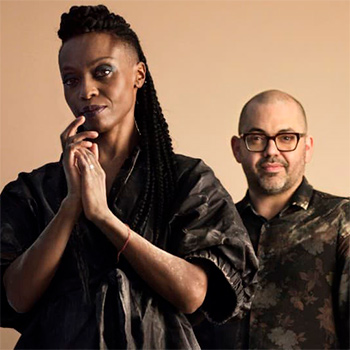
Morcheeba are a British band whose music brings together trip-hop, downtempo, soul, psychedelic rock, hip-hop, blues, folk and pop. The group formed in the mid-1990s around vocalist Skye Edwards and brothers Paul and Ross Godfrey. Today, Morcheeba exist as the creative partnership of Skye Edwards and Ross Godfrey, expanding into a full band for live performances.
Morcheeba are most often mentioned alongside Massive Attack, Portishead and Tricky. The comparison is understandable: the band emerged during the height of British trip-hop and used slow breakbeats, samples, heavy basslines and atmospheric electronics. Yet their second album already made it clear that one genre was too restrictive for Morcheeba. Skye Edwards later said directly that the label “trip-hop” had always seemed too narrow for the band’s music.
Morcheeba’s greatest strength is not their association with any particular scene, but their rare sense of space. Their songs seem to leave a little air around every instrument. Skye’s voice never fights the arrangement, Ross’s guitar never tries to dominate the mix, and the electronic rhythm never overwhelms the listener. As a result, the band’s recordings sound equally natural late at night through headphones, in a car, by the sea or in front of a festival crowd numbering in the tens of thousands.
The chance encounter that started Morcheeba
The band’s story did not begin in a record-company office or at a carefully arranged audition. Ross Godfrey and Skye Edwards met in 1994 at a house party in Greenwich. Skye had gone there with a friend, but arrived before her and struck up a conversation with Ross and his friend Justin. No one that evening could have imagined that the chance meeting would lead to one of the most distinctive British bands of its era.
By that point, Ross and his older brother Paul were already experimenting with electronic music. Paul was interested in hip-hop, rhythm, sampling and studio production. Ross played guitar and keyboards and was drawn to psychedelic rock, blues and traditional songwriting. What the brothers lacked was a voice capable of bringing those different worlds together.
Justin told Ross that Skye could sing. She was initially uncertain and performed her songs so quietly at their first session that Ross asked her to sing louder. Yet that soft, almost conversational delivery soon became one of Morcheeba’s defining features. Instead of a conventionally powerful vocalist, the band found a voice that could sound intimate, calm, sensual and slightly detached all at once.
This created the original creative triangle: Ross wrote the music and built the harmonic foundation, Paul handled the rhythms, production, concepts and a large share of the lyrics, while Skye transformed the material into songs through her voice and melodic choices. This model shaped Morcheeba’s sound across their first four albums.
What does the name Morcheeba mean?
The name began as an ironic play on words. The first part, MOR, refers to the expression middle of the road, used in the English-speaking music industry for accessible, not overly radical music. The word cheeba was used as slang for cannabis.
According to Paul Godfrey, the name was conceived as a joke about hip-hop clichés and the music industry’s excessively serious attitude towards image. In the end, a word created almost by accident proved remarkably accurate: Morcheeba really did learn how to combine experimental culture with melodies that could reach a broad audience.
Early recordings and the China Records deal
The first tracks were made at home using affordable studio equipment, samplers, tape machines and live instruments. The musicians were not trying to reproduce the sound of a conventional rock band. They assembled songs layer by layer: finding the right rhythm, adding guitar textures, keyboards, noise and fragments of recordings, and only then weaving in the vocals.
The band signed with China Records and released the early Trigger Hippie EP in 1995. Their debut album, Who Can You Trust?, followed in 1996 and marked the beginning of Morcheeba’s international recognition. The record reached number 57 on the UK Albums Chart and remained there for 11 weeks.
Who Can You Trust?: a dark, hypnotic debut
Who Can You Trust? was the album that came closest to classic trip-hop. It featured slowed-down hip-hop beats, scratching, heavy bass, electric piano, fragments of psychedelic guitar and tense pauses.
Even from the beginning, however, Morcheeba sounded softer than many of their contemporaries. While Portishead’s music often immersed the listener in anxiety and Tricky’s records were built around a sense of internal conflict, Morcheeba left room for warmth within their darker arrangements. AllMusic described the debut as smoother and more soul-oriented than many comparable records of the period, noting the band’s ability to turn accessible melodies into something mysterious and slightly dangerous.
Key tracks included Trigger Hippie, Tape Loop, Never an Easy Way, Moog Island and the title track Who Can You Trust?. They already contained all the essential elements of Morcheeba’s future style: intimate vocals, a lazy groove, psychedelic guitar and the feeling of a soundtrack to a film that never existed.
Skye was pregnant while the debut album was being recorded. She continued working almost until the birth of her son, then went on tour with the baby. The singer later recalled that she was afraid of giving her bandmates a reason to cancel a concert or video shoot because of her motherhood, so she agreed to almost everything and combined the group’s first major tours with caring for her young son.
Working with David Byrne
The success of Morcheeba’s early recordings attracted the attention of David Byrne, founder of Talking Heads. He was intrigued by the way the band combined samples, electronic rhythms and live instruments without dismantling traditional song structure.
Byrne contacted the group and came to work at their London studio. Morcheeba helped record and produce material for his album Feelings: Paul Godfrey contributed programming, sampling and scratching, and the collaboration covered a significant portion of the record. For the young band, it was important recognition from a musician who had spent decades combining rock, funk, electronics and music from different cultures.
Big Calm: the album that made Morcheeba a major band
Their second album, Big Calm, released in 1998, was both an artistic and commercial breakthrough. Morcheeba retained the slow beats and atmospheric electronics, but broadened their palette with folk, reggae, jazz, blues, orchestral arrangements and cinematic psychedelia.
The album was more song-focused and varied than the debut. Electronic production was no longer the main event in itself; it served the melody and mood. AllMusic called Big Calm a stylistic breakthrough in which pop, lounge, reggae, jazz and electronic music managed to coexist peacefully within a single record.
In the UK, Big Calm reached number 18, but its real influence far exceeded that modest peak. The album spent 113 weeks on the UK chart and was eventually certified double platinum. It sold gradually, passed from listener to listener and became one of the defining records of the late 1990s.
The story behind The Sea
The album’s central track was The Sea. Ross and Paul developed the song’s foundation during a long overnight studio session. Later, they played Skye the chord sequence and lyrics, and she found the vocal melody.
The recording combined a drum loop, strings, psychedelic wah-wah guitar and Skye’s calm voice. Ross connected the mood of the song with the Godfrey brothers’ childhood on the Kent coast and a trip the band made to Brighton.
The record company initially refused to release The Sea as a full single, believing it was not obvious enough for radio. Nevertheless, the song began to take on a life of its own. It gained additional recognition after being used in the British television programme Shipwrecked and gradually became one of Morcheeba’s most beloved works.
What makes The Sea special is that it does not try to impress the listener in its opening seconds. The track slowly reveals its space and invites the listener to enter it. Even decades later, Skye and Ross still name it as one of their favourite songs to perform live.
Other important songs on Big Calm
The album also included Blindfold, Part of the Process, Let Me See, Friction, Shoulder Holster and Over and Over. Each track revealed a different side of the band, ranging from reggae and soul to intimate folk and almost orchestral pop.
Big Calm ultimately defined Morcheeba’s image as a band capable of being relaxed without becoming background music, melodic without being simplistic, and electronic while remaining deeply human and warm.
Fragments of Freedom and the move towards brighter pop
On their third album, Fragments of Freedom, released in 2000, Morcheeba deliberately moved away from the twilight atmosphere of their early work. The music featured more funk, disco, soul, brass and energetic choruses.
The shift divided the audience. Some listeners missed the slow, hazy compositions, while others saw the new record as proof that Morcheeba had no desire to endlessly copy their own success. Even Skye was initially sceptical about the album’s most upbeat single, Rome Wasn’t Built in a Day, considering it too light for a group widely perceived as a downtempo act.
Time changed the song’s reputation. Rome Wasn’t Built in a Day became Morcheeba’s biggest international pop hit, entered numerous national charts and became an essential part of their live set. In the UK, the single reached number 34 and spent six weeks in the Top 100. Skye noted that the song reached the Top 10 in ten countries and helped the band move into festival-headliner status.
The album itself climbed to number six on the UK chart and remained there for 32 weeks. It remains Morcheeba’s highest-charting studio album in Britain.
Charango: eclecticism, guest artists and the end of the first era
The fourth album, Charango, was released in 2002. It continued the move towards a broader pop sound while restoring some of the introspection of Big Calm. The album included Otherwise, Way Beyond, Slow Down, Aqualung, Sao Paulo and other tracks.
The record featured guest performers including rappers Slick Rick and Pacewon, while Lambchop’s Kurt Wagner contributed to Undress Me Now. The unusual combination reflected Morcheeba’s long-standing habit of bringing hip-hop together with acoustic and orchestral music.
Critical responses were mixed. Some reviewers valued the complexity of the arrangements and the band’s ability to shift mood, while others felt Morcheeba had moved too far towards a safe radio format. Commercially, the album remained successful and reached number seven in the UK.
Inside the band, however, exhaustion and tension were building. For years, the members had recorded, given interviews and toured almost without pause. In 2003, Paul Godfrey told Skye that the group would continue without her. Ross later admitted that he had not supported the decision, but at the time the musicians were too worn down to deal with their relationships calmly.
Skye Edwards leaves Morcheeba
The phrase “Skye left Morcheeba,” often found in short biographies, is not entirely accurate. According to the singer herself, the decision was not hers: the manager called and told her that the brothers intended to continue without her.
Skye’s first reaction was even a sense of relief. After years of touring, relationships within the band had become difficult and the members had stopped understanding one another. Even so, the separation was painful. For several years, Skye barely followed Morcheeba’s new releases, comparing it to watching a former partner start a new family.
The compilation Parts of the Process was also released in 2003, bringing together the key recordings from the band’s first era. It reached number six on the UK chart and became one of Morcheeba’s most successful releases.
Morcheeba without Skye: The Antidote
The first album following the line-up change was The Antidote, released in 2005. The lead vocals were recorded by Daisy Martey, previously a member of Noonday Underground.
Her delivery was noticeably more powerful and theatrical than Skye’s restrained singing. The arrangements changed along with the voice: electronics moved into the background, giving way to acoustic instruments, retro pop, blues, country and 1960s psychedelia. The album reached number 17 in the UK, but divided listeners who regarded Skye’s voice as inseparable from the very idea of Morcheeba.
The Antidote should not be seen only as a failed attempt to replace the former singer. It is an independent and fairly bold experiment by the Godfrey brothers. The problem lay elsewhere: listeners knew the group’s emotional formula too well and were not ready to accept it without one of its central components.
Dive Deep and the guest-vocalist model
On the 2008 album Dive Deep, the brothers abandoned the idea of having a permanent vocalist. Instead, different tracks were performed by guest artists including British singer Judie Tzuke, Norwegian singer-songwriter Thomas Dybdahl, rapper Cool Calm Pete, French vocalist Manda Zamolo and others.
This approach turned Morcheeba into something close to a production laboratory. The group’s identity remained audible through Ross’s guitars, the brothers’ rhythms and their studio signature, but every song acquired a different central character.
One of the finest works from this period was Enjoy the Ride, featuring Judie Tzuke. It later emerged that the brothers had offered the song to Skye, but at the time she declined to return to the project.
A chance meeting and reunion
The turning point came in 2009. Skye saw Ross in the street in London’s Shepherd’s Bush. They had not spoken for around seven years, and at first the singer wanted to avoid the encounter, but then approached and embraced her former bandmate.
Later, the musicians met at a restaurant with the symbolic name Julie’s, the same name as Skye’s friend who had once brought her to that party in Greenwich. After talking, they decided to try working together again.
The reunion was not a marketing stunt built around an anniversary tour. It grew out of changed human relationships. After years of separate lives, Skye and Ross were finally able to appreciate what they had once taken for granted.
Blood Like Lemonade: the return of the familiar voice
Blood Like Lemonade arrived in 2010, becoming the first Morcheeba album with Skye Edwards since Charango. From the opening chords and the singer’s first lines, listeners were returned to a familiar world of nocturnal rhythms, minor-key keyboards, guitar shadows and melodies somewhere between pop and soul.
The album was not a literal recreation of Big Calm. The lyrics contained more dark stories, strange characters and almost Gothic narratives. The title track, for example, told a fantastical story about a former priest who became a vampire hunter.
Critics largely viewed the record as the return of the natural chemistry between Skye’s voice and the Godfrey brothers’ music. After the experiments with different singers, it became especially clear that Morcheeba’s identity had never been created by one element alone, but by the interaction of specific people.
Head Up High: an attempt to expand the formula
The next album, Head Up High, appeared in 2013. The band made greater use of dance rhythms, electro-funk, rap and contemporary club production. Guest performers included Chali 2na, Rizzle Kicks, Ana Tijoux, James Petralli and Nature Boy.
The album was uneven, but important for understanding Morcheeba: once again, the group showed that it did not regard its signature downtempo sound as a museum exhibit. They were prepared to take it apart and combine it with new genres, even at the risk of receiving a mixed response.
After this phase, tensions between the Godfrey brothers intensified. In 2014, Paul announced that he intended to leave the group. A dispute also emerged over the rights to the Morcheeba name: Skye and Ross were unable to agree with him on buying out his share, and for a period they were forced to release music under other names.
The Skye & Ross project
In 2016, Skye Edwards and Ross Godfrey released the album Skye & Ross. Formally it was a new project, although the voice, guitars, rhythms and general atmosphere clearly continued the Morcheeba story.
The material became more organic and family-oriented. The live line-up included Skye’s husband, bassist Steve Gordon, her son, drummer Jaega, and Ross’s wife Amanda Zamolo. The musicians combined acoustic instruments, heavy guitar effects and the characteristically relaxed rhythms associated with their work.
The project proved that the creative core of Skye and Ross could exist independently. Yet the absence of the familiar name affected radio and audience attention: Skye herself later noted that the Skye & Ross album did not receive the same level of airplay as releases carrying the Morcheeba name.
The return of the Morcheeba name and Blaze Away
By 2018, Skye and Ross were once again able to use the name Morcheeba. The album Blaze Away was not an attempt to recreate the past, but the beginning of a new period in which the group now existed without Paul Godfrey.
The internal division of roles changed. Paul had previously been the principal lyricist, so Skye had to develop more actively as a writer and storyteller. Ross took on a larger share of the programming, production and rhythm construction.
On Blaze Away, Morcheeba once again combined downtempo, blues, folk, electronics and hip-hop. British rapper Roots Manuva appeared on the title track, while French artist Benjamin Biolay contributed to Paris sur Mer. Reviewers noted that the record restored the glowing, slightly hazy atmosphere that had first drawn listeners to the band in the 1990s.
Blackest Blue: a darker and more personal album
Morcheeba released Blackest Blue in 2021. Work on the record coincided with the pandemic, when cancelled tours allowed the musicians, for the first time in years, to slow down and spend as much time in the studio as the material required.
According to Skye, the lyrics became darker and more personal than those on Blaze Away. They reflected family difficulties, the anxious social climate and events surrounding the Black Lives Matter movement. The track Falling Skies addressed social issues not through a direct slogan, but through an ambiguous image.
The album featured Brad Barr of The Barr Brothers and British guitarist Duke Garwood. Even so, the central formula remained unchanged: Skye’s voice, Ross’s guitar and production in which live instruments dissolved into an electronic environment.
Escape the Chaos: Morcheeba after three decades
Morcheeba’s eleventh studio album, Escape the Chaos, was released on 23 May 2025, in the year the band marked three decades of history. The record included 12 tracks, among them Call for Love, We Live and Die, Elephant Clouds, Bleeding Out, Dead to Me and the title track Escape the Chaos.
The title reflects the album’s central theme: the desire to find inner stillness in a world saturated with conflict, messages, screens and alarming news. Ross explained the idea of “escaping the chaos” in simple terms: sometimes it is necessary to switch off devices, read, swim, sleep, meditate or simply listen closely to music.
On Peace of Me, the band collaborated with London rapper Oscar #Worldpeace, while Amanda Zamolo appeared on Pareidolia. Musically, the album brings together familiar guitars, analogue synthesizers, keyboards, slow beats and cinematic arrangements, without trying to artificially recreate the sound of 1998.
Escape the Chaos reached number 71 on the UK chart. The position was more modest than the band’s results in the early 2000s, but Morcheeba’s return to the main albums ranking after so many years underlined the durability of their audience.
Remix the Chaos and the band’s activity in 2026
In 2026, Morcheeba continued developing the material from their latest album through the Remix the Chaos series. The first instalment began a planned three-part cycle, with each part featuring new versions of four songs.
Volume 1 featured Paula Tape, Trance Wax, Frazer Ray and Brothers Counsell. The producers moved Morcheeba’s songs into the world of contemporary breakbeat, trance, UK bass and club electronics while preserving Skye’s vocal parts and Ross’s signature guitar lines. The vinyl edition appeared on 18 April 2026 as part of Record Store Day and entered the UK Physical Singles Chart.
In this way, the band completed a kind of circle. In the 1990s, Morcheeba brought elements of hip-hop and club culture into intimate song-based music. Three decades later, a new generation of electronic producers is returning those songs to the dance floor.
Why Skye Edwards’s voice is unmistakable
Skye Edwards rarely relies on showy vocal virtuosity. She does not overload songs with long melismas and never tries to overpower the arrangement through volume. Her strength lies in tone, phrasing and her ability to hold a pause.
Her voice contains elements of soul, jazz, pop and an almost conversational style at the same time. Even dramatic lines are often delivered calmly, leaving listeners free to feel the hidden tension for themselves.
This is precisely why Skye’s voice works so well in Morcheeba’s music. It does not cover the electronic details, but seems to glide above them. After her absence from two albums, it became completely clear that she was not simply a featured singer, but one of the band’s central instruments.
The later period added another dimension to her role. Following Paul Godfrey’s departure, Skye became the principal lyricist and began bringing more of her personal experience, family concerns and reflections on the wider world into the songs.
The role of Ross Godfrey
Ross Godfrey is the musical architect of modern Morcheeba. He plays electric and acoustic guitars, bass, keyboards, analogue synthesizers and other instruments, while also handling programming, arrangements and production.
His guitar style is defined not by the number of notes, but by texture. Ross uses slide, wah-wah, fuzz, tape echo and other effects, turning the guitar at different moments into a blues voice, psychedelic noise or an almost orchestral backdrop.
Despite the complexity of the equipment, the original writing process remains simple: Ross sits down with a guitar or piano, searches for chords and a melody, and then finds a suitable rhythm. Modern technology changes the speed and methods of recording, but not the foundation of his work.
Paul Godfrey’s contribution
Although Paul Godfrey is no longer part of the current line-up, his role in shaping Morcheeba was fundamental. He was responsible for the hip-hop component of the early sound, created beats, worked with samples, handled production and wrote a significant share of the lyrics during the classic period.
Paul helped create the contrast on which the early albums were built: hard or strange stories were delivered through Skye’s soft voice, while dark rhythmic constructions existed alongside Ross’s melodic guitars.
The modern duo develops the music in a different direction, but Who Can You Trust?, Big Calm, Fragments of Freedom and Charango are impossible to imagine without the creative thinking of all three original members.
Morcheeba’s musical style
Morcheeba’s music is easier to recognise than to describe with one genre label. Its main elements include:
- slow and mid-tempo hip-hop rhythms;
- soft, closely recorded vocals;
- deep bass without excessive aggression;
- psychedelic and blues-influenced guitars;
- Rhodes, Wurlitzer, Hammond and analogue synthesizers;
- orchestral and cinematic details;
- elements of soul, reggae, folk and disco;
- guest rappers and vocalists;
- melodies strong enough to exist independently of the electronic arrangement.
Their best songs work on two levels at once. On the surface, they are pleasant and accessible pieces that can easily function as accompaniment. Closer listening, however, reveals many details: an unexpected noise, a barely audible backing vocal, a guitar effect, a rhythmic change or an instrument that appears for only a few seconds.
That is why the description “chillout band” is both fair and insufficient. Morcheeba certainly know how to create a relaxed mood, but they do so with a level of arranging skill that cannot be reduced to background music.
Morcheeba’s chart success
Morcheeba were never a typical singles band. Their songs often unfolded too slowly for standard radio, while the album remained their central format.
On the UK chart, the group placed three albums in the Top 10: Fragments of Freedom reached number six, Charango number seven and the compilation Parts of the Process number six. Big Calm peaked at number 18, but remained on the chart for 113 weeks, a figure that demonstrates its long-term impact far better than the peak position alone.
In the singles chart, their biggest British result was Rome Wasn’t Built in a Day, which reached number 34. Yet the group’s international popularity was always broader than its performance in its home market: Morcheeba built an especially loyal following across continental Europe, Australia and other regions.
Morcheeba’s significance for electronic music
Morcheeba helped make trip-hop accessible to listeners who did not normally follow club music or experimental electronics. They proved that slow beats and samples could coexist with traditional songwriting, folk guitar, blues and soul vocals.
At the same time, the band was never simply a softened version of the Bristol scene. Their music contains less urban anxiety, but more images of nature, roads, water, space and light. It is no coincidence that one of Morcheeba’s defining songs is called The Sea, or that the musicians particularly enjoy performing near seas and lakes.
Their legacy is visible not in an army of direct imitators, but in the spread of the approach itself: electronic music can be complex, atmospheric and production-driven without abandoning clear melody and the human voice.
Morcheeba’s essential songs
The Sea
A track from Big Calm that became a symbol of the band without the support of a conventional single campaign. Its strength lies in the combination of a simple image of the sea, a slow groove, psychedelic guitar and almost weightless vocals.
Rome Wasn’t Built in a Day
Morcheeba’s best-known upbeat song. At first, Skye considered it too pop-oriented, but it later became one of the highlights of every concert and the band’s biggest international hit.
Trigger Hippie
One of the band’s earliest works and a concentrated expression of their original aesthetic: a hip-hop beat, dark bass, scratching and soul vocals.
Part of the Process
A song in which a calm melody sits alongside reflections on everyday pressure and the need to accept change as part of life.
Blindfold
One of the most emotionally intense tracks on Big Calm. Strings and a restrained rhythm create a sense of internal drama without tipping into open hysteria.
Otherwise
A melodic piece from Charango that presents Morcheeba as an intimate pop band with orchestral thinking.
Enjoy the Ride
One of the central songs from the period without Skye, recorded with Judie Tzuke. It preserved Morcheeba’s familiar sense of travel and gentle forward motion.
Blood Like Lemonade
A dark narrative song that marked Skye’s return and showed that the band could combine its familiar downtempo sound with an almost fantastical storyline.
Sounds of Blue
One of the key songs from the later period: a deep, slow and visually rich work that demonstrates the mature creative partnership between Skye and Ross.
We Live and Die
A track from Escape the Chaos that reflects on the band’s history, time, human closeness and the inevitability of change.
Morcheeba studio discography
- Who Can You Trust? — 1996
- Big Calm — 1998
- Fragments of Freedom — 2000
- Charango — 2002
- The Antidote — 2005
- Dive Deep — 2008
- Blood Like Lemonade — 2010
- Head Up High — 2013
- Blaze Away — 2018
- Blackest Blue — 2021
- Escape the Chaos — 2025
The 2016 album Skye & Ross occupies a separate place in the story. Formally, it is not part of Morcheeba’s discography, but it represents an important transition between Paul Godfrey’s departure and the return of the band’s name.
Conclusion
Morcheeba’s history is far from a perfectly straight line. It contains a chance meeting, rapid success, exhaustion, a painful separation, attempts to replace the irreplaceable, a family dispute, the loss of the band’s name and an unexpected return.
That is precisely why the group’s music still feels alive. Morcheeba did not remain unchanged after 1996; they rebuilt themselves several times. First around Paul’s beats, Ross’s guitar and Skye’s voice. Then around guest vocalists. Later, around the friendship and trust that Skye and Ross managed to restore after seven years of silence.
Their greatest secret is not the slow tempo or the soft vocals. It lies in their refusal to rush the music. Morcheeba allow a song to breathe, the listener to pause and emotions to emerge without unnecessary pressure. In an age when attention is constantly fractured by notifications and endless streams of content, that sound has proved not to be a relic of the 1990s, but a rare and increasingly valuable form of freedom.