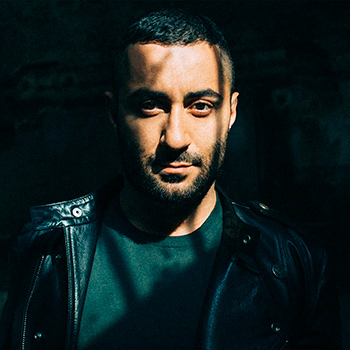
Joseph Capriati (real name — Giuseppe Capriati; born July 25, 1987, in Caserta, Campania, Italy) — is an Italian DJ, music producer and founder of the labels Redimension and Metamorfosi Records. His career is closely connected with the Neapolitan school of electronic music, the Drumcode, CLR and Analytic Trail labels, Ibiza club culture and the development of contemporary techno.
At the same time, the description «techno DJ» does not fully define Capriati. His first serious passion in electronic music was house, and over the years his sets and studio recordings have moved freely between techno, house, tech house, minimal, dub, melodic electronic music and more experimental forms. This side of his work became especially evident on his third studio album Metamorfosi and in the club event series of the same name.
During his career, Capriati has released three studio albums — Save My Soul, Self Portrait and Metamorfosi — recorded mixes for the fabric and Global Underground series, and collaborated with Adam Beyer, Louie Vega, Eric Kupper, Byron Stingily, Indira Paganotto, Dennis Cruz, Rino Cerrone and other musicians. He has also earned a separate reputation as a specialist in extended DJ sets: in 2017, one of his performances in Miami lasted 25 hours and 30 minutes.
Childhood in Caserta
Giuseppe Capriati grew up in Caserta, a city north of Naples. His family lived not far from the center, in an area the musician later remembered as a close-knit community where most neighbors knew one another well.
His interest in DJing appeared extremely early. In 1998, when Capriati was around eleven years old, he watched a DJ perform at an event for the American community connected with military infrastructure based in the region.
What fascinated him was not only the sound of the music, but the process itself: turntables, a mixer and the ability of one person to control the mood of an entire venue.
His family could not afford professional equipment. During the summer, the future musician worked with a relative to save money for his first turntable. A second deck was given to him by another relative, while a simple two-channel mixer came from an acquaintance.
Using this basic home setup, Capriati learned how to mix records and began playing at friends' parties in garages and private homes.
House Before Techno
Although Joseph Capriati's name would later become primarily associated with techno, the first electronic genre that truly captured his attention was house.
A particularly important influence was a cassette recording of a Little Louie Vega DJ set from one of the Angels Of Love parties in Naples. Capriati has said that he listened to the tape almost every day.
His early reference points included Masters At Work, Louie Vega, Todd Terry, David Morales and other American house producers.
As a teenager, he regularly visited record shops even when he did not have enough money to buy vinyl. There, Capriati read specialist magazines, studied interviews with DJs and looked through equipment catalogs.
First Residencies
One of Capriati's first regular venues was the Subway club in Caserta.
It was not an underground techno venue in the modern sense. The club hosted birthdays, weddings and ordinary commercial parties, which meant the young DJ had to play a wide variety of styles — pop, Latin music, commercial dance and house.
Capriati later described this experience as a crucial school in learning how to work with a crowd. If people stopped dancing, the DJ had to understand why and change the musical direction.
That practice developed his ability to read an audience, a skill that would later become especially important during his marathon sets.
First Encounter with Techno
In the early 2000s, Capriati attended a large techno party for the first time. One of the key events was a twelve-hour party in Naples in 2003 featuring Dave Clarke, Billy Nasty and Rino Cerrone.
The musician was impressed not only by the heavier, more mechanical sound, but also by the entire culture surrounding techno — the length of the night, the behavior of the crowd and the possibility of constructing a DJ set as a long-form story.
After that, techno gradually began to occupy an increasingly important place in his own performances.
DJ Jampa and the Move to His Own Name
In his early years, Capriati performed under the stage name DJ Jampa.
Later, when he began producing his own music, the artist decided to abandon a separate DJ alias. He viewed his studio recordings as more personal work and wanted to release them under his real surname.
The Italian name Giuseppe was replaced with the more internationally accessible form Joseph. This is how the name Joseph Capriati emerged, under which the rest of his career developed.
Beginning as a Producer
Around 2005, Capriati began learning music production.
Initially, he worked in a friend's studio, studying software and the structure of electronic composition. Later, he bought his own audio interface and MIDI keyboard.
His home studio was extremely basic. In one interview, Capriati recalled using ordinary consumer speakers that reproduced almost no low frequencies, so at times he would literally check bass vibrations with his hand.
By 2006, he was already producing finished tracks and secured a residency at the Disco Seven club, where he met representatives of the local electronic music industry.
The Neapolitan School of Techno
Capriati developed alongside one of Italy's most influential regional techno scenes.
Since the 1990s, Naples had established its own school of electronic music associated with artists such as Rino Cerrone, Marco Carola, Gaetano Parisio and Markantonio.
Rino Cerrone and Markantonio had a particularly strong influence on the young Capriati. He described them as mentors not only musically: the more experienced artists taught him the practical rules of international touring, studio mixing and mastering, and introduced him to the professional side of the industry.
Although Capriati was born in Caserta, his early professional development is therefore usually discussed specifically within the context of the Neapolitan techno scene.
First Releases
Joseph Capriati's first official releases appeared in 2007.
One of his early records was the Formaldehyde EP on Globox Recordings. Other releases followed that same year, including Flip Da Box EP and the C'est La Vie EP.
C'est La Vie was released on November 20, 2007, via Analytic Trail — Markantonio's label, which played an important role in shaping a new wave of Neapolitan techno.
The release included four tracks:
- «Menestrello»;
- «Oasi»;
- «Poker D'Assi»;
- «C'est La Vie».
The success of these early records quickly took Capriati beyond the local scene.
2008 and International Development
In 2008, the number of releases and collaborations increased significantly.
Capriati worked with Rino Cerrone, Markantonio and Uto Karem, releasing music on Unrilis, Loose Records, Agile Recordings and other European labels.
One of the most notable tracks was «Molotov», created with Markantonio. The track received support from Richie Hawtin and other major techno DJs.
At the same time, Capriati began performing regularly outside Italy.
CLR and Drumcode
The next major stage in his career came in 2009.
Chris Liebing's CLR label released the Login EP, and shortly afterward Capriati began working with Drumcode, the label founded by Swedish producer Adam Beyer.
His first releases for Drumcode were «Sidechains» and «Kontrol Room».
The relationship with Drumcode became a long-term one. Over the following years, Capriati released music regularly on the label and became one of the most recognizable artists in its catalog alongside Adam Beyer himself.
Save My Soul
In 2010, Joseph Capriati released his debut studio album Save My Soul on Analytic Trail.
The album was important because it already demonstrated a broader musical range than his club singles suggested.
Alongside functional techno, Capriati included calmer, more atmospheric and experimental tracks. This approach would later become a consistent feature of his full-length projects: for him, an album should not simply be a collection of DJ tools.
Drumcode and Adam Beyer
In the early 2010s, his collaboration with Adam Beyer became especially close.
Drumcode released Capriati tracks including «Gashouder», «Vesuvio», «The Gallery» and others.
In 2012, Adam Beyer and Joseph Capriati jointly released the Congenial Endeavor EP.
These releases coincided with a period when Drumcode was becoming one of the largest international brands in contemporary techno, while Capriati became a regular presence at its events.
Ibiza and Music On
Ibiza became especially important to Capriati's international career.
In 2012, he began performing regularly at the new Music On party created by Marco Carola at Amnesia.
During the first season, Capriati played six sets in the Main Room. By 2013, he had become an official Music On resident and played eight events during the season.
His harder techno sound in the Main Room contrasted with the house and tech house direction Marco Carola developed on the Terrace.
Music On played a major role in transforming Capriati from a respected techno producer into an international headliner in his own right.
Self Portrait
In November 2013, Drumcode released his second studio album, Self Portrait.
The title emphasized the personal nature of the project. Capriati wanted to present not only his familiar club sound but a broader musical portrait.
The album's best-known tracks included:
- «Fratello»;
- «Awake»;
- «Basic Element»;
- «This Then That»;
- «Easy Come Easy Go»;
- «Always and Forever»;
- «Deep Thoughts».
The opening track «Electrolytic» used ambient and breakbeat elements, while «Awake» represented more direct peak-time techno.
This range confirmed that Capriati approached the album format differently from his DJ-oriented releases.
Autoritratto Documentary
The Self Portrait project was accompanied by the documentary Autoritratto.
Filming took place in Caserta and focused on the musician's origins, family, friends and local scene.
The film was included in the album's CD/DVD edition and helped reveal a more personal side of an artist who by then spent much of the year touring internationally.
fabric 80
In 2015, Joseph Capriati recorded fabric 80 for the famous mix series associated with London's fabric club.
The mix was recorded live using two CDJs and a mixer — in the same way Capriati might perform a regular club set during the night.
The selection included music by Adam Beyer, Recondite, Joel Mull, Gary Beck, Brian Sanhaji, Alan Fitzpatrick and other producers, as well as Capriati's own track «Partenopeo».
He structured the mix as a journey between different rooms of fabric: from groove-driven house and tech house material into heavier techno and then back toward a more melodic ending.
Redimension
In 2016, Capriati launched his own label, Redimension.
The name reflected his desire to create a space where he could expand his musical boundaries beyond the expectations associated with his Drumcode career.
The first release featured two collaborations with Adam Beyer, «Parallels» and «External Links».
They were followed on Redimension by Prospective Journeys with Flavio Folco.
The label later released music by other artists and became Capriati's main platform for studio experimentation.
Marathon DJ Sets
By this stage, Capriati had developed a separate reputation for extended performances.
Unlike a standard one- or two-hour festival slot, a marathon set allowed him to begin with house, move through minimal and tech house into techno, and then shift tempo and mood again.
Capriati played sets lasting ten, twelve or more hours in clubs across Europe and the Americas.
The most famous example took place on November 18–19, 2017, at Heart Nightclub in Miami.
The set lasted 25 hours and 30 minutes. Capriati later said that he had intended to play for a long time, but had not planned in advance to go beyond 24 hours.
It remains the longest DJ set of his career.
House Returns to the Foreground
Despite his international reputation as a techno DJ, Capriati never completely left house behind.
Particularly important were his encounters with one of his earliest musical heroes, Louie Vega.
Capriati and Vega began performing together, including extended vinyl-only sets. Spending time with one of the founders of Masters At Work encouraged Joseph to reconnect with the music he had listened to before discovering techno.
Gradually, the idea emerged for an album that could bring together both sides of his musical biography.
Burning Man and a Change in Creative Approach
Another important impulse came from Capriati's first visit to Burning Man in 2018.
The festival experience influenced the way he viewed electronic music as a space where dancefloor function could coexist with more personal and experimental expression.
Over the following several years, he worked on material that eventually became Metamorfosi.
Metamorfosi
On September 4, 2020, Redimension released Capriati's third studio album, Metamorfosi.
The title itself — «Metamorphosis» — described changes both in Capriati's music and in his attitude toward his own public image.
Instead of making an album consisting exclusively of hard techno, he created a project in which house, acid, broken beat, melodic electronic music, ambient elements and club tracks coexist.
The album included:
- «Improvvisazione»;
- «Beautiful Morning»;
- «Spirit Brothers» with Louie Vega;
- «Anything Is Possible»;
- «Dust»;
- «New Horizons» with James Senese;
- «Metamorfosi»;
- «Psychic Journey»;
- «Goa»;
- «It's All About Love»;
- «Love Changed Me» with Eric Kupper and Byron Stingily;
- «Let's Change The World».
Louie Vega, James Senese and Byron Stingily
The guest list on Metamorfosi reflects several different layers of Capriati's musical interests.
Louie Vega represents the American house music Joseph had listened to since childhood.
James Senese is a saxophonist and one of the notable figures in Neapolitan music culture, combining funk, jazz and local traditions.
Eric Kupper and vocalist Byron Stingily are associated with the classic American house scene.
For that reason, Metamorfosi was not a rejection of Capriati's previous career, but an attempt to bring different musical periods of his life together within a single project.
2021 and a Forced Break
In January 2021, Capriati was hospitalized following a serious family conflict in Caserta and underwent emergency surgery for a chest injury.
His condition was initially described as serious, but the musician recovered and later returned to professional activity.
The incident occurred during a period when the touring industry was already largely shut down because of the COVID-19 pandemic.
Metamorfosi Becomes a Club Project
The title of the third album gradually developed into a separate event concept.
In 2022, Capriati launched the Joseph Capriati presents Metamorfosi series at Amnesia Ibiza.
The first season included three events. Unlike a conventional artist-led party centered around one genre, Metamorfosi was built around the idea of musical movement between house and techno.
Over the following years, the project expanded steadily:
- 2022 — three parties;
- 2023 — five;
- 2024 — eight;
- 2025 — a fourteen-week residency;
- 2026 — fourteen consecutive weeks.
Metamorfosi 2024
By 2024, the project occupied both of Amnesia's key music spaces.
Capriati used the Terrace primarily for groovy house, tech house and more open electronic sounds, while the second room allowed him to present heavier and more experimental forms of techno.
Guests across different editions of Metamorfosi included Paul Kalkbrenner, Jamie Jones, Seth Troxler, Chris Stussy, WhoMadeWho, Sara Landry, Indira Paganotto and other artists.
Peace & Blessings
In May 2024, New York label Nervous Records released the single «Peace & Blessings» featuring American house vocalist Arnold Jarvis.
For Capriati, the track became a direct tribute to the genre through which he first discovered electronic dance music.
Rather than modern hard techno, the track draws on the spiritual and vocal side of classic American house — percussion, warm synthesizers and a full song-oriented vocal performance.
Mantra with Indira Paganotto
On June 13, 2024, Capriati and Spanish-Italian producer Indira Paganotto released the collaborative Mantra EP on her ARTCORE label.
The release consists of two tracks:
- «Ananda»;
- «Mantra».
«Ananda» is closer to Capriati's classic high-energy techno, while «Mantra» leans more heavily toward the psychedelic and psytrance elements associated with Paganotto.
The collaboration demonstrated that after a period of actively reconnecting with house, Capriati had not abandoned heavier techno.
Move to Lisbon
In 2024, Capriati also changed his usual working environment.
After roughly twelve years of living in Barcelona, he moved to Lisbon and began building a new studio there.
The musician connected the move with a desire to reduce the amount of touring, devote more time to his own music and live closer to nature and the ocean.
During the same period, he spoke about adopting a calmer lifestyle and consciously stepping away from a constant routine of club afterparties.
Global Underground #47: Montreal
On March 21, 2025, Global Underground #47: Joseph Capriati — Montreal was released.
For Capriati, taking part in the Global Underground series was an important continuation of the path begun with fabric 80: instead of making an original studio album, he was given the opportunity to present his own understanding of DJing as an art form.
The mix is divided into two contrasting parts. The first leans more heavily toward house, groove and warmer sounds, while the second gradually moves toward deeper and harder techno.
The selection includes music by Louie Vega, Anané, Deetron, Carl Cox, Solomun, Âme, Marc Romboy, Oliver Huntemann, Len Faki, Rino Cerrone and other artists.
Capriati also included his own track «Meandri».
GU47 is not Joseph Capriati's fourth studio album — it is an artist-curated DJ compilation in the Global Underground series.
Metamorfosi at Hï Ibiza
During the 2025 season, Metamorfosi left Amnesia for the first time and moved to Hï Ibiza.
From July 4 through October 3, Capriati hosted the party every Friday for a total of 14 weeks.
The project occupied three spaces within the club, while the musical program was built around different sides of the contemporary house and techno scenes.
For Capriati, the season represented the largest expansion of the Metamorfosi brand since its launch.
Metamorfosi Records
On June 20, 2025, Capriati expanded the project name into a new record label, Metamorfosi Records.
The new imprint operates alongside Redimension but has its own concept.
While Redimension has historically been more closely connected with techno and Capriati's personal studio work, Metamorfosi Records focuses on house, tech house, minimal and dub grooves and deliberately avoids restricting itself to darker techno sounds.
The first release was a collaboration between Joseph Capriati and Spanish producer Dennis Cruz — «No Sleep».
Cosmopop
On June 27, 2025, Capriati appeared for the first time on Sven Väth's Cocoon Recordings.
His track «Cosmopop» was included on the compilation Cocoon Compilation V.
The track differs noticeably from Capriati's traditional peak-time techno: the tempo is around 122 BPM, while the core of the production is built on a soft rolling groove and melodic harmonic layers.
The release continued the direction of recent years, during which the artist has consciously moved away from the need to fit a single genre identity.
Metamorfosi Returns to Amnesia in 2026
For the 2026 season, Metamorfosi returned to Amnesia Ibiza, the club where the project originally began.
The residency runs on Tuesdays from June 30 through September 29 and spans 14 consecutive weeks — the longest Metamorfosi season at Amnesia.
The musical program is divided between the Terrace and Main Room, allowing Capriati to develop the house-oriented and techno sides of the project at the same time.
The season lineup includes Richie Hawtin, Jamie Jones, Seth Troxler, Chris Stussy, Ben Klock, Maceo Plex, Damian Lazarus, BLOND:ISH, Dubfire, Anfisa Letyago, Freddy K, WhoMadeWho, Fatima Hajji and other artists.
The residency coincided with Amnesia's 50th anniversary.
Musical Style
Joseph Capriati's music is usually categorized as techno, although his professional history presents a more complex picture.
Several main directions can be identified in his work:
- techno — the foundation of his international breakthrough in the late 2000s and his Drumcode period;
- house — the first electronic genre he became passionate about as a child;
- tech house — an important part of his extended sets and contemporary Metamorfosi concept;
- minimal and dub — especially noticeable in early productions and selected club sets;
- melodic electronic music — more prominent on Metamorfosi and in later releases.
For Capriati, genre labels have gradually become less important than groove and the development of a DJ set.
DJing Style
Joseph Capriati developed first and foremost as a DJ, and only afterward as a producer.
His approach is based on long-form development. Instead of delivering a constant sequence of climaxes, he can gradually change tempo, rhythmic density and genre, moving from house through minimal and tech house into techno.
Years of experience with marathon sets gave him the ability to work with extremely long musical arcs.
In later interviews, Capriati noted that over time he stopped treating the length of a set as an achievement in itself. In his view, the experience gained from multi-hour performances now allows him to create a complete musical journey even within two or three hours.
Connection with Naples
Although Capriati was born in Caserta and has spent a significant part of his adult life outside Italy, the Neapolitan electronic music school remains an important part of his musical identity.
It was through Rino Cerrone, Markantonio and local labels that he received his first professional opportunities.
Later, Capriati repeatedly returned to music from that generation — for example, by reworking early Rino Cerrone tracks in the Rilis Classics project.
On Metamorfosi, the connection with the region extended beyond techno through his collaboration with Neapolitan saxophonist James Senese.
Studio Albums
- 2010 — Save My Soul — Analytic Trail;
- 2013 — Self Portrait — Drumcode;
- 2020 — Metamorfosi — Redimension.
Major DJ Mixes
- 2015 — fabric 80 — fabric;
- 2025 — Global Underground #47: Joseph Capriati — Montreal — Global Underground.
Selected Releases
- 2007 — Formaldehyde EP;
- 2007 — C'est La Vie EP;
- 2008 — Molotov — with Markantonio;
- 2009 — Login EP;
- 2009 — Sidechains / Kontrol Room;
- 2010 — Gashouder;
- 2011 — Vesuvio;
- 2012 — Congenial Endeavor — with Adam Beyer;
- 2013 — Awake / Fratello;
- 2016 — Parallels / External Links — with Adam Beyer;
- 2017 — Prospective Journeys — with Flavio Folco;
- 2018 — Rilis Classics;
- 2020 — Goa;
- 2024 — Peace & Blessings — featuring Arnold Jarvis;
- 2024 — Mantra EP — with Indira Paganotto;
- 2025 — Meandri;
- 2025 — No Sleep — with Dennis Cruz;
- 2025 — Cosmopop.
Joseph Capriati's Labels
Redimension
Founded in 2016 as Capriati's own creative platform. Redimension has released his collaborations, music by other producers and the album Metamorfosi.
Metamorfosi Records
Launched in 2025 as a musical extension of the event series of the same name. The label focuses on house, tech house, minimal, dub grooves and a broader club sound.
Creative Journey
It is easy to mistakenly describe Joseph Capriati's story as a linear progression from a young Neapolitan techno producer to an international headliner. In reality, his musical path has changed direction several times.
House was his first passion even before he discovered techno. The Neapolitan scene gave him technical training and professional mentors. CLR and Drumcode brought him to the international level, while Music On made Ibiza an important part of his career.
By the mid-2010s, Capriati had developed a very stable image as a powerful peak-time techno DJ. It was precisely the limitations of that image that he later began consciously moving away from.
Metamorfosi became the central point of this new period: house returned to his music not simply as a memory of his youth, but as an equal part of his own musical language. The album was followed by the event series of the same name, Ibiza residencies and a separate record label.
By the mid-2020s, Joseph Capriati is therefore more accurately described not as an artist representing one specific branch of techno, but as a DJ who connects different generations of house and techno. His professional identity is built around groove, long-form development and constant movement between musical styles — the idea he ultimately expressed through the word Metamorfosi.