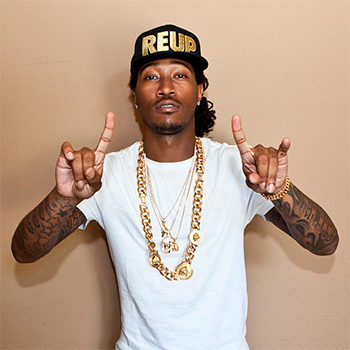
Future is an American rapper, singer, songwriter and record producer from Atlanta. He was born on November 20, 1983, under the name Nayvadius DeMun Wilburn. In 2022, the artist publicly supported reports that he had changed his surname to Cash, although the details of the legal process were never openly disclosed. For this reason, the most accurate approach in biographical materials is to state his birth name and separately mention his later use of the surname Cash.
Future became one of the leading architects of modern trap music. He transformed Auto-Tune from a tool used to smooth vocals into an expressive instrument in its own right, learning to combine rapping, melody, rasping, moaning, whispering and emotionally charged ad-libs within a single performance. His style influenced several generations of artists, from members of the Atlanta scene to international stars of melodic rap. Pitchfork included Future among the most important musicians of the 2010s, emphasising that his influence extends far beyond awards or individual radio hits.
Behind the public image of a cold, self-assured figure drawn to destructive pleasures lies a far more complex songwriter. Future’s music constantly moves between opposites: luxury and loneliness, emotional dependence and deliberate detachment, euphoria and inner exhaustion. His ability to hold these states at the same time has made his work far more enduring than ordinary club music.
As of July 2026, Future has achieved 12 No. 1 albums on the Billboard 200, three Grammy wins from 15 nominations and 245 entries on the Billboard Hot 100. The latter figure is the third-highest total in the chart’s history. His tenth solo studio album, The Real Me, also debuted at the top of the Billboard 200.
Quick Facts
Stage name: Future
Birth name: Nayvadius DeMun Wilburn
Also known as: Nayvadius DeMun Cash
Date of birth: November 20, 1983
Place of birth: Atlanta, Georgia, USA
Hometown neighbourhood: Kirkwood, Atlanta
Occupations: rapper, singer, songwriter, producer
Main genres: trap, Southern hip-hop, melodic rap
Early stage name: Meathead
Other personas and nicknames: Future Hendrix, Pluto
Musical collective: Dungeon Family
Label: Freebandz
Main distributor: Epic Records
Key producer-collaborators: Metro Boomin, Southside, Zaytoven, Mike Will Made-It, DJ Esco, TM88
Number of solo studio albums: 10
Number of No. 1 albums on the Billboard 200: 12
Grammy wins: 3
Major songs: Mask Off, March Madness, Codeine Crazy, Life Is Good, Wait for U, Like That, Low Life, Turn On the Lights
Childhood and Coming of Age in Atlanta
Future grew up in Atlanta, a city that had become one of the most important centres of American hip-hop by the end of the 1990s. He attended Columbia High School in Decatur but did not complete his final year. As a young man, Nayvadius was closer to street life than to a professional music career and initially did not view the recording studio as a realistic path towards a stable future.
A turning point came through his relationship with his cousin Rico Wade, a member of the production team Organized Noize and one of the founders of the Dungeon Family collective. Wade’s studio had welcomed OutKast, Goodie Mob, Killer Mike, CeeLo Green and other artists who helped create a distinct language for Southern rap. For Future, entering this environment was more than an opportunity to approach a microphone: it became a complete education in songwriting.
Future later explained that he saw members of Dungeon Family as people with street backgrounds he understood who had found a legal and creative way to build better lives. The studio became an alternative to his former environment and showed him that rap could be more than a temporary pastime: it could become a profession.
Dungeon Family and the Early Stage Name Meathead
At the beginning of his career, Nayvadius used the stage name Meathead. He was part of the Dungeon Family-affiliated group Da Connect, which worked on its own project under Rico Wade’s guidance.
It was within this group that he began to be called The Future. The nickname was gradually shortened to Future and became his permanent stage name. It proved particularly appropriate: within several years, the artist genuinely became one of the musicians who defined the direction of rap’s development.
Rico Wade taught him not simply to rap verses, but to construct a complete song. The process began with the chorus, followed by the central concept, and only then were the verses written. That discipline remained even after Future adopted a freer, more improvisational recording style. Behind the apparent stream of consciousness in his best songs, there is almost always a carefully calculated melodic centre.
During this early period, Future did not yet use Auto-Tune as the central feature of his sound. His delivery was closer to traditional Southern rap, and his voice sounded considerably more direct. His transformation into a melodic and emotionally unpredictable performer took place gradually.
From Da Connect to a Solo Career
After his period with Dungeon Family, Future came under the mentorship of rapper Rocko, the founder of A1 Recordings. Rocko helped him move from being a member of a group towards solo work and establish relationships with the major music industry.
In 2011, Future signed a deal with Epic Records. For the label, the choice was not accidental: Epic executive Antonio “L.A.” Reid had previously been involved in developing the Atlanta scene and had worked with Organized Noize during OutKast’s rise.
Around the same period, Future created his own imprint, Freebandz. He used it not only to release his own recordings, but also as a platform for affiliated artists and producers. Over the years, Young Scooter, DJ Esco, Doe Boy, Real Boston Richey and other performers have worked with Freebandz.
The Mixtapes 1000, Dirty Sprite and True Story
Future began attracting wider attention through a series of mixtapes. Between 2010 and 2011, he released 1000, Kno Mercy, Dirty Sprite and True Story.
These recordings did not yet possess the full artistic cohesion of his later work, but they already revealed several important qualities:
-
the ability to turn a few words into an addictive chorus;
-
fluid movement between rapping and singing;
-
a guttural and slightly distorted voice;
-
the combination of street bravado with melancholy;
-
unusual pronunciation, allowing the same word to sound different in neighbouring lines.
Future’s first major appearance on a national chart came through rapper YC’s song Racks. Future performed the chorus and effectively created the track’s most memorable element. Pitchfork noted that he pronounced the same word in numerous ways, turning a simple repetition into an evolving melodic construction.
Another important track was Tony Montana from the mixtape True Story. The title referred to the central character of the film Scarface, while the deliberately stretched and indistinct delivery became an early example of Future’s later style. A version featuring Drake was subsequently released.
Streetz Calling and Astronaut Status
In 2011, Future released Streetz Calling, followed by Astronaut Status in early 2012. By this point, he had already become one of Atlanta’s most important new voices.
Songs such as Same Damn Time, Magic, Space Cadets and Birds Take a Bath demonstrated that the artist could create more than memorable guest choruses: he was capable of building a complete world of his own. His characters seemed to exist simultaneously on the street, inside an expensive car, in a nightclub and in some imaginary outer-space environment.
This cosmic imagery later became embedded in the nickname Pluto. Future presented himself as an artist living on a separate planet and operating according to his own rules. The image helped connect the harsh reality of Atlanta with psychedelic and futuristic production.
Pluto: The First Studio Album
Future’s debut album, Pluto, was released in April 2012. It included Tony Montana, Magic, Same Damn Time, Neva End, Turn On the Lights and other songs.
On the album, Future was still searching for a balance between street rap and the wider pop market. Some tracks sounded like extensions of his mixtapes, while others were built around clearer melodies and romantic themes.
His biggest solo hit became Turn On the Lights. Rather than presenting himself as a traditionally confident seducer, Future searched for a woman he could trust. His Auto-Tune-treated voice sounded mechanical and vulnerable at the same time, a combination that later became one of the foundations of modern melodic rap.
Pluto did not top the Billboard 200, but it established the foundation for his later career. GQ described the debut as promising and observed that by the time of his next album, Future was already regarded as a major artist whose new releases were anticipated by the national rap audience.
How Future Changed the Use of Auto-Tune
Processed vocals had already become an important part of hip-hop before Future. T-Pain built a virtuosic R&B style around Auto-Tune, while Kanye West used it to create an emotionally cold sound on 808s & Heartbreak.
Future discovered a different function for the technology. He did not use the effect to make his voice sound cleaner or technically more accomplished. Auto-Tune made his tone rougher, blurred the boundaries between words and allowed him to transform his voice into a synthesizer.
His performances can broadly be divided into several layers:
-
Lyrical: the meaning of a particular line.
-
Rhythmic: how the syllables are arranged within the beat.
-
Melodic: the movement of the vocal pitch.
-
Timbral: rasping, distortion, nasal tones, whispering or shouting.
-
Emotional: the feeling conveyed, which may contradict the literal lyrics.
Future can deliver a line about wealth as though he is experiencing defeat, or describe internal pain with deliberate confidence. This contradiction distinguishes him from many performers who later borrowed only the external features of his style.
Honest: Moving Towards a Larger Pop Sound
Future’s second album, Honest, was released in 2014. Its production was considerably more ambitious than that of his debut, and the guest list included Drake, Kanye West, André 3000, Pharrell Williams, Pusha T, Wiz Khalifa and other artists.
Among its most notable songs were:
-
Honest;
-
Move That Dope;
-
I Won;
-
Covered N Money;
-
Benz Friendz;
-
Blood, Sweat, Tears.
Move That Dope combined hard-edged production by Mike Will Made-It with verses from Pusha T and Pharrell Williams. I Won, featuring Kanye West, presented Future’s more commercial and romantic side, while Benz Friendz with André 3000 reconnected him with his Dungeon Family roots.
The album achieved a strong chart debut and a gold certification, but some fans considered it overly calculated for the major music industry. Future later admitted that on an album called Honest, he himself had not been honest enough.
This dissatisfaction led to one of the most important creative turns in 2010s rap.
Personal Drama and a Change in Artistic Language
While working on Honest, Future was in a relationship with singer Ciara. They became engaged, collaborated musically, and in 2014 welcomed their son Future Zahir. Their relationship ended that same year.
It would be an excessive simplification to treat Future’s subsequent projects as a literal diary of the breakup. However, the emotional crisis coincided with a transformation in his music. The artist abandoned his attempt to please everyone and returned to a more private, dark and uncompromising sound.
Instead of a carefully calculated pop album, he began releasing mixtapes in which trust, romantic intimacy, substance dependence, success and self-destruction existed within the same psychological space.
Monster: The Beginning of a Legendary Series
The mixtape Monster was released in autumn 2014. It became a turning point not only in Future’s career, but also in the development of trap music.
This project fully established his most recognisable character: a wealthy, emotionally damaged man who hides his fear of intimacy behind luxury, sex, drugs and aggression.
The project’s defining track was Codeine Crazy. On the surface, the song describes substance use and nightlife, but its emotional centre lies in the feeling of losing control. Future’s voice gradually stops sounding like a confident rap performance and becomes a painful internal monologue.
This revealed an important characteristic of his work: harmful and destructive behaviour is not always presented as a victory. It often sounds like a symptom of a condition from which the character cannot escape.
Beast Mode with Zaytoven
In January 2015, Future released the mixtape Beast Mode, produced entirely by Zaytoven.
In contrast to the heavy darkness of Monster, this project used more airy keyboards and fluid rhythms. Zaytoven created an atmosphere resembling church music or jazz improvisation, while Future moved freely over the production.
The project demonstrated how strongly his style depends on his interaction with a particular producer. Future does not simply place the same voice over different beats. He adjusts his rhythm, tone and chorus structure to the musical logic of his collaborator.
56 Nights and the Story of DJ Esco
The third part of the unofficial series was the mixtape 56 Nights, created with DJ Esco and Southside.
The title was connected to the story of DJ Esco, who spent 56 nights in prison in Dubai after prohibited substances were discovered in his luggage. Future transformed the story into a dark project about survival, pressure and returning home.
The central track was March Madness. The song did not achieve the chart results that many later Future singles would reach, but it became one of the defining cultural anthems of his career. It simultaneously conveys celebration, street anxiety and reflections on police violence.
The sequence of Monster — Beast Mode — 56 Nights restored Future’s credibility with his core audience and prepared the way for his greatest studio success at that point. GQ described the three projects as a triumphant return after the more divisive Honest period.
DS2: Future’s Definitive Album
DS2, short for Dirty Sprite 2, was released in July 2015 and became Future’s first album to top the Billboard 200.
The record brought the sound of the preceding mixtapes together in a cohesive studio project. Its production involved Metro Boomin, Southside, Zaytoven, Sonny Digital and other key figures in Atlanta trap.
Its central songs included:
-
Thought It Was a Drought;
-
Where Ya At;
-
Freak Hoe;
-
Stick Talk;
-
Slave Master;
-
Blood on the Money;
-
The Percocet & Stripper Joint.
Pitchfork observed that on DS2, Future abandoned his attempts to fit the traditional pop-star model and concentrated his own dark aesthetic to its maximum intensity. Beneath the album’s outward nihilism are feelings of entrapment, dependence and a struggle to maintain control over a deteriorating personality.
DS2 was also important because it proved the commercial viability of music that had previously been considered too dark and regional. After its release, the sound of Atlanta trap permanently ceased to be a niche phenomenon.
Future and Metro Boomin
The collaboration between Future and Metro Boomin became one of the defining creative partnerships in modern rap. One of their earliest major collaborations was Karate Chop in 2013, after which Metro regularly contributed to the artist’s key albums and singles.
Their musical compatibility is based on contrast:
-
Metro creates cold, anxious and spacious production;
-
Future fills that space with an emotionally unstable voice;
-
the bass and drums provide physical energy;
-
melodic details intensify the feeling of nocturnal loneliness.
Metro does more than provide Future with instrumentals. In their best collaborations, the producer constructs a setting in which the artist’s voice becomes the central character.
Their most important songs include Karate Chop, Honest, Monster, Mask Off, Jumpman, Low Life, Type Shit, Like That and We Still Don’t Trust You. The Recording Academy noted that their partnership helped transform trap from a regional Atlanta style into one of the leading international musical movements.
What a Time to Be Alive with Drake
In September 2015, Future and Drake released the collaborative project What a Time to Be Alive. The album emerged while Future was at the peak of his mixtape run and Drake was already one of the world’s biggest stars.
The album topped the Billboard 200 and included:
-
Digital Dash;
-
Big Rings;
-
Diamonds Dancing;
-
Scholarships;
-
Jumpman;
-
Jersey.
Despite the equal billing of both performers, the project’s musical atmosphere largely belonged to Future’s world. Much of the recording took place in Atlanta, while producers Metro Boomin and Southside provided its characteristic dark sound.
Jumpman became the project’s largest mainstream hit, while Diamonds Dancing became one of the two artists’ most emotionally expressive collaborations.
EVOL and Low Life
In February 2016, Future released the album EVOL. Its title is the word love written backwards and reflects the inverted understanding of love found throughout his music.
The only featured performer was The Weeknd, who appeared on Low Life. The track brought together two artists whose personas were built around nightlife, emotional detachment and self-destructive pleasure.
EVOL became Future’s third consecutive album to top the Billboard 200, following DS2 and What a Time to Be Alive.
FUTURE and HNDRXX: Two Sides of One Artist
In February 2017, Future released two albums only one week apart.
The first, FUTURE, primarily represented the artist’s harder trap side. The second, HNDRXX, was more melodic, personal and closely connected to contemporary R&B.
Both projects debuted at No. 1 on the Billboard 200. Future became the first artist in the chart’s history to have two different albums debut at the top in consecutive weeks. HNDRXX replaced his own album FUTURE at No. 1.
The achievement was significant for more than commercial reasons. The two albums explained the structure of his stage persona:
-
Future — a cold, aggressive and street-oriented character;
-
Hndrxx — a melodic songwriter who acknowledges emotional dependence and vulnerability.
The division was not absolute, but it helped listeners understand that Future could make considerably more varied music than the label “mumble rap” suggested.
Mask Off
The biggest hit from FUTURE was Mask Off, produced by Metro Boomin.
The track was built around a flute sample from Tommy Butler’s recording Prison Song. The repeating melody created an almost hypnotic atmosphere, while Future rapped over it with unusual restraint.
The song climbed to No. 5 on the Billboard Hot 100 and became the artist’s most successful solo single at that time.
The success of Mask Off is particularly revealing: its chorus consists of only a few repeated words, yet the voice, rhythm and instrumental loop create far more meaning than the literal lyrics. It remains one of the best examples of Future’s ability to transform minimalism into a mass anthem.
HNDRXX and Future’s Melodic Side
On HNDRXX, the artist sings much more frequently, uses less aggressive arrangements and addresses the consequences of relationships.
Songs such as My Collection, Use Me, Coming Out Strong, Selfish, Sorry and Turn On Me portray a character who desires emotional intimacy but cannot exist within it without control, jealousy and self-destruction.
The album’s title refers to Jimi Hendrix, although Future does not attempt to imitate his music. For him, the Hendrix image represents creative freedom, psychedelia and the right to move beyond genre expectations.
Super Slimey, Beast Mode 2 and WRLD on Drugs
After his double release in 2017, Future continued to work actively on collaborative projects.
Super Slimey, recorded with Young Thug, united two of the most influential experimental figures in Atlanta melodic rap. Their styles differ: Future sounds heavier and darker, while Young Thug is more flexible and unpredictable.
In 2018, Beast Mode 2 with Zaytoven continued the intimate chemistry of their first project.
That same year, Future and Juice WRLD released WRLD on Drugs. The project emphasised Future’s connection with a new generation of performers for whom melodic rap, emotional instability and themes of addiction had already become a familiar language.
The Superfly Soundtrack
In 2018, Future curated the soundtrack for the new version of the film Superfly. He worked as both a performer and producer, assembling music suited to a contemporary interpretation of the crime story.
The soundtrack demonstrated his ability to work not only on a personal album, but also on a broader musical narrative. However, in terms of artistic importance, the project is generally considered less significant than his central solo releases.
The WIZRD
In January 2019, Future released Future Hndrxx Presents: The WIZRD.
The album was perceived as a summary of the first decade of his solo career. Future no longer needed to prove that mixtape intensity could coexist with long-term success. He now appeared as an established artist who had influenced much of the younger rap generation.
Songs including Never Stop, Jumpin on a Jet, Crushed Up, F&N, Promise U That and Krazy but True combined familiar trap aesthetics with reflections on status, legacy and the cost of success.
The WIZRD topped the Billboard 200 and continued Future’s series of No. 1 releases.
His First Grammy Win
Future received his first Grammy Award for his contribution to King’s Dead alongside Jay Rock, Kendrick Lamar and James Blake. The song appeared on the soundtrack to Black Panther and won Best Rap Performance.
Future later received two more awards: one for Wait for U and another for his contribution to Killer Mike’s Scientists & Engineers. He has three wins from 15 Grammy nominations.
For a long time, the number of awards did not reflect the scale of his influence. Future had already transformed the language of rap by the time the Recording Academy began regularly recognising his work.
High Off Life and Life Is Good
The album High Off Life was released in May 2020. Its main commercial driving force was Life Is Good with Drake.
The track is structured like two separate songs combined into one. Drake dominates the first half, while Future enters after the beat switch with a sharper and more street-oriented performance.
Life Is Good peaked at No. 2 on the Billboard Hot 100, but became one of the biggest recordings in Future’s catalogue.
The album itself topped the Billboard 200. It also included Trapped in the Sun, Hard to Choose One, Solitaires, Ridin Strikers, Accepting My Flaws and other songs.
Pluto x Baby Pluto with Lil Uzi Vert
At the end of 2020, Future and Lil Uzi Vert released the collaborative album Pluto x Baby Pluto.
The title emphasised the senior artist’s influence: Future had long used the Pluto persona, while Lil Uzi Vert presented himself as Baby Pluto.
The project demonstrated both continuity and the differences between generations. Uzi used a more animated, colourful and playful style, while Future maintained the project’s heavier and more melancholic centre.
I Never Liked You
Future released I Never Liked You in April 2022. It debuted at No. 1 on the Billboard 200 with 222,000 equivalent album units, at that time the largest opening week for one of Future’s solo albums.
The title continued the image of an emotionally detached character, although the album also contained more vulnerable songs.
The track list included:
-
712PM;
-
I’m Dat N***;
-
Keep It Burnin with Kanye West;
-
For a Nut with Gunna and Young Thug;
-
Puffin on Zootiez;
-
Wait for U with Drake and Tems;
-
Love You Better;
-
Holy Ghost.
Wait for U
Wait for U became Future’s first song as the lead artist to top the Billboard Hot 100.
He had previously appeared on Drake’s No. 1 hit Way 2 Sexy, but Wait for U became his first chart-topper under his own lead billing. The song debuted at the top of the Hot 100 while I Never Liked You simultaneously reached No. 1 on the Billboard 200.
The song uses a vocal sample from Tems’ track Higher. Her voice creates a feeling of distant emotional presence, while Future and Drake describe their inability to maintain intimacy while still demanding patience and loyalty.
Future received a Grammy for Wait for U in the Best Melodic Rap Performance category.
Future as a Symbol of “Toxic” Romance
On social media, Future is frequently reduced to a caricature representing male emotional unavailability. Memes portray him as someone who avoids responsibility, manipulates his partners and turns a breakup into a demonstration of superiority.
This interpretation has some basis in his lyrics, but does not explain them fully. Many Future songs portray not a victor, but a character incapable of building a trusting relationship.
His bravado often serves a defensive function. Behind his declarations of freedom are:
-
a fear of becoming dependent on another person;
-
a feeling of betrayal;
-
an inability to speak openly about attachment;
-
an attempt to suppress emotional pain;
-
an awareness of his own destructive behaviour without the ability to change.
For this reason, Future’s best work can be viewed as a chronicle of distorted masculinity. He does not necessarily condemn his character, but neither does he always portray him as happy.
We Don’t Trust You and We Still Don’t Trust You
In 2024, Future and Metro Boomin released two full-length collaborative albums: We Don’t Trust You and We Still Don’t Trust You.
The first project was primarily trap-oriented, hard-edged and confrontational. The second placed greater emphasis on melody, R&B and atmospheric production.
Both albums debuted at No. 1 on the Billboard 200. The Recording Academy described 2024 as the largest stage of Future and Metro Boomin’s collaboration: the two projects earned them four Grammy nominations.
Like That and the Beginning of 2024’s Biggest Rap Conflict
The centrepiece of We Don’t Trust You was Like That, featuring Kendrick Lamar.
In his verse, Lamar rejected the concept of the so-called “big three,” which usually included himself, Drake and J. Cole. The lines were interpreted as a direct challenge and became the starting point for the most widely discussed rap conflict of 2024.
Like That debuted at No. 1 on the Billboard Hot 100 and remained there for three weeks. It became Future’s third chart-topper after Way 2 Sexy and Wait for U.
Although the public’s attention was largely focused on the conflict between Lamar and Drake, Future and Metro created the platform on which years of indirect tension developed into open musical confrontation.
Mixtape Pluto
In September 2024, Future released Mixtape Pluto. Its title and artwork returned him to his mixtape identity and early cosmic persona.
The project debuted at No. 1 on the Billboard 200, becoming Future’s third chart-topping album in only six months. Billboard noted that no solo artist in the chart’s regular history had achieved three new No. 1 albums so quickly.
All 17 songs from the project entered the Billboard Hot 100. This large-scale chart presence reflects the mechanics of the streaming era, but also demonstrates the unusual stability of Future’s audience: listeners consume not only a few major singles, but complete projects.
The Real Me
Future’s tenth solo studio album, The Real Me, was released on July 10, 2026. The standard edition contains 22 tracks with a total duration of approximately 59 minutes. Titles include F**k A Interview, One Two, No Misery, California Girls, Tank Top Pluto, Konnichiwa and Radio.
Unlike many later albums by major rap artists, the record is focused almost entirely on Future and is not built around a list of celebrity guests. This emphasises the project’s stated idea: revealing the person behind the public character.
However, the title The Real Me does not mean that the artist completely abandons his familiar mask. The album explores the blurred boundary between Nayvadius and Future: the real person and the persona that has existed for more than a decade through displays of wealth, emotional coldness and internal chaos.
Pitchfork noted that the project is less concerned with another breakup than with the psychological consequences of living inside one’s own stage character for many years. Moments of genuine vulnerability exist alongside harshness and the repetition of familiar gender stereotypes.
The Chart Success of The Real Me
The Real Me debuted at No. 1 on the Billboard 200 with 131,000 equivalent album units. Approximately 118,000 came from streaming units based on 120.29 million official on-demand streams of the album’s songs in the United States.
It became Future’s twelfth project to top the Billboard 200. He moved ahead of Eminem, who has 11 chart-topping albums, and took sole possession of third place among rappers by number of No. 1 albums. Only Drake and Jay-Z rank higher.
A total of 17 songs associated with the release appeared on the Billboard Hot 100. Thanks to 16 new debuts, Future’s total number of charting hits reached 245, the third-highest figure in Hot 100 history behind Drake and Taylor Swift.
Recording Method and Creative Productivity
Future is known for working at high speed in the studio. He often records music in extended sessions, improvising melodies and lyrics directly at the microphone.
This does not mean that the songs are created randomly. His early training under Rico Wade gave him a strong understanding of choruses, concepts and structure. Even Future’s free improvisation is supported by many years of songwriting experience.
His working method can be described as accumulative:
-
a large amount of material is recorded;
-
different rhythmic and melodic possibilities are explored through the voice;
-
the strongest fragments are developed into choruses;
-
songs are grouped according to atmosphere;
-
an album or mixtape is assembled from them.
This approach allows Future to release several projects within a short period without repeating exactly the same emotional tone.
Influence on the New Generation
Traces of Future’s style can be heard in Lil Uzi Vert, Lil Baby, Gunna, Juice WRLD, Desiigner and many other artists. Future himself has claimed that he created a vocabulary from which later performers borrowed melodies, verse structures and ad-libs.
This influence does not mean that every one of these musicians is a direct copy of him. Rather, Future expanded the range of acceptable expressive tools in rap:
-
a man can sound emotionally broken without turning to a traditional ballad;
-
Auto-Tune can intensify roughness rather than merely smooth the voice;
-
a song can be melodic without conventional singing;
-
an internal crisis can exist inside a club hit;
-
a mixtape can possess the artistic value of a complete album.
Future has maintained a rare position: he is a senior and highly influential performer who continues to be viewed as a competitor to the current generation.
He does not exist separately from new trends, returning only for anniversary projects. Instead, Future regularly appears on recordings by younger artists and adapts his delivery to their musical worlds.
GQ noted that performers from the new generation continued to regard him not only as a historical figure, but also as a contemporary colleague and rival.
Personal Life
Future’s personal life has regularly become the subject of media reports, legal disputes and social-media discussion.
It is reliably known that he was engaged to Ciara and is the father of their son Future Zahir, born in 2014. The artist also has other children, although the exact number varies across public sources.
Charitable Work
Future and members of his family operate the FreeWishes Foundation. The organisation works in education, healthcare, social services and programmes aimed at increasing independence and opportunity within local communities.
The foundation has organised events for Atlanta families, awarded educational scholarships and supported healthcare workers during the COVID-19 pandemic. In 2020, FreeWishes worked with local seamstresses to produce protective masks for hospitals.
This activity rarely becomes a central part of Future’s public image, but it adds another dimension to an artist whose connection to Atlanta extends beyond musical aesthetics.
Future’s Most Important Songs
Turn On the Lights
One of the first solo songs to establish Future as a writer of vulnerable melodic rap. The romantic lyrics do not sound gentle, but anxious and almost desperate.
Same Damn Time
A street anthem built around the simple idea of existing in several modes simultaneously. The song helped establish Future as a master of short and instantly recognisable choruses.
Codeine Crazy
One of the deepest songs in his catalogue. Behind the drug imagery lie loss of control, emotional dependence and an attempt to suppress internal pain.
March Madness
A cult recording that combined club energy with anxiety, political imagery and a feeling of instability on American streets.
Where Ya At
A collaboration with Drake about people who appear only after success has been achieved. One of the main singles from DS2.
Low Life
A dark duet with The Weeknd combining trap and alternative R&B.
Mask Off
Future’s most recognisable solo hit of the 2010s. Its flute loop, minimalist chorus and detached delivery turned the song into an international phenomenon.
Life Is Good
A two-part collaboration with Drake that became one of Future’s biggest commercial hits.
Wait for U
Future’s first chart-topper as the lead artist. The melodic song featuring Drake and Tems earned him a Grammy.
Like That
A collaboration with Metro Boomin and Kendrick Lamar that topped the Billboard Hot 100 and triggered the biggest rap conflict of 2024.
Future’s Solo Studio Albums
-
Pluto — 2012
-
Honest — 2014
-
DS2 — 2015
-
EVOL — 2016
-
FUTURE — 2017
-
HNDRXX — 2017
-
Future Hndrxx Presents: The WIZRD — 2019
-
High Off Life — 2020
-
I Never Liked You — 2022
-
The Real Me — 2026
Key Mixtapes
-
1000;
-
Kno Mercy;
-
Dirty Sprite;
-
True Story;
-
Streetz Calling;
-
Astronaut Status;
-
Monster;
-
Beast Mode;
-
56 Nights;
-
Purple Reign;
-
Beast Mode 2;
-
Mixtape Pluto.
Main Collaborative Projects
-
Free Bricks — with Gucci Mane;
-
What a Time to Be Alive — with Drake;
-
Super Slimey — with Young Thug;
-
WRLD on Drugs — with Juice WRLD;
-
Pluto x Baby Pluto — with Lil Uzi Vert;
-
We Don’t Trust You — with Metro Boomin;
-
We Still Don’t Trust You — with Metro Boomin.
Future Albums That Reached No. 1 on the Billboard 200
As of July 2026, the following projects had topped the Billboard 200:
-
DS2;
-
What a Time to Be Alive;
-
EVOL;
-
FUTURE;
-
HNDRXX;
-
The WIZRD;
-
High Off Life;
-
I Never Liked You;
-
We Don’t Trust You;
-
We Still Don’t Trust You;
-
Mixtape Pluto;
-
The Real Me.
Future Songs That Topped the Billboard Hot 100
Way 2 Sexy
Drake’s song featuring Future and Young Thug became the first No. 1 hit of Future’s career. Before that, he had appeared on the chart 125 times, which at the time represented the longest wait for a first chart-topper by number of entries.
Wait for U
Future’s first No. 1 as the lead artist. The recording featured Drake and Tems.
Like That
The collaborative single by Future, Metro Boomin and Kendrick Lamar spent three consecutive weeks at No. 1.
Grammy Awards
Future has received three Grammy Awards:
-
King’s Dead — Best Rap Performance;
-
Wait for U — Best Melodic Rap Performance;
-
Scientists & Engineers — Best Rap Performance.
As of 2026, the artist had received a total of 15 nominations.
Why Future’s Music Outlived the “Mumble Rap” Trend
Many artists associated with the “mumble rap” wave remained tied to a particular era. Future outlasted it because his music was never based solely on unusual pronunciation.
At the heart of his best recordings are:
-
a strong sense of melody;
-
the ability to create choruses;
-
a recognisable emotional conflict;
-
careful selection of producers;
-
the ability to change style while preserving his identity;
-
an understanding of an album as a separate psychological world.
For this reason, Monster, DS2, HNDRXX and The Real Me sound different from one another while remaining the work of the same author.
Editorial Conclusion
Future’s story is not simply that of a rapper who managed to repeat one commercially successful formula many times. His career represents a continuous expansion of the possibilities of the human voice within hip-hop.
Rico Wade taught him how to construct songs. Atlanta’s mixtape scene taught him to work quickly. Auto-Tune allowed him to turn vocal tone into an independent instrument. Metro Boomin, Zaytoven, Southside and other producers helped reveal different sides of his musical personality.
Future made dark emotionality compatible with club energy. He learned to describe loneliness in a way that allowed thousands of people to shout the chorus together. He created a character who appears to possess everything, yet rarely feels satisfied internally. He then transformed the tension between the person and that character into the foundation of a long-running discography.
His influence can be heard not only in the voices of other rappers. It is also present in the structure of the modern music industry: the rapid pace of releases, the blurred boundary between albums and mixtapes, the central role of producer partnerships and the freedom to move from rapping to singing within a single line.
By July 2026, Future had already taken his place among the most commercially successful artists in the history of the Billboard 200. Yet his primary legacy cannot be measured by 12 No. 1 albums. It lies in the fact that after Future, the rap voice gained the right to sound powerful, distorted, melodic, cruel, vulnerable and emotionally unresolved all at once.