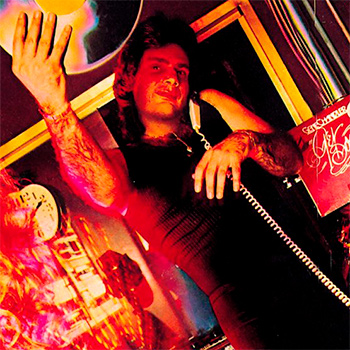
Francis Grasso (25 March 1948, Brooklyn, New York — 20 March 2001, New York) was an American DJ and one of the key pioneers of modern club DJing. In the late 1960s and early 1970s, he helped transform the act of playing records from a sequence of separate songs into a continuous musical performance: he developed beatmatching, used headphone cueing, brought slip-cueing techniques from radio practice into the club environment, and structured long sets as carefully controlled journeys across the dancefloor.
Grasso worked at New York clubs including Salvation II, Tarots, Sanctuary and The Haven before disco had fully emerged as a distinct musical genre. His influence is not associated with his own hit singles or studio albums, but with fundamental principles of DJ performance that would later become standard across disco, house, techno and virtually all of modern club culture.
Brooklyn, dancing and the path to DJing
Francis Grasso was born and raised in Brooklyn. As a young man, his professional ambitions had little to do with club music: he studied, was interested in literature and spent some time working in other fields. His route into New York nightlife began through dancing.
According to Grasso’s own recollections, several serious motorcycle accidents left him with coordination problems, and a doctor recommended dancing as part of his recovery. What began almost as a form of therapy unexpectedly led him into the club world.
Grasso became one of the dancers at the famous Trude Heller's in Greenwich Village. He danced on small platforms close to the audience while bands performed live. The experience later proved crucial: Grasso understood music first and foremost from the perspective of someone on the dancefloor and developed an intuitive sense of how rhythm affected movement.
Salvation II and the accidental beginning of a career
Francis Grasso’s DJ career began around 1967–1968 at the New York club Salvation II. One night, the club’s resident DJ, Terry Noel, failed to appear at the start of his shift, and the owners asked Grasso to try taking over the turntables.
By modern standards, the technical setup was extremely basic: two Rek-O-Kut turntables and a control that allowed the operator to switch or move between the two signal sources. At the time, the records usually belonged to the club rather than the DJ.
Grasso already knew popular music well and understood how the dancefloor reacted. His first shift was a success, and after Terry Noel eventually arrived late, the job was offered to the new DJ.
The episode marked the beginning of Grasso’s professional career, although at the time he could hardly have known that he was about to take part in the development of an entirely new form of musical performance.
What a DJ was before Francis Grasso
To understand Grasso’s importance, it is necessary to remember how different the role of a club DJ was in the late 1960s. The basic task was usually to play an appropriate record, let it finish and then put on the next one. Transitions could be abrupt, and the dancefloor effectively had to rebuild its rhythmic momentum after each change.
Mixing records existed before Grasso. His predecessor Terry Noel had already experimented with overlapping tracks, so the claim that Francis Grasso simply “invented mixing two records” is historically too simplistic.
Grasso’s revolution lay elsewhere: he made rhythmic continuity and the dramatic arc of the entire set central responsibilities of the DJ. Music no longer had to feel like a sequence of separate requested songs; it could become a single flow that the performer could accelerate, slow down, intensify and reshape emotionally.
Tarots and the road to Sanctuary
After Salvation II closed, Grasso spent some time without a permanent club job and worked, among other things, servicing air-conditioning systems. He later found himself at Tarots on Union Square and offered the owners a chance to hear what he could do behind the decks.
The equipment there was even more primitive: instead of a proper transition control, there was simply a switch between two turntables. Even so, Grasso continued developing his sequencing skills and practising fast, rhythmically coherent transitions between records.
It was at Tarots that an employee from Sanctuary heard him and invited him to audition. According to Grasso, only a handful of records were needed for him to get the job. Sanctuary soon became the defining club of the first major phase of his career.
Sanctuary — a laboratory for modern DJing
Sanctuary was located on West 43rd Street in Manhattan inside a former church. The DJ booth occupied an unusual space near what had once been the altar, adding to the theatrical atmosphere of the club.
Sanctuary’s original audience was largely heterosexual and consisted in significant part of couples. After a change of ownership and the events surrounding the Stonewall uprising, the club shifted towards a gay audience in 1969–1970 and became one of the landmark spaces of early New York dance culture.
For Grasso, the change in audience had musical consequences. The dancefloor became more intense and demanded much longer periods of continuous movement. Instead of alternating fast records with slow songs, the DJ could maintain a high energy level for hours.
It was in this environment that Grasso fully developed the idea of the DJ set as an independent work in its own right.
Beatmatching
The technical innovation most closely associated with Francis Grasso is beatmatching. The principle is to prepare the next record so that its rhythm matches the rhythm of the record already playing. The two tracks can then be layered together and transitioned without breaking the pulse of the dancefloor.
Today, this seems like an elementary part of DJing. In the late 1960s, however, the task was far more difficult. Dance records were played by live drummers, meaning the tempo within a single song could naturally speed up or slow down. There was no digital synchronisation, automatic tempo analysis or modern turntable technology with precise pitch control.
Grasso had to listen to both records simultaneously, manually track any rhythmic drift and choose the transition point entirely by ear and even by reading the groove patterns on the vinyl.
As a result, the transition was no longer just a technical pause between two songs. It became a musical event in itself.
Did Francis Grasso really invent beatmatching?
The phrase “Francis Grasso invented beatmatching” appears frequently in popular histories of electronic music, but a more historically precise description is that he was one of the first systematic practitioners and the most important early populariser of beatmatching in club culture.
DJs had experimented with overlapping records before him. Grasso, however, consistently used rhythmic alignment to preserve continuous movement on the dancefloor and demonstrated just how far the technique could be developed.
His importance therefore lies not in a single moment of “invention,” but in transforming a new approach to mixing into a complete performance language.
Slip-cueing: another important historical nuance
Francis Grasso is also closely associated with the technique known as slip-cueing. The DJ holds the vinyl record still while the turntable platter continues to rotate underneath it, then releases the record at exactly the chosen moment. This allows the music to begin almost instantly from the required point and at the correct speed.
Grasso is sometimes described as the inventor of slip-cueing, but that is not entirely accurate. He himself said that he learned the method from radio DJ Bob Lewis. Similar techniques had already been used in broadcasting.
Grasso’s historical contribution was that he adapted and developed the practice for the dance club, combining it with headphone cueing, mixing and control of the dancefloor’s rhythm.
Headphones as a working tool for the DJ
Another fundamental element of his approach was the use of headphones to preview the next record.
For a modern DJ, it is difficult to imagine working without a separate cue channel. In early club culture, however, the necessary equipment had not yet become a standard feature.
Grasso used the ability to hear the next record separately from what the audience was hearing. This allowed him to locate the correct section, identify its rhythm and prepare the exact entry point.
The combination of two turntables, a mixer, headphones and a cued next record effectively contains the basic architecture of the traditional DJ workstation that would remain in use for decades.
Why his technique was so difficult
In the digital DJ era, two tracks can be synchronised automatically with great precision. Grasso worked with vinyl recordings played by live musicians.
Even if two songs began at roughly the same tempo, they could drift apart after just a few bars. The DJ therefore had to monitor both records constantly and keep correcting the transition.
Early beatmatching was therefore not a mechanical process of matching two BPM numbers, but an almost continuous exercise in critical listening.
Particularly impressive were the moments when Grasso held two records together for long enough to create a new combination of rhythms, instruments and vocal elements.
Musical programming was more important than technique
Reducing Francis Grasso’s contribution to beatmatching alone would, however, be a mistake. Equally important was his approach to musical programming.
Grasso observed the dancefloor as a living system. He could gradually increase the intensity of the material, drive the crowd towards an emotional peak, then reduce the pressure before building the energy again later.
In his view, the next record was not chosen simply because it was a popular hit on its own. It was selected because, at that exact moment, it continued the story begun by the previous track.
This helped establish a principle that would later become fundamental to club culture: a DJ does not play individual songs — a DJ plays the entire night.
What Francis Grasso played
The term “disco DJ” requires some historical qualification when applied to Grasso. When he began his career, disco did not yet exist as a clearly defined genre.
His musical range was extraordinarily broad. A single set could include soul, funk, rhythm and blues, psychedelic rock, Latin music and African rhythms.
Among the artists Grasso recalled playing in his sets were James Brown, The Temptations, The Four Tops, The Supremes, The Staple Singers, Led Zeppelin, Brian Auger & The Trinity and many others.
One of his key club records was You're the One by Little Sister. James Brown’s Hot Pants also played an important role. He used I'll Take You There by The Staple Singers and could even work Led Zeppelin’s Immigrant Song into a dance set.
For Grasso, genre labels were secondary. What mattered most was rhythm, groove and the way a particular record affected people in a particular moment.
Rock inside early dance culture
To a modern listener, the presence of Led Zeppelin and other rock music in the history of disco may seem unusual. But club culture at the turn of the 1960s and 1970s had not yet been divided into rigid genre categories.
Grasso could connect a heavy rock drum pattern with soul or funk if the tracks provided the rhythmic continuation he needed. He was interested in the physical energy of a record rather than the marketing category under which it was sold.
This freedom of programming became one of the defining principles of the early New York DJ school and later appeared in the work of many great club selectors.
African and Latin rhythms
Records with prominent percussion played an important role in Grasso’s sets. New York dance culture was developing in a city where African American, Latin American, Caribbean and European musical traditions constantly intersected.
Grasso actively used records in which drums and percussion could become the central element of a composition. This approach helped gradually shift the focus of club music away from the traditional song format towards rhythm as a value in its own right.
That logic would later become fundamental to disco, then house and many other forms of electronic dance music.
The DJ becomes a performer
Before the arrival of a new generation of club DJs, the person behind the turntables was often a secondary figure. Audiences came primarily for the venue, the social experience and familiar songs.
Francis Grasso helped change that relationship. People began coming on particular nights because he was the person behind the decks.
In this context, the DJ ceased to be merely a member of the club staff and became an author of the musical experience. He determined the sequence of music, controlled the emotional pace of the night and developed a recognisable personal style.
This idea seems natural in an era of international DJ tours and festival headliners, but at the turn of the 1960s and 1970s it represented a radical transformation of the profession itself.
Sanctuary and the formation of disco culture
The history of Sanctuary is also important because the club existed at the moment when a new urban culture was developing in the aftermath of Stonewall. Grasso recalled being at The Haven on the night of the Stonewall uprising in the summer of 1969.
After this period, open dance spaces serving gay audiences became crucial laboratories for New York’s emerging club culture. Music could be played longer, louder and more freely than in traditional venues built around couples.
The intensity of these dancefloors directly influenced the development of DJ methods. The need to maintain uninterrupted movement encouraged longer mixes, improvements in sound systems and the search for records with powerful rhythmic sections.
The film Klute and a rare visual record of the era
Sanctuary also became connected with film history. Scenes from director Alan J. Pakula’s Klute, starring Jane Fonda and Donald Sutherland, were filmed inside the club.
Grasso recalled being behind the DJ booth during the shoot and spending several weeks combining film work with his regular night shifts at the club.
For the history of club culture, this episode is particularly interesting because relatively few photographs and film recordings survive from the earliest period of New York DJing.
Sound systems, Alex Rosner and Richard Long
Grasso took the technical side of club sound extremely seriously. He believed that the quality of a DJ’s performance was directly limited by the capabilities of the equipment.
During this period, engineers Alex Rosner and Richard Long were developing New York’s club sound infrastructure. Grasso worked with systems and equipment they designed and refined, and he took an active interest in discussions about what a DJ actually needed during a performance.
He was especially close to Richard Long, who would later become one of the most important engineers in American club culture and create celebrated sound systems for leading New York venues.
The early history of DJing therefore developed in two directions at the same time: the performer’s technique was evolving while the equipment required to realise that technique was also being improved.
Influence on other DJs
Grasso’s methods quickly began to spread throughout the New York scene. He personally named Michael Cappello and Steve D'Acquisto among his students.
From there, the new culture developed collectively. David Mancuso created long musical journeys at The Loft and placed particular emphasis on sound quality. Nicky Siano developed the dramatic possibilities of mixing and worked with multiple turntables. Walter Gibbons experimented with breaks and custom edits of records. Later, Larry Levan transformed many of these ideas into the unique musical language of Paradise Garage.
Francis Grasso was not the sole creator of modern club culture, but he stood very close to the beginning of that chain.
Club Francis
Around 1974, Grasso opened his own venue, Club Francis, on MacDougal Street above the historic Cafe Wha? in Greenwich Village.
By then, the club industry was already changing rapidly. Music that DJs had once been forced to discover among soul, funk, rock and imported records was gradually becoming a distinct commercial market for dance recordings.
For a pioneer accustomed to building completely unexpected musical combinations, the standardisation of disco was an ambiguous development.
Why Grasso became disillusioned with commercial disco
By the middle of the 1970s, when disco had become an independent mass-market genre, Grasso had already developed a critical attitude towards the new sound.
He felt that much of the commercial output had become too uniform: a consistent dance beat made a DJ’s work easier, but also reduced the musical unpredictability that had attracted him to the early clubs.
There is a certain historical irony in this. The techniques he helped develop contributed to creating the environment in which disco could flourish, yet once the industry began deliberately producing records with stable rhythms designed to be easy to mix, Grasso himself found the new formula too simple and standardised.
Leaving active DJing
By the end of the 1970s, Grasso had gradually stepped away from regular club work. The main professional phase of his career effectively ended before the DJ became a major international figure in show business.
This is one reason his name remained less familiar to the general public for so long than those of DJs from the following generation. He did not become a famous producer, release a series of commercial albums or build a career around his own recording brand.
By the time house and techno had made DJ mixing a global practice, one of the people who had helped establish the foundations of that performance language was already largely absent from the contemporary club industry.
Francis Grasso and the absence of a traditional discography
In the case of Francis Grasso, a conventional “discography” section would be historically misleading. He belonged to an era when a DJ primarily played other people’s records and created a new musical flow from them directly inside the club.
Grasso did not leave behind a body of studio albums or singles comparable to the discography of a modern DJ-producer. His work was the set itself: the sequence of records, the transitions, the layering and the response to a particular audience.
Much of this art existed only in the moment of performance and was never professionally recorded. This is why the legacy of early club DJs is considerably harder to document than that of conventional recording artists.
Historical recordings of his sets
A small number of amateur recordings of Grasso’s performances from the early 1970s have survived, particularly those associated with Sanctuary. Their technical quality is far removed from that of modern live recordings, but their historical value is enormous: they make it possible to hear club DJing at the moment when its basic language was still being formed.
For researchers of electronic music, these recordings are valuable not so much for the individual tracks selected as for the way Grasso connected them, worked with duration and fearlessly brought together music from different genres.
Renewed interest in Francis Grasso
In the late 1990s, club culture historians Bill Brewster and Frank Broughton, while working on the history of DJing, tracked Grasso down in Brooklyn.
On 4 February 1999, Frank Broughton recorded an extensive interview with him. It became one of the most important primary sources on the origins of modern DJing because Grasso spoke in detail about Salvation II, Sanctuary, The Haven, early turntables, mixing techniques, music and the people who shaped the first generation of the club scene.
The interview is especially valuable because many popular legends can be compared directly with Grasso’s own account. He himself explained, for example, that he had not invented slip-cueing from scratch: he learned the principle from someone connected with radio broadcasting and then developed it further in the club environment.
Maestro
Grasso’s story also appears in the documentary Maestro, directed by Josell Ramos. The film explores the rise of New York’s underground dance culture and also features the stories of David Mancuso, Larry Levan, Nicky Siano and other key figures from the scene.
The film was released after Grasso’s death and helped restore his name to the historical narrative surrounding the origins of modern club culture.
Death
Francis Grasso died in New York on 20 March 2001, just a few days before his 53rd birthday. He was 52 years old.
His death came at precisely the moment when researchers and a new generation of DJs were beginning to reconstruct the history of the early club scene and to understand the scale of his contribution far more clearly.
From Grasso to modern electronic music
There is an enormous technological distance between Francis Grasso and the modern festival DJ, but the underlying logic of the work has remained remarkably similar.
A DJ listens to one track while the audience hears another. The DJ identifies the right moment to transition, synchronises musical structures and uses the sequence of recordings to control tension on the dancefloor.
Vinyl turntables later gained precise pitch control; specialised mixers, Technics SL-1200s, CD players, digital systems, software and automatic synchronisation followed. But the fundamental idea of the continuous set had been established much earlier.
It is on this level that Grasso’s contribution continues to exist in virtually every modern DJ booth.
Francis Grasso’s place in the history of DJing
Francis Grasso’s importance cannot be measured in record sales or chart positions. His own career began before disco had fully emerged and ended long before the global explosion of electronic dance music.
His legacy was the very grammar of DJ performance.
Before this revolution, the DJ primarily selected records. Afterwards, records could become raw material for the DJ’s own performance. Two finished compositions could be transformed into elements of a larger form created by a performer in real time, directly in front of the dancefloor.
Grasso also helped change the status of the profession. Audiences could come to a club specifically to hear a particular DJ, trusting that person to choose the music and shape the direction of the entire night. This model would later become central to clubs such as Paradise Garage, The Warehouse, Studio 54, Ministry of Sound, Space, Berghain and the global culture of DJing as a whole.
Francis Grasso therefore occupies a unique position between two eras. He was not yet an electronic producer in the modern sense and worked with soul, funk, rock and records driven by live drummers. But the way he connected that music already belonged to the future.
That is his historical significance: Francis Grasso did not invent the DJ, but he helped transform the person who played records into a performer capable of controlling music, time and the dancefloor.