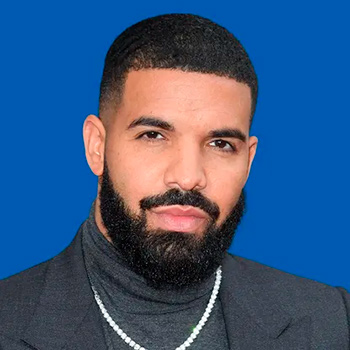
Drake (full name — Aubrey Drake Graham; born October 24, 1986, in Toronto, Canada) is a Canadian rapper, singer, songwriter, producer and actor, and one of the most commercially successful figures in 21st-century popular music. He made the fluid transition between rap and melodic R&B one of the foundations of his style and significantly influenced the way these forms are combined in contemporary popular music. The Recording Academy has described his career as one of those that noticeably changed the development of rap in the 21st century.
Among Drake’s best-known songs are Best I Ever Had, Forever, Over, Find Your Love, Headlines, Marvins Room, Take Care, The Motto, Started from the Bottom, Hold On, We're Going Home, Hotline Bling, One Dance, Controlla, Passionfruit, God's Plan, Nice for What, In My Feelings, Nonstop, Toosie Slide, Laugh Now Cry Later, What's Next, Way 2 Sexy, Jimmy Cooks, Rich Flex, First Person Shooter, Slime You Out, NOKIA and Janice STFU. His catalog spans rap, R&B, pop, trap, dancehall, Afrobeats, house, British club music and other styles.
By 2026, the scale of his chart career had become unprecedented. Following the simultaneous release of the albums ICEMAN, HABIBTI and MAID OF HONOUR, Drake became the first artist in history to occupy all three top positions of the Billboard 200 at the same time. He also reached 402 entries on the Billboard Hot 100, including a record 90 Top 10 hits, while ICEMAN became his fifteenth No. 1 album on the Billboard 200.
Toronto, Memphis and family
Aubrey Drake Graham was born on October 24, 1986, in Toronto. His father, Dennis Graham, is a musician from Memphis who played drums and performed for a time with Jerry Lee Lewis. His mother, Sandi Graham, worked as a teacher. After his parents divorced, Drake lived primarily with his mother in Toronto but also spent time with his father in Memphis.
The musical background on his father’s side of the family was especially notable. Dennis Graham’s brother, Larry Graham, became a well-known bassist with Sly and the Family Stone and later worked with Prince. Another relative was guitarist and songwriter Mabon “Teenie” Hodges, associated with classic recordings by Al Green.
Drake grew up in Toronto in a family with African American and Canadian Jewish roots. In his youth, he attended Forest Hill Collegiate Institute and Vaughan Road Academy, while Toronto’s musical culture existed alongside regular trips to Memphis. This dual geography would later be reflected in his music: he was never tied to a single traditional regional school of American rap.
Degrassi: acting career before music
Aubrey Graham first became professionally known not through music, but through acting. In 2001, he was cast as Jimmy Brooks in the Canadian teen series Degrassi: The Next Generation. His character was a high school basketball player who becomes paralyzed after a school shooting and is forced to use a wheelchair. Drake remained on the series until the end of the 2000s and was already well known to Canadian television audiences before his first major musical hits.
Working on Degrassi gave him unusual experience for an aspiring rapper: years in front of the camera, regular filming schedules, public appearances and an understanding of the entertainment industry. At the same time, he began writing his own lyrics and recording music.
Room for Improvement and Comeback Season
His first mixtape, Room for Improvement, was released in 2006. On these early recordings, Drake was primarily a rapper, while the vocal side that would later become central to his style was only beginning to take shape. The following year he released Comeback Season through his own October's Very Own structure.
One of the notable tracks from this period was Replacement Girl with Trey Songz. These early recordings attracted the attention of Jas Prince, who introduced Drake’s music to rapper Lil Wayne. That connection became decisive for the next stage of his career.
So Far Gone and the first major breakthrough
In February 2009, Drake released the mixtape So Far Gone. It was this project that transformed the Canadian actor and aspiring rapper into one of the most discussed new artists on the North American scene.
The main hit was Best I Ever Had, which reached No. 2 on the Billboard Hot 100. That same year, Drake appeared alongside Kanye West, Lil Wayne and Eminem on Forever, which reached No. 8. Before even releasing his first official studio album, he had already scored two US Top 10 hits.
So Far Gone made much clearer the quality that would later define his music: Drake could rap, shift into near-conversational singing and then combine both approaches within a single track. Instead of always bringing in a guest R&B vocalist, he increasingly performed the melodic parts himself.
Noah “40” Shebib and the formation of Drake’s sound
One of the main architects of Drake’s musical language became Toronto producer and engineer Noah “40” Shebib. Their recordings were built around restrained rhythms, deep low frequencies, muted textures and large amounts of open space between instruments.
This production style suited Drake’s delivery perfectly: his voice could exist somewhere between speech, rap and singing without requiring a dramatic change in arrangement. The Drake–40 partnership continued through virtually his entire later career and became an important part of the recognizable sound of Toronto’s modern R&B and rap scene. 40 later became one of the founders of OVO Sound together with Drake and Oliver El-Khatib.
Lil Wayne and Young Money
After meeting Lil Wayne, Drake began performing with him and entered the orbit of Young Money Entertainment. The agreement became official in 2009. Nicki Minaj was also developing her career there, and Young Money quickly became one of the leading rap crews of the early 2010s.
Drake and Lil Wayne later recorded dozens of collaborations. Among the best known are Miss Me, The Motto, HYFR, She Will and Right Above It. Yet even by the time of his first album, Drake already had such a large audience of his own that he quickly moved beyond the status of Wayne’s protégé.
Thank Me Later
Drake’s first studio album, Thank Me Later, was released in 2010 and immediately topped the Billboard 200. It included Over, Find Your Love, Miss Me and Fancy. Find Your Love reached the Top 5 of the Billboard Hot 100.
It was already clear that Drake had no intention of choosing between rap and R&B. Over represented his more direct rap side, while Find Your Love was built almost entirely around vocal melody.
However, his own artistic model would only become fully realized on the next project.
Take Care
Take Care, released in 2011, became one of the defining albums of Drake’s career. Here, cold synthesizers, slow rhythms, R&B and rap no longer existed as separate genre sections but as a single sonic environment.
Key tracks include Headlines, Marvins Room, Take Care, Crew Love, Make Me Proud, HYFR and The Motto. Marvins Room is especially characteristic: a dark song about jealousy, loneliness and a late-night call to an ex-partner. Emotional openness had existed in hip-hop long before Drake, but he made it a permanent foundation of an exceptionally large-scale commercial rap career.
Part of the material was created with The Weeknd, who at the time was only beginning to emerge from Toronto’s underground R&B scene. Their interaction became one of the important episodes in the history of modern Toronto music.
Take Care won the Grammy for Best Rap Album, giving Drake his first Recording Academy victory.
The Motto and YOLO
One of the most noticeable cultural traces of the era came from The Motto with Lil Wayne. The song helped popularize the abbreviation YOLO — You Only Live Once. The phrase itself had existed earlier, but after The Motto it became one of the most recognizable internet and conversational expressions of the early 2010s.
Nothing Was the Same
In 2013, Drake released his third studio album, Nothing Was the Same. If Take Care revolved around emotional uncertainty, the new album sounded significantly tougher and more self-assured.
Started from the Bottom became one of the major rap hits of the period. The opposite side of the album was represented by Hold On, We're Going Home with Majid Jordan — an almost pure R&B and pop track with synthesizer production recalling the 1980s.
The album also included Tuscan Leather, Furthest Thing, Worst Behavior, From Time, Too Much and Pound Cake / Paris Morton Music 2. The coexistence of Started from the Bottom and Hold On, We're Going Home on the same record demonstrates how freely Drake was already moving between rap and song-oriented pop music.
OVO Sound
In 2012, Drake, Noah “40” Shebib and Oliver El-Khatib founded OVO Sound. The name grew out of October's Very Own, a designation Drake had used long before achieving worldwide fame.
Over the years, PARTYNEXTDOOR, Majid Jordan, dvsn, Roy Woods, Naomi Sharon and other artists became associated with OVO Sound. The broader OVO brand also expanded into OVO Fest, clothing, radio projects and other ventures.
Toronto itself became just as important an element. Drake repeatedly used the city’s landscape, local references and the designation “The 6”, turning his hometown into part of his musical identity.
If You're Reading This It's Too Late
In February 2015, If You're Reading This It's Too Late appeared without a traditional long promotional campaign. The project was considerably harder than Take Care and Nothing Was the Same and was much more strongly focused on rap.
Its most notable tracks included Legend, Energy, 10 Bands, Know Yourself, No Tellin', 6 God, Star67 and 6PM in New York. The project debuted at No. 1 on the Billboard 200.
Know Yourself proved especially enduring: a line about driving around Toronto became one of Drake’s most recognizable live moments.
What a Time to Be Alive
In September of the same year, Drake released the collaborative project What a Time to Be Alive with Future. Its musical foundation came from Atlanta trap, with Metro Boomin playing an important production role.
The record included Digital Dash, Big Rings, Jumpman, Scholarships and Diamonds Dancing. It also topped the Billboard 200 and demonstrated how easily Drake could adapt his own delivery to another artist’s musical environment.
Hotline Bling
Hotline Bling also arrived in 2015, built on material from Why Can't We Live Together by American musician Timmy Thomas. The song reached No. 2 on the Billboard Hot 100.
An even larger cultural impact came from the music video directed by Director X: Drake’s movements, minimalist colored sets and unusual choreography generated an enormous number of internet memes.
In 2017, Hotline Bling brought him two Grammys — for Best Rap/Sung Performance and Best Rap Song.
Views and One Dance
Drake’s fourth studio album, Views, was released in 2016. The cover, showing Drake atop the CN Tower, emphasized his connection with Toronto, although musically it became one of the most international releases of his career.
The main hit was One Dance with Wizkid and Kyla, combining pop, dancehall, Afrobeats and house. It became Drake’s first No. 1 on the Billboard Hot 100 as a lead artist.
Controlla, Too Good, Feel No Ways and Childs Play also became highly popular. Views spent 13 weeks at No. 1 on the Billboard 200 — longer than any other Drake album.
More Life
In 2017, Drake released More Life, describing it not as a conventional album but as a “playlist.” The format reflected his desire to place a wide range of musical styles within a single project.
Trap, R&B, British grime, dancehall, Afrobeats and house appeared side by side. Key recordings included Passionfruit, Free Smoke, Portland, Sacrifices, Blem, Teenage Fever and Do Not Disturb.
Passionfruit proved particularly enduring — a restrained song built around a soft club rhythm, almost the opposite in structure of a traditional large-scale rap single.
More Life spent three weeks at No. 1 on the Billboard 200. That same year, Drake won 13 Billboard Music Awards in a single ceremony, setting what was then a record for the show.
2018: God's Plan, Nice for What and Scorpion
The beginning of 2018 became one of the most commercially powerful periods of Drake’s career. God's Plan debuted directly at No. 1 on the Billboard Hot 100. Nice for What followed with the same result.
In June, Drake released the double album Scorpion. The first half leaned more heavily toward rap, while the second focused more on R&B. Alongside God's Plan and Nice for What, it included Nonstop, Emotionless, Mob Ties, Jaded, In My Feelings, Don't Matter to Me and March 14.
In My Feelings became the third track from this period to top the Hot 100 and gained additional mass popularity through a viral dance trend on social media.
Scorpion spent five weeks at No. 1 on the Billboard 200. At the time of its release, its songs occupied seven positions in the Hot 100 Top 10 simultaneously, one of the clearest examples of how album chart performance was changing in the streaming era.
God's Plan later won the Grammy for Best Rap Song.
The Pusha T conflict and Drake’s son Adonis
At the same time, Drake’s long-running conflict with Pusha T escalated sharply in 2018. Drake released Duppy Freestyle, and Pusha responded with The Story of Adidon, in which he publicly revealed that Drake had a son.
Drake’s son Adonis was born to French artist Sophie Brussaux in October 2017. His paternity was confirmed in 2018, and Drake addressed the subject openly on Scorpion, particularly in Emotionless and March 14.
The Pusha T conflict became a serious reputational blow to Drake within competitive rap culture, but it had virtually no effect on Scorpion’s commercial performance. This split between enormous mainstream popularity and recurring debates over his status as a rapper would appear many more times in his career.
Care Package
In 2019, Drake released Care Package, an official compilation of songs that had previously circulated separately and were not included on his main albums. They included Dreams Money Can Buy, Trust Issues, Days in the East, Draft Day, 5AM in Toronto, 4PM in Calabasas and The Motion.
Even this archival material debuted at No. 1 on the Billboard 200, confirming the unusual depth of Drake’s catalog.
Dark Lane Demo Tapes and Toosie Slide
In 2020, Drake released the compilation Dark Lane Demo Tapes, combining new recordings with previously released material. It included Chicago Freestyle, When to Say When, Time Flies, Pain 1993 and Toosie Slide.
Toosie Slide debuted at No. 1 on the Billboard Hot 100. Its dance instructions in the chorus and release during the rapid rise of short-form video platforms made the track especially well suited to a new model of music distribution.
Certified Lover Boy
In September 2021, Drake released his sixth studio album, Certified Lover Boy. On it, he largely returned to the established combination of atmospheric R&B, trap and long rap verses.
Key tracks included Champagne Poetry, Girls Want Girls, Fair Trade, Way 2 Sexy, TSU, Pipe Down, Knife Talk and Race My Mind.
Way 2 Sexy with Future and Young Thug debuted at No. 1 on the Hot 100, while the album itself spent five weeks at the top of the Billboard 200.
Honestly, Nevermind
In June 2022, Drake unexpectedly released Honestly, Nevermind, the most overtly dance-oriented album in his discography.
Instead of the usual dominance of rap, most of the album was built around house and electronic club music. Particularly characteristic tracks included Massive, Sticky, Falling Back, A Keeper and Flight's Booked.
The closing track Jimmy Cooks with 21 Savage differed sharply from the rest of the album and was a more traditional rap recording. It debuted at No. 1 on the Billboard Hot 100.
Honestly, Nevermind also reached No. 1 on the Billboard 200.
Her Loss with 21 Savage
A few months later, Drake and 21 Savage expanded on the success of Jimmy Cooks with the collaborative album Her Loss.
The album included Rich Flex, Major Distribution, On BS, Spin Bout U, Hours in Silence, Circo Loco, Pussy & Millions and Middle of the Ocean. It topped the Billboard 200, while Rich Flex received several Grammy nominations.
For All the Dogs
Drake’s eighth solo studio album, For All the Dogs, was released on October 6, 2023. Guests included SZA, J. Cole, 21 Savage, Yeat, PARTYNEXTDOOR, Bad Bunny, Sexyy Red and others.
Slime You Out with SZA debuted at No. 1 on the Billboard Hot 100. It was followed by First Person Shooter with J. Cole, which also reached the top of the chart. Other notable tracks included Virginia Beach, IDGAF, 8AM in Charlotte and Rich Baby Daddy.
For All the Dogs debuted at No. 1 on the Billboard 200 with 402,000 equivalent album units and spent two weeks at the summit. It was later expanded as For All the Dogs Scary Hours Edition, adding six more tracks.
Drake and Kendrick Lamar
In the spring of 2024, the long-running tension between Drake and Kendrick Lamar turned into an open rap battle. The immediate trigger for the new phase was Like That by Future and Metro Boomin, featuring a verse from Lamar.
Drake responded with Push Ups and Taylor Made Freestyle, followed by Family Matters. Kendrick Lamar then released Euphoria, 6:16 in LA, Meet the Grahams and Not Like Us. Drake’s main sequence of replies concluded with The Heart Part 6.
The confrontation quickly moved beyond conventional musical competition, with both artists making highly personal accusations. Not Like Us became the biggest commercial success of the feud.
The legal dispute over Not Like Us
In January 2025, Drake filed a federal lawsuit against Universal Music Group over the release and promotion of Not Like Us. Kendrick Lamar himself was not named as a defendant. Drake alleged that UMG had distributed and promoted a song containing false and defamatory accusations about him.
In October 2025, federal judge Jeannette Vargas dismissed the lawsuit. The court concluded that within the context of an aggressive rap battle, the disputed statements were understood as opinion and hyperbolic insults rather than verifiable assertions of fact. The ruling concerned the legal classification of the lyrics in that specific context and did not establish whether the accusations contained in the song were true.
Drake appealed the decision. In 2026, his attorneys continued proceedings before the United States Court of Appeals for the Second Circuit; by mid-2026, the appeal remained pending.
$ome $exy $ongs 4 U
Drake’s next major release after the feud was a collaborative album with longtime OVO artist PARTYNEXTDOOR.
$ome $exy $ongs 4 U was released on February 14, 2025. The album was more strongly focused on R&B and relationships than most of Drake’s previous major projects. Key tracks included CN TOWER, SOMETHING ABOUT YOU, NOKIA, DIE TRYING, GIMME A HUG and SOMEBODY LOVES ME.
The album debuted at No. 1 on the Billboard 200 with 246,000 equivalent album units and became Drake’s fourteenth project to top the chart.
NOKIA became the album’s biggest standalone hit and earned a double-platinum RIAA certification among 2025 releases. SOMEBODY LOVES ME brought Drake and PARTYNEXTDOOR a 2026 Grammy nomination for Best Melodic Rap Performance.
At the end of 2025, IFPI ranked Drake third among the world’s biggest recording artists, behind Taylor Swift and Stray Kids.
ICEMAN, HABIBTI and MAID OF HONOUR
On May 15, 2026, Drake released three solo studio albums simultaneously. ICEMAN had been the main project prepared in advance, while HABIBTI and MAID OF HONOUR were announced as surprise releases shortly before launch. Billboard identified them respectively as Drake’s ninth, tenth and eleventh solo studio albums.
ICEMAN
ICEMAN contains 18 tracks and is more strongly focused on rap than the other two albums. It includes Make Them Cry, Janice STFU, National Treasures, Ran to Atlanta, Whisper My Name, 2 Hard 4 the Radio, B's on the Table and the previously released What Did I Miss?. Guests include Future, 21 Savage and Molly Santana.
Janice STFU debuted at No. 1 on the Billboard Hot 100 and became Drake’s fourteenth No. 1. With that achievement, he surpassed Michael Jackson for the most Hot 100 chart-toppers among male solo artists.
HABIBTI
HABIBTI contains 11 tracks and focuses more heavily on Drake’s melodic R&B side. Guest artists include PARTYNEXTDOOR, Sexyy Red and Loe Shimmy.
MAID OF HONOUR
MAID OF HONOUR contains 14 tracks. Its musical environment once again combines rap, R&B and Caribbean influences, with appearances from Central Cee, Popcaan, Sexyy Red and others.
Historic Top 3 takeover of the Billboard 200
The three albums occupied the top three positions on the US Billboard 200 simultaneously:
- ICEMAN — No. 1
- HABIBTI — No. 2
- MAID OF HONOUR — No. 3.
Drake became the first artist in the regular history of the Billboard 200 to occupy the top three positions at the same time. ICEMAN opened with 463,000 equivalent album units, HABIBTI with 114,000 and MAID OF HONOUR with 110,000. ICEMAN tracks alone generated 462.2 million official on-demand streams in the United States during their debut week.
ICEMAN became Drake’s fifteenth No. 1 album on the Billboard 200. He surpassed Jay-Z for the most No. 1 albums among male solo artists and tied Taylor Swift among solo acts. Only The Beatles remained ahead, with 19 No. 1 albums.
Billboard Hot 100 records
The triple release in 2026 produced several more records. On the Billboard Hot 100 dated May 30, Drake simultaneously charted 42 songs, 40 of which debuted that same week.
His main Hot 100 records then stood at:
- 402 entries on the Hot 100;
- 90 Top 10 hits;
- 47 Top 5 hits;
- 35 Top 3 hits;
- 27 Top 2 hits;
- 10 songs that debuted directly at No. 1.
In addition, Janice STFU became his fourteenth Hot 100 No. 1. At the time, this was the record among male solo artists; among all performers, Drake trailed only The Beatles and Mariah Carey, while sharing the next position with Taylor Swift and Rihanna.
Grammy
According to the official Recording Academy statistics after the 2026 ceremony, Drake had 5 wins from 56 nominations.
Drake’s five Grammy wins:
- Take Care — Best Rap Album;
- Hotline Bling — Best Rap/Sung Performance;
- Hotline Bling — Best Rap Song;
- God's Plan — Best Rap Song;
- WAIT FOR U by Future featuring Drake and Tems — Best Melodic Rap Performance.
Despite his enormous commercial achievements, Drake’s relationship with the Grammys has always been complicated. He has publicly criticized the way artists are placed into genre categories and in some years chose not to submit his own recordings for consideration.
Drake as a rapper
His major pop hits sometimes overshadow the rap side of his catalog. However, recordings such as 5AM in Toronto, Tuscan Leather, 6PM in New York, 4PM in Calabasas, Diplomatic Immunity, Middle of the Ocean and 8AM in Charlotte reveal another side of his work — long verses, complex internal rhythm and minimal reliance on traditional choruses.
A separate tradition developed around songs whose titles contain a time and city. On these tracks, Drake usually rejects an obvious pop structure and focuses almost entirely on rapping.
One of the defining characteristics of his lyrics is the constant coexistence of self-confidence and doubt. Commercial success, money and competitive superiority can appear in the same song alongside jealousy, mistrust, loneliness and failed relationships.
The vocal side
Drake never built his career around the kind of virtuosic singing associated with traditional R&B. His strength was different: a short melodic line could sound like a natural continuation of conversational speech.
This can be heard especially clearly in Find Your Love, Marvins Room, Hold On, We're Going Home, Hotline Bling, One Dance, Passionfruit, Teenage Fever, Jaded, Massive and a significant part of $ome $exy $ongs 4 U.
The key innovation was not simply that a rapper started singing. That had happened long before Drake. More important was how freely he erased the boundary between the two approaches within a single song, and how commercially durable that model became.
Dancehall, Afrobeats, house and the British scene
Throughout his career, Drake repeatedly turned to regional musical styles. Dancehall and Afrobeats were especially prominent on Views. More Life incorporated British grime, house and Caribbean forms. Honestly, Nevermind was built almost entirely around electronic dance music. At other points, he used Atlanta trap, UK drill and various forms of Southern US rap.
This approach helped bring particular styles and artists to a huge international audience, but it also became a recurring source of criticism. Drake was repeatedly accused of adopting current regional trends too quickly for his own music.
Even so, the ability to change musical environments while retaining a recognizable voice became one of the main reasons for his career longevity. One Dance, Passionfruit, Jimmy Cooks and Massive come from very different musical traditions, yet all are immediately identifiable as Drake recordings.
Major collaborations
A major part of Drake’s influence is also connected with songs released by other artists. Among the most notable are:
- What's My Name? — Rihanna feat. Drake;
- Work — Rihanna feat. Drake;
- SICKO MODE — Travis Scott;
- Life Is Good — Future feat. Drake;
- WAIT FOR U — Future feat. Drake & Tems;
- No Guidance — Chris Brown feat. Drake;
- Look Alive — BlocBoy JB feat. Drake;
- Going Bad — Meek Mill feat. Drake;
- Walk It Talk It — Migos feat. Drake;
- MIA — Bad Bunny feat. Drake;
- Moment 4 Life — Nicki Minaj feat. Drake;
- I'm on One — DJ Khaled feat. Drake, Rick Ross & Lil Wayne;
- Yes Indeed — Lil Baby & Drake.
In May 2025, Drake became the first artist to reach ten Diamond certifications from the RIAA, and later that year significantly increased that total through new catalog certifications.
Drake studio albums
- Thank Me Later — 2010
- Take Care — 2011
- Nothing Was the Same — 2013
- Views — 2016
- Scorpion — 2018
- Certified Lover Boy — 2021
- Honestly, Nevermind — 2022
- For All the Dogs — 2023
- ICEMAN — 2026
- HABIBTI — 2026
- MAID OF HONOUR — 2026
Billboard officially identified the three 2026 releases as Drake’s ninth, tenth and eleventh solo studio albums.
Other major projects
- Room for Improvement — 2006, mixtape
- Comeback Season — 2007, mixtape
- So Far Gone — 2009, mixtape
- If You're Reading This It's Too Late — 2015
- What a Time to Be Alive — 2015, with Future
- More Life — 2017
- Care Package — 2019
- Dark Lane Demo Tapes — 2020
- Her Loss — 2022, with 21 Savage
- $ome $exy $ongs 4 U — 2025, with PARTYNEXTDOOR
Key Drake songs
Best I Ever Had, Forever, Over, Find Your Love, Headlines, Marvins Room, Take Care, The Motto, Started from the Bottom, Hold On, We're Going Home, 0 to 100 / The Catch Up, Energy, Know Yourself, Jumpman, Hotline Bling, One Dance, Controlla, Passionfruit, God's Plan, Nice for What, In My Feelings, Nonstop, Toosie Slide, Laugh Now Cry Later, What's Next, Way 2 Sexy, Fair Trade, Jimmy Cooks, Rich Flex, First Person Shooter, Slime You Out, NOKIA, SOMEBODY LOVES ME, Janice STFU, National Treasures and Ran to Atlanta.
Drake’s influence on contemporary music
Drake’s influence cannot be reduced to Billboard records alone. By the late 2000s, rap and R&B had already been interacting for many years, but the commercial model often relied on a division of roles: the rapper handled the verses while a singer performed the melodic chorus. Drake made that separation unnecessary.
On So Far Gone, this approach was still taking shape; Take Care turned it into a fully developed language, while Nothing Was the Same proved that one artist could exist equally convincingly in a major rap hit and an almost pure pop or R&B song. Views expanded the model through dancehall and Afrobeats, More Life through British and Caribbean music, and Honestly, Nevermind through house.
Equally significant was the changing image of what the biggest rap artist could be. Vulnerability and romantic disappointment had existed in hip-hop long before Drake, but rarely became such a consistent part of the image of an artist operating at this commercial scale. Marvins Room could sit beside Headlines, and Hold On, We're Going Home beside Started from the Bottom, without forcing the artist to choose one role over the other.
Drake also proved exceptionally well adapted to the digital model of the music industry. Between traditional albums came standalone singles, guest verses, collaborative projects, archival compilations and surprise full-length releases. As a result, his presence on the charts remained almost uninterrupted for many years.
The culmination of this model came in 2026: three simultaneously released albums occupied the top three places on the Billboard 200, while 42 Drake songs were present on the Hot 100 at the same time. By then, his catalog had reached 402 entries on the main US singles chart and 90 Top 10 hits.
At the same time, Drake’s place in rap history remains more complex than his commercial statistics. His career has repeatedly been accompanied by debates over his use of regional musical styles, the boundary between rap and pop, competitive feuds and the enormous power that comes with an audience of such scale.
From a teenage role in Degrassi and the independently released Room for Improvement to Take Care, Views, Scorpion, the dance-oriented Honestly, Nevermind, the conflict with Kendrick Lamar and the historic triple release of 2026, Drake’s career has been built on an ability to keep changing musical form without abandoning his own voice. His central legacy lies precisely there: after Drake’s success, the boundary between rapper, R&B singer and global pop star became far less clearly defined.