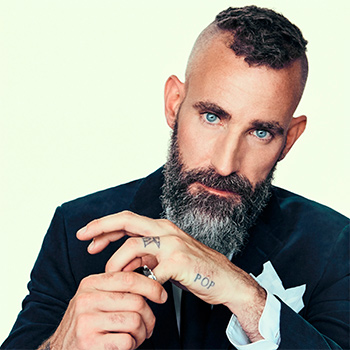
DJ White Shadow, also known as DJWS (real name — Paul Edward Blair; born September 20, 1975, Youngstown, Ohio, USA) is an American music producer, songwriter and DJ. He is best known for his long-running collaboration with Lady Gaga: Blair contributed to nine tracks on the album Born This Way, became one of the key producers of ARTPOP, and later worked on six songs for the film A Star Is Born. In 2020, as one of the soundtrack producers, he received a Grammy for Best Compilation Soundtrack for Visual Media.
Some reference sources still list 1978 as DJ White Shadow’s year of birth. However, Astro-Databank states that it obtained information from Blair’s birth certificate, which records the date as September 20, 1975.
DJWS’s career extends far beyond his work with Lady Gaga. He went from being a club DJ in Japan, Detroit and Chicago to major pop production, remixes, music for advertising and film. At different stages, Blair worked with Pitbull, Estelle, DNCE, Rachel Platten, Austin Mahone and other artists, handled music strategy for W Hotels and participated in the creation of W Sound Suites studios. In the 2020s, he continued combining music with film, technology and entrepreneurial projects.
Childhood, Detroit and the first records
Paul Blair was born in Youngstown and spent part of his childhood in a family with farming roots. His father worked at the General Motors plant in Lordstown. When Paul was in fifth grade, the family moved to the Detroit area — a city that would later have a defining influence on his musical interests.
He began collecting records as a child. One of his early gateways into music was the radio program and compilation Mr. Magic's Rap Attack, through which Blair discovered early American hip-hop. Detroit’s electronic scene later became another major influence. As a teenager, he listened to club radio broadcasts, developed an interest in techno and began teaching himself how to DJ.
His passion for vinyl did not disappear when the industry moved into the digital era. In a 2024 interview, Blair said that his collection contained around 50,000 records.
Japanese, university and his first regular DJ job
Blair’s educational background was unusual for a future electronic producer. He studied Japanese for four years in high school. He initially enrolled at Michigan State University, where, at his family’s insistence, he chose international business, and later had the opportunity to spend his first university year in Japan.
Blair later clarified that the widespread version claiming he began studying international business at Western Michigan University is inaccurate: after returning from Japan, he changed direction and transferred to Western Michigan University, deciding to earn a degree in education. He ultimately graduated as a teacher and spent some time teaching Japanese and creative writing at school.
The year in Japan turned out to be far more important for his musical career than his original field of study. Blair lived in the Takamatsu and Sakaide area and one day offered to play several records for the owner of a local venue. He had already practiced at home, but it was in Japan that he first began performing regularly for a real audience and getting paid for it.
The performances became weekly. Between classes, he drew and copied his own flyers, posted them around town and gradually learned not only the technical side of mixing, but also how to attract an audience.
During his stay in Japan, Blair also attended concerts by American artists including James Brown, Beastie Boys, TLC and B.B. King. For an aspiring DJ, watching major stage performers became another lesson in how to work with a crowd.
Return to the United States and the birth of the DJ White Shadow name
After Japan, Blair continued playing at university parties and became increasingly immersed in Midwestern club culture. Over time, DJing began to earn him more money than the profession he had studied for, and music eventually became his main occupation.
The name DJ White Shadow appeared during the early period of his performances. Blair recalled that in mid-1990s clubs he was often the only white person behind the DJ booth. His friend and promoter Kevin Brown began calling the tall, thin DJ White Shadow — after the American television series The White Shadow. The nickname stuck and became his stage name.
Chicago gradually became the main professional center for DJ White Shadow. The city allowed him to work simultaneously with house, hip-hop and a broader range of club music. Unlike DJs who built their sets around a single genre, Blair learned early to judge the needs of the specific dancefloor in front of him.
This experience would later become important in the studio as well: for DJWS, music was never only about melody or harmony, but also about controlling tension, dynamics and audience response.
Chicago, Los Angeles and the Hyde parties
By the mid-2000s, the American club industry had changed significantly. DJs were increasingly becoming stars in their own right, while Los Angeles had emerged as one of the main markets for high-paying performances. Blair began working regularly between Chicago and California.
In Los Angeles, he organized Sunday parties at the small Hyde club, which held roughly 80–100 people. Instead of the then-fashionable mixture of rock and rap hits, he played old-school house, hip-hop and dance records. The nights gradually became popular among professional dancers and industry figures, and well-known artists and actors soon began appearing at Hyde as well.
It was there that the meeting took place that changed DJ White Shadow’s career.
Meeting Lady Gaga’s team
One of Blair’s sets was heard by Matthew Williams, who at the time was working within Lady Gaga’s creative circle. He asked the DJ to prepare a selection of music for him.
DJWS’s material was later used in the creation of musical interludes for Gaga’s concert show. After that work, Williams promised to connect Blair with the singer when she began recording new material. DJWS himself has said that he initially entered the team through music for The Monster Ball, and only afterward was given the opportunity to present his own studio ideas.
When work began on Gaga’s next album, Blair prepared a large number of instrumental sketches. What initially looked like an opportunity to send a few ideas to a famous singer developed into a long-term creative partnership.
Born This Way — the breakthrough
The album Born This Way, released in 2011, took DJ White Shadow from the club world into the ranks of prominent global pop producers.
He received songwriting and production credits on nine tracks:
Born This Way, The Edge of Glory, Government Hooker, Americano, Bloody Mary, Black Jesus + Amen Fashion, Bad Kids, Highway Unicorn (Road to Love) and Electric Chapel.
The collaboration did not follow a model in which the singer was simply handed a finished instrumental. Blair described his work with Gaga as a constant joint process: sometimes his musical idea came first, sometimes the singer brought lyrics or an almost complete song, after which the material would be rebuilt multiple times.
The title track Born This Way went through an especially long development process. In different interviews, DJWS has said that he ended up with roughly 120–125 versions of the song.
Blair’s roots in electronic club music are especially noticeable in Government Hooker. The track was based on an earlier demo created by DJ White Shadow together with DJ Snake. After the tempo was changed and the material reworked, the composition became part of the sessions for Gaga’s album.
The Edge of Glory, by contrast, demonstrated the producer’s ability to combine an electronic foundation with an almost rock-scale arrangement. One of the central elements of the recording was the saxophone part performed by Clarence Clemons of the E Street Band.
That range became one of the defining features of Born This Way: electronic, techno, synth-pop, rock and industrial did not exist as isolated genres on the record, but constantly intersected.
In 2012, Born This Way was nominated for a Grammy in the Album of the Year category, with Paul Blair officially listed by the Recording Academy among the producers of the nominated album.
DJWS solo releases
Alongside the success of Born This Way, Blair began releasing more music under his own name.
In 2011, he released the five-track EP I'm Killing Me. Compared with his pop production for Gaga, the material was considerably harder and more experimental. During the same period, DJWS performed on the American iDentity festival tour and at Lollapalooza.
In 2012, the electronic release If You Like It appeared under the name White Shadow on Kitsuné Musique.
In 2013, Pussy Drugs Fear and The Clock Is Ticking followed. The latter project was released in December through Mass Appeal and continued the experimental side of Blair’s work.
DJ White Shadow’s solo discography has never been the main focus of his career. His own releases have functioned more as a space for sonic experimentation, while most of his professional activity has remained connected with production, songwriting, remixes and music direction for other projects.
ARTPOP
The second major stage of his collaboration with Lady Gaga was the album ARTPOP, released in 2013.
On the original version of the album, DJ White Shadow served as producer on seven tracks: Sexxx Dreams, Jewels N' Drugs, MANiCURE, Do What U Want, ARTPOP, Swine and Applause. In the album’s studio credits, he was also listed as one of the central members of the production team.
Compared with Born This Way, the electronic component became even more pronounced. The album drew heavily on the aesthetics of EDM, techno and early-2010s club music, while distinguishing itself from conventional festival production through complex structures and constant stylistic shifts.
The most prominent work from this period was Applause. Gaga and Blair are credited among the songwriters and principal producers, while Nick Monson and Dino Zisis participated as co-producers.
DJWS also played an important role in the creation of Do What U Want. He initially presented Gaga with the musical foundation of the track, which had existed before the final work on ARTPOP. The song later became the album’s second single. In 2019, the original version featuring R. Kelly was removed from digital editions and subsequent physical reissues of the album.
Remixes and work outside Lady Gaga’s albums
Despite moving into major pop production, Blair never abandoned DJ culture or remixing. He created his own versions of Born This Way, Judas, Scheiße, Applause and Do What U Want, while also working with material by other artists.
In 2017, DJ White Shadow once again appeared among the songwriters of Lady Gaga’s The Cure, together with Lukas Nelson, Nick Monson and Mark Nilan. Blair himself does not have a production credit on that recording: the song was officially produced by Gaga, Nick Monson and the Detroit City team.
This distinction is important for understanding his role accurately: DJWS’s collaboration with Gaga did not always mean producing an entire recording directly — on different projects he worked as a producer, co-writer, programmer or contributor to the development of the original concept.
A Star Is Born
The next major stage of their collaboration was completely different from Born This Way or ARTPOP.
For the 2018 film A Star Is Born, Blair participated in creating songs written not simply for Lady Gaga as a pop artist, but for her screen character Ally. The music had to work both as standalone material and as part of the character’s development within the film.
DJWS co-wrote and produced six songs: Look What I Found, Heal Me, Why Did You Do That?, Hair Body Face, Before I Cry and Is That Alright?.
The contrast between these compositions and Blair’s earlier work is particularly revealing. While Government Hooker or Swine were built around aggressive electronic production, Is That Alright? represents a completely different side of the producer — an emotional pop ballad centered on the voice and song structure.
The soundtrack brought DJ White Shadow the biggest professional recognition of his career. At the 2020 Grammy Awards, A Star Is Born won Best Compilation Soundtrack for Visual Media. Paul Blair was named by the Recording Academy among the soundtrack’s producers alongside Lady Gaga, Bradley Cooper, Nick Monson, Lukas Nelson, Mark Nilan Jr. and Benjamin Rice.
According to the official Grammy database, Blair has one win and two nominations: the victory for A Star Is Born and the Album of the Year nomination for Born This Way.
Advertising, Pac-Man and W Hotels
Outside the album industry, DJ White Shadow has also worked with advertising and major brands.
In 2015, he participated in Bud Light’s Up for Whatever campaign, which aired during Super Bowl XLIX. For the commercial, built around a giant real-life Pac-Man maze, Blair reworked music from the classic game and also appeared in the advertisement himself. The project remains one of the best-known examples of his work in commercial sound design.
In the mid-2010s, Blair became music director for W Hotels in North America and proposed the concept of W Sound Suites — professional recording studios located directly inside hotels. The first such studio opened at W Bali, followed by facilities in Seattle, Hollywood and Barcelona. DJWS participated in designing the layouts and selecting professional equipment.
The project was directly connected with his touring experience: a musician traveling on the road does not always have access to a high-quality studio at the exact moment when a new idea appears.
Musical approach
DJ White Shadow is difficult to reduce to a single genre.
The foundation of his musical language was shaped by Detroit techno, Chicago house and hip-hop. In pop production, these influences were joined by synth-pop, electro, rock, industrial and R&B. At the same time, Blair rarely tried to define himself through one fixed set of recognizable sounds.
His strength lies in his ability to change production methods depending on the task. In Government Hooker, aggressive club electronics play the central role; The Edge of Glory requires the combination of synthesizers with rock dynamics and live saxophone; Applause is built as a large-scale electronic pop track; Is That Alright? follows the logic of a ballad.
This approach is directly connected to his many years of experience as a DJ. Blair learned to evaluate music not only by genre, but also by the function it performs for a particular audience, performer or stage.
DJ White Shadow in the 2020s
In recent years, Blair has expanded his activities beyond conventional studio work. On his official website, he describes himself as the founder and head of SETSPACE — a platform connecting DJs, organizers and listeners. His projects also include DISCO_NECT, while in film he works as a music supervisor and executive producer.
DJWS has continued releasing music as well. In 2022, he released the single Just the Way You Are and a remix EP based on it. In 2026, the project Beast appeared, associated with the tracks Walk Out, Underground, The Ring, Shots Fired and Ready Player Fight.
In summer 2026, DJ White Shadow and DISCO_NECT also created a remix of Free to Love for Duran Duran and Nile Rodgers, included in the official Free to Love: Hot Star Remixes package.
Main solo releases
- I'm Killing Me — 2011
- If You Like It — 2012
- Pussy Drugs Fear — 2013
- The Clock Is Ticking — 2013
- DJ White Shadow vs. PacMan — 2015
- Just the Way You Are — 2022
- Beast — 2026
The significance of DJ White Shadow
DJ White Shadow’s main place in modern music is connected not with the number of solo albums he has released, but with how naturally he transferred the experience of a club DJ into large-scale pop production.
He did not enter global pop music from an academic studio background or from the generation shaped by the festival EDM scene. By the time he began working on Born This Way, he already had years of vinyl collecting, Detroit techno, American hip-hop, his first paid performances in Japan, and extensive club experience in Chicago and Los Angeles behind him.
That is why his best-known recordings differ so noticeably from one another. Born This Way demonstrated his ability to combine club electronics with rock and pop dramaturgy; ARTPOP allowed him to move much further into synthetic and experimental sound; A Star Is Born proved that his production language does not depend on heavy electronic arrangements.
Paul Blair remains above all a producer for whom working with the artist is more important than displaying a fixed personal signature. From small clubs and his first sets in Japan to Lady Gaga, the Grammy Awards, film and his own technology projects, his career has been built around one principle: the musical solution should serve the specific song, performer and audience rather than a predetermined formula.