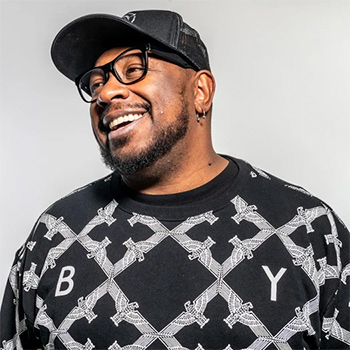
DJ Marky is a Brazilian DJ, producer, musician and founder of Innerground Records. His real name is Marco Antonio da Silva. He was born on June 14, 1973, in the Cangaíba district of São Paulo.
DJ Marky achieved international recognition as one of the leading figures in Brazilian drum & bass and as a highly skilled club DJ. Together with XRS, DJ Patife, Drumagick and other musicians, he helped shape a scene that combined British breakbeats and bass music with the rhythms, melodies and musical heritage of Brazil. His greatest commercial success was LK (Carolina Carol Bela), recorded with XRS and Stamina MC, which reached the UK Top 20.
DJ Marky is known for far more than his own productions. A significant part of his reputation rests on his DJ sets: fast and technically demanding mixing, scratching, the use of several sound sources and an ability to adjust his programme in response to the crowd. Marky himself has emphasised that he sees himself primarily as a DJ rather than exclusively as a drum & bass artist. His collection and sets bring together jazz, funk, soul, disco, hip-hop, house, techno and Brazilian music.
Key facts
Real name: Marco Antonio da Silva
Stage name: DJ Marky
Early alias: DJ Marky Mark
Date of birth: June 14, 1973
Place of birth: São Paulo, Brazil
Home district: Cangaíba
Occupations: DJ, music producer, label owner
Main genres: drum & bass, jungle, liquid funk
Label: Innerground Records
Main collaborators: XRS, Makoto, Stamina MC, S.P.Y, L-Side
Best-known track: LK (Carolina Carol Bela)
Main albums: In Rotation, My Heroes, The Time Is Right
Childhood and the family record collection
Marco Antonio da Silva grew up in a home where music was constantly playing. His mother worked as a seamstress, while his father served in the police and played music in his spare time. The family collection included Brazilian recordings, jazz, soul and funk.
Among the records that shaped his taste, Marky has mentioned works by Jorge Ben, Milton Nascimento, Lô Borges, Marcos Valle, Elis Regina, Antônio Carlos Jobim, Martinho da Vila, Miles Davis, James Brown, Marvin Gaye and Billy Paul. He became interested in records at around the age of seven.
Neighbourhood parties in São Paulo were also highly influential. Marco’s older sisters attended them, while he listened from outside with his friends as a child. He would later search for the songs he had heard on the radio and ask his mother to buy the records he liked.
According to his own recollections, Marky began working with turntables at around the age of eleven. He later bought vinyl with money earned from temporary jobs before finding employment in record shops. Almost all of his wages went back into music. In a 2024 interview, his collection was estimated at nearly 30,000 records.
Learning to DJ independently
Marky had no formal musical education. He taught himself how to mix by listening to radio programmes and recording shows by Brazilian DJs Ricardo Guedes, Grego, Cuca and Sylvio Muller.
His first significant achievement was winning a DJ competition held by the Showbusiness club in eastern São Paulo. After the contest, he was offered a job at the venue.
At first, Marky rehearsed his entire programme at home and played almost the same sequence of tracks each week. He later admitted that being dismissed from the club proved to be a valuable lesson: a DJ should not simply perform a prepared set without mistakes, but understand the music, read the room and change direction in real time.
That principle remained central throughout his career. Marky generally does not prepare a final track list in advance. His choice of the next record depends on the mood of the venue, the audience’s reaction and the way the previous transition develops.
Sound Factory and Toco
One of the most important venues in the early stage of his career was Sound Factory. Marky worked there as a resident DJ and was given the freedom to play new electronic music arriving from Europe and the United States.
The club hosted Laurent Garnier, Josh Wink, Little Louie Vega and other international artists. At the same time, Marky worked in a record shop connected to the owner of Sound Factory, giving him access to imported releases that were difficult to find in Brazil.
The next stage was the large Toco club in the Vila Matilde district. Its main room accommodated several thousand visitors, while Marky was given a separate area where he could play more experimental music. He also took part in popular daytime events aimed at younger audiences.
At the beginning of his career, the musician used the name DJ Marky Mark. It was later shortened to DJ Marky to avoid confusion with the American performer Marky Mark, the stage name then used by Mark Wahlberg.
From hip-hop to jungle and drum & bass
Marky’s musical foundations were built on hip-hop, funk, soul and Black Brazilian music. During the first half of the 1990s, British hardcore, jungle and drum & bass were added to those influences.
DJ Patife recalled that Marky introduced him to The Dark Stranger by Boogie Times Tribe. The record became one of the musicians’ key examples of the emerging British breakbeat sound.
Marky and Patife followed the British scene through imported records, catalogues and magazines such as Mixmag and DJ Mag. They were drawn to rougher and rhythmically more complex material that differed noticeably from the commercial electronic music played in São Paulo’s major clubs.
Marky did not abandon his earlier musical interests after moving towards drum & bass. On the contrary, funk, soul, jazz and Brazilian harmonies gradually became central to his own understanding of the genre.
Lov.e, the Vibe night and the international stage
After Toco closed, the musician spent some time without a permanent venue. The situation changed when he was invited to the new club Lov.e, which opened in São Paulo in 1998.
Marky’s weekly night was called Vibe. As interest in drum & bass grew, it became one of the centres of the city’s club culture. The event attracted musicians, members of the fashion industry, television professionals and people from other creative fields.
British artists began appearing at Lov.e. Among the visitors was Bryan Gee, a DJ, promoter and founder of V Recordings. After hearing Marky perform, he invited him to London.
Marky’s first major British set took place in 1999 at a Planet V night at The Mass in Brixton. He was initially given an early slot in front of an almost empty room. Later, when Grooverider arrived late, Bryan Gee asked the Brazilian DJ to return to the decks, this time in front of a packed venue.
Marky used techniques that were unfamiliar to much of the British audience: he opened two channels simultaneously and mixed records without headphones. Following that performance, he began receiving invitations to other events across the UK.
The connection between the Brazilian and British scenes
By the late 1990s, a consistent exchange of music had developed between São Paulo and London. DJ Patife brought video recordings of Brazilian parties to the Movement office, after which Bryan Gee and other British figures began working more actively with musicians from Brazil.
In 2001, V Recordings released The Brasil EP, the first British-label release dedicated to Brazilian drum & bass. It combined heavy breakbeats with soul, bossa nova, samba and brighter harmonies.
Brazilian musicians did not create a separate genre governed by strict rules. Their contribution lay in expanding the language of drum & bass: the music could remain fast and bass-heavy while incorporating acoustic instruments, jazz chords, vocals and recognisably Brazilian rhythms.
DJ Marky became the most internationally visible representative of this movement through the combination of his productions and, above all, his exceptional reputation as a club DJ.
Collaboration with XRS
One of DJ Marky’s main creative partners was the Brazilian producer XRS, whose real name is Xerxes de Oliveira.
The musicians met in the early 1990s. Their roles in the studio developed naturally: XRS had stronger command of the equipment, programming and technical side of production, while Marky brought records, samples and musical ideas and worked on the arrangements.
Together they created a significant part of Marky’s classic catalogue, including LK, Rotation, Soul Samba, Get Down, Breeze, Misto Quente, Moments of Lust and other tracks.
Their collaboration should be understood as a partnership between a DJ-arranger and a studio producer. It would be inaccurate to attribute the entire sound to only one of them.
The story of LK
LK was created by DJ Marky and XRS in the early 2000s. The musicians were trying to find a sound of their own rather than imitate the dark British techstep that dominated the scene at the time.
Marky brought a section of Carolina Carol Bela, recorded by Jorge Ben and Toquinho in 1970, into the studio. His father had played the record when Marky was a child. The acoustic guitar and vocal elements of the original recording became the foundation of the new track.
The production process was technically simple. According to Marky, they used several keyboards, a Yamaha mixer and only around six channels. Most of the composition was assembled during a single studio session.
The working title was inspired by an everyday scene at home. After seeing the kitchen floor wet after cleaning, Marky came up with the phrase Liquid Kitchen and shortened it to LK. Before that, the musicians informally called the track Patinha Theme because they believed DJ Patife would like it.
From instrumental to the version with Stamina MC
LK was initially an instrumental track. Bryan Gee selected it from several demos and began distributing it to British DJs on dubplates.
During one performance, British artist Stamina MC improvised over the instrumental with a line beginning It’s the way. The audience remembered the vocal part and began singing along to it at later shows.
When Marky returned to the UK, he discovered that clubgoers were asking for a track called It’s the Way, which he did not recognise. When the crowd began singing Stamina MC’s part during the instrumental version, the musicians decided to record the vocal officially.
LK (Carolina Carol Bela) was released by V Recordings in 2002. It reached number 17 on the main UK singles chart, spent six weeks in the Top 100, climbed to number two on the dance chart and reached number three on the independent singles chart.
The success brought DJ Marky, XRS and Stamina MC to the television programme Top of the Pops. For a drum & bass track built around a Brazilian sample, it represented a rare move from club culture into mainstream British entertainment.
The significance of LK
LK was not the first track to combine drum & bass with jazz, soul or Latin American music. Its significance lay in the scale of its reach and in how naturally Brazilian material was integrated into a British club format.
The song demonstrated that bass music did not have to be exclusively dark or aggressive. High tempo, breakbeats and low frequencies could coexist with acoustic guitar, warm harmony and an immediately memorable vocal.
Following the success of the single, Marky moved from performing mainly in Brazil to regular touring across the UK, Europe, Japan, Australia and other regions.
Even so, LK does not define his entire career. It remains his biggest mainstream hit, but Marky’s standing within the professional scene is connected far more strongly to his DJ technique, musical selection and decades of work within club culture.
In Rotation
The first major studio album, In Rotation, was released on March 9, 2004, under the names DJ Marky and XRS. The record contains 12 tracks with a total running time of approximately one hour.
The album brought together several directions:
- melodic, soul-oriented drum & bass;
- Brazilian samples;
- jazz harmonies;
- harder club tracks;
- vocal productions;
- instrumental liquid funk.
In Rotation includes LK, Rotation, Soul Samba, Breeze, Get Down, Tijuana Frogs, Moments of Lust and other recordings. The album demonstrated that the Brazilian aesthetic of Marky and XRS could not be reduced to a single acoustic sample or a summery mood.
The record was built around groove and dancefloor response. Marky stressed that it was not conceived as a formal “tribute” to a particular culture or group of artists. The musicians selected samples and ideas they found interesting and tested how convincingly the results worked in a club.
In Rotation reached number 34 on the UK Independent Albums Chart.
Innerground Records
DJ Marky founded his own label, Innerground Records, in 2003. Its catalogue became a platform for Marky’s own releases as well as music by other drum & bass producers.
Innerground has released music by Calibre, Makoto, S.P.Y, Random Movement, Bungle, Total Science, L-Side, Level 2 and other artists from the international scene.
The label has never been limited exclusively to “Brazilian” drum & bass. Its catalogue covers liquid funk, soulful material, harder club tracks and compositions in which melody and musical groove take priority.
In 2024, Innerground marked its 21st anniversary with a new version of Soul Samba, produced by DJ Marky and Makoto.
DJ Marky behind the decks
Marky is regarded first and foremost as a DJ and selector. Even after the appearance of successful original releases, studio production never replaced live performance for him.
The main characteristics of his sets include:
- fast and precise mixing;
- scratching within drum & bass sets;
- the use of several decks at once;
- long transitions and layered parts;
- unexpected changes of genre;
- physically active work with turntables;
- selecting tracks during the performance itself.
His technical routines became famous far beyond drum & bass. However, tricks are not the sole focus of his sets: Marky treats technique as a way to maintain the movement of the programme rather than as a separate sporting demonstration.
He identifies groove as the main criterion when choosing a track. Speed itself is secondary; what matters is whether the music provokes a physical and emotional response.
Musical interests beyond drum & bass
Marky regularly performs Influences sets featuring the music that shaped his taste: funk, disco, jazz, soul, hip-hop, boogie, house, techno and Brazilian recordings.
He does not regard these genres as a separate hobby. Their elements continually enter his drum & bass:
- funk shapes the rhythmic movement;
- soul influences the vocal parts;
- jazz informs the harmonies and keyboards;
- disco and boogie influence the bass lines;
- hip-hop informs the use of samples and scratching;
- Brazilian music shapes the percussion, syncopation and choice of melodic material.
This approach explains why his sets can move beyond a single tempo without losing their internal logic.
DJ mixes and compilations
Before releasing his first studio album, Marky issued a series of mixes and compilations that introduced Brazilian audiences to jungle and drum & bass.
Important releases from this period include Audio Architecture from 2000 and Audio Architecture 2, released the following year. These recordings presented Marky primarily as a DJ and curator of British bass music.
In 2004, he recorded an Essential Mix for BBC Radio 1, further strengthening his position within the British scene.
The project DJ Marky & Friends Presents: The Master Plan appeared in 2007. It was not a conventional solo studio album, but a compilation and DJ-led presentation of the Innerground catalogue and artists associated with the label. It featured music by Calibre, Logistics, Random Movement, Digital, Bungle and Marky himself.
My Heroes
The album My Heroes was released by Innerground Records on June 15, 2015. It contains 16 tracks with a total running time of approximately ninety minutes.
The title refers to the musicians, DJs and people close to Marky who influenced him. However, the record is not a collection of cover versions. Marky used his own musical language to connect drum & bass with funk, jazz, soul and Brazilian melody.
Makoto, S.P.Y, MC GQ, Singing Fats, Random Movement, A-Sides, Collette Warren and other artists took part in the recording.
The key tracks include:
- My Heroes;
- Roundabout with Makoto;
- Get It Up;
- Around You;
- Silly;
- Freedom;
- Frenesi;
- Those Moments.
The album confirmed that Marky approaches studio work as an extension of DJ culture: different musical traditions are brought together not through theory, but through rhythm, sequencing and a sense of motion.
Collaborations with Makoto, S.P.Y and other producers
Throughout his career, Marky has regularly worked with other musicians. After his best-known period with XRS, important partners included Japanese producer Makoto, Brazilian artist S.P.Y, as well as Bungle, L-Side, Random Movement, Pola & Bryson and other figures from drum & bass.
With Makoto, he recorded and reworked several melodic tracks, including Roundabout and a new version of Soul Samba. Their work is typically built around jazz keyboards, soft harmonies and detailed breakbeats.
Collaborations with S.P.Y, including Yellow Shoes and Brainstorm, demonstrate a denser and more club-oriented side of Marky’s music.
Marky’s production discography therefore does not have a single fixed sound. The result depends heavily on the collaborator, but always retains his characteristic attention to groove and musicality.
The Time Is Right
The album The Time Is Right was released by the British label Shogun Audio on July 21, 2023. It was DJ Marky’s first major album project after an extended break and contains 15 tracks.
The material was created before the COVID-19 pandemic, during the restrictions and after they had ended. Marky suffered a severe case of the illness and was hospitalised. This was later followed by a personal crisis connected to the end of a relationship. These events contributed to the album’s more emotional character.
The musician initially planned to work mainly alone, but gradually brought in friends and long-term collaborators. Participants included:
- Pola & Bryson;
- Makoto;
- Charli Brix;
- SOLAH;
- MC GQ;
- L-Side;
- Alibi;
- Melinki;
- D’Cypher;
- Harry Shotta.
The key tracks include Colours of My Mind, Natural Feeling, Back & Forth and Wrong Hands.
The Time Is Right does not abandon energetic club drum & bass, but places greater emphasis on the artist’s experiences, support from friends and recovery after a difficult period.
Kochi EP
In 2024, Innerground Records released the Kochi EP, named after the Japanese city that made a strong impression on Marky during a tour.
The release contains:
- Kochi;
- Star Trippin’;
- (It’s Just a) Simple Song;
- Soul Samba — DJ Marky & Makoto Remix 2024.
The final track is a new version of a composition originally recorded by Marky and XRS in 2004. The EP was accompanied by a tour of Japan.
DJ Marky & Friends
Alongside his label, Marky runs the live series DJ Marky & Friends. Its format is built around a broad understanding of drum & bass, with programmes featuring artists from different generations, MCs, producers and Marky’s regular collaborators.
The series has taken place in Brazil and the United Kingdom. In February 2026, DJ Marky & Friends was held at KOKO in London with Pola & Bryson, Breakage, Makoto, Kira, MC GQ, SP and MC Rage.
As of July 2026, DJ Marky continues to tour internationally, performing drum & bass programmes and genre-spanning Influences sets while also overseeing the Innerground Records catalogue.
Musical style
DJ Marky’s music is most commonly classified as drum & bass and liquid funk. However, the term liquid funk describes only part of his catalogue.
His productions include:
- fast breakbeats;
- deep but not always aggressive bass;
- jazz keyboards;
- soul vocals;
- acoustic Brazilian samples;
- funk and boogie;
- elements of samba and baião;
- hard club-oriented bass lines.
Brazilian elements do not appear in every track and are not used as a compulsory decorative feature. Marky can produce music without obvious national references while remaining recognisable through rhythmic swing, harmonies and an overall sense of movement.
His approach differs from the simplistic formula of “samba over drum & bass”. Brazilian influence is expressed not only through direct samples but through his relationship with groove: the drums and bass must move fluidly, while melody exists on equal terms with the low frequencies.
Main albums
In Rotation — 2004
A collaborative studio album by DJ Marky and XRS. It contains LK, Rotation, Soul Samba, Breeze, Get Down and other key recordings from their classic period.
My Heroes — 2015
Marky’s first major solo album. It brought together original compositions, collaborations and the musical influences that shaped his career.
The Time Is Right — 2023
An album released by Shogun Audio, shaped by the pandemic, personal experiences and collaborations with friends from the international drum & bass scene.
Important mixes, compilations and EPs
- Audio Architecture — 2000;
- Audio Architecture 2 — 2001;
- The Brasil EP — contributor, 2001;
- DJ Marky & Friends Presents: The Master Plan — 2007;
- Influences — genre-spanning DJ compilation;
- Run the Streets EP — 2020;
- Kochi EP — 2024.
Essential tracks
LK (Carolina Carol Bela)
A collaboration with XRS and Stamina MC. Built around a sample from a song by Jorge Ben and Toquinho, it became Marky’s only single to reach the main UK Top 20.
Rotation
One of the central tracks on In Rotation, combining soft harmony with a dense club rhythm.
Soul Samba
A collaboration with XRS that demonstrates the Brazilian side of their drum & bass. Marky and Makoto produced a new version of the track in 2024.
Breeze
A melodic track from the classic period that exists in several versions and remixes.
Moments of Lust
A vocal composition featuring Vikter Duplaix that combines drum & bass with soul and contemporary electronic songwriting.
Yellow Shoes
A collaboration between DJ Marky and S.P.Y that gained additional recognition through a Calibre remix.
Silly
A track from My Heroes whose popularity grew considerably several years after its original release.
Colours of My Mind
A collaboration with Pola & Bryson connected to the personal and emotional period during which The Time Is Right was created.
Natural Feeling
A track featuring Charli Brix and Alibi that combines vocal liquid drum & bass with Marky’s characteristic melodic sensibility.
DJ Marky played a central role in the international recognition of Brazilian drum & bass. He was not the scene’s only participant: DJ Patife, XRS, Drumagick, DJ Andy and many other musicians worked alongside him. However, Marky combined three qualities that allowed him to become the movement’s most visible figure:
- exceptional technique as a club DJ;
- an ability to connect British and Brazilian musical cultures;
- a commercially successful track that moved beyond the underground scene.
LK introduced him to a global audience, but a single hit did not sustain his career. Marky remained in demand because of his collector’s relationship with music, his ability to work with different generations of producers and his refusal to turn a set into a fully pre-programmed show.
His legacy also lies in expanding perceptions of drum & bass. After the Brazilian wave, fast bass music could be not only dark or technological, but also warm, melodic, funky and open to national musical traditions.
DJ Marky remains, above all, a DJ: someone who constructs a musical narrative from other artists’ records and his own productions, reads the mood of the audience and turns technical mastery of the turntables into a complete form of live performance.

![Calibre feat. DJ Marky - Amen Tune [Mixed]](https://cdn.minatrix.com/covers/2026/07/100_79843.jpg "Cover Calibre feat. DJ Marky - Amen Tune [Mixed]")