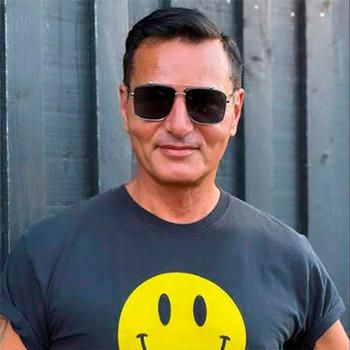
David Vendetta (real name David Paparusso) is a French DJ, music producer and remixer, and one of the notable figures of European house music in the 2000s. He is best known for tracks such as Love to Love You Baby, Unidos Para La Música, Break 4 Love, Bleeding Heart and Hold That Sucker Down, as well as the albums Rendez-Vous and Vendetta. His music combines a classic house foundation with electro house, tribal rhythms, prominent vocal performances and Mediterranean influences.
Early years and path into music
David Paparusso was born in the French town of Longwy, located in the Meurthe-et-Moselle department. Before turning to music professionally, he worked in the pharmaceutical field, but by the early 2000s he had decided to focus entirely on DJing and producing electronic music.
The Paris club scene became the main environment in which David Vendetta developed as a DJ. He worked as a resident at well-known venues including Les Bains Douches, Folies Pigalle, Amnesia and Redlight. Unlike many producers who began exclusively with studio work, Vendetta developed his career simultaneously as a club DJ and as a creator of his own material.
Early releases and Antoine Clamaran
David Vendetta’s first notable studio works appeared in the early 2000s. During this period, French DJ and producer Antoine Clamaran played an important role in his professional development. With his involvement, Vendetta released early maxi-singles pairing Fiction with No Sex, She Loves Me with Party People, and Alicante with Cleopatra.
These recordings belonged to the harder club-oriented side of early-2000s house. They already displayed characteristics that would become typical of Vendetta’s style: a dense rhythmic foundation, a pronounced bassline, tribal percussion and an emphasis on extended club arrangements designed primarily for DJ sets.
Collaboration with Roger Sanchez and Stealth Records
The next important stage was his collaboration with American house DJ Roger Sanchez. In the mid-2000s, Vendetta began producing remixes for Sanchez’s label Stealth Records. Works from this period include remixes of Dancin' by A Tribe Called Es, Tempo Da Solo by Sueno Soul and Twisted by Aston Martinez.
Working around Stealth Records took Vendetta beyond the French club scene. His remixes began appearing in the sets and compilations of international house DJs, while the producer gradually developed his own sound at the intersection of tribal house, progressive house and more direct electro house.
During the same period, he also remixed music by Sander Kleinenberg, DJ Chus and David Penn, Kurd Maverick and other figures from the European and American house scenes.
Love to Love You Baby — the breakthrough
David Vendetta achieved broad recognition in 2006 with the release of Love to Love You Baby. The track uses a vocal performance from the classic song of the same name by Donna Summer, created in the 1970s with Giorgio Moroder and Pete Bellotte.
Vendetta did more than simply place the recognisable vocal over a contemporary club arrangement. His version was built around the contrast between Donna Summer’s sensual performance and the harder house rhythm of the mid-2000s. This approach made the track accessible both to club audiences and to listeners of commercial radio.
Love to Love You Baby reached the Top 20 of the French singles chart and became the producer’s first major commercial success. It was after this release that the name David Vendetta began appearing regularly outside the specialised house scene.
Unidos Para La Música
The next key release was Unidos Para La Música, recorded with vocalist Akram Sedkaoui. While Love to Love You Baby drew on disco heritage, here Vendetta placed greater emphasis on a Mediterranean aesthetic: Latin rhythms, acoustic elements and expressive male vocals.
The track became one of the biggest hits of David Vendetta’s entire career and climbed to No. 5 on the French chart. The Cosa Nostra Mix version became particularly popular and helped establish the name Cosa Nostra as part of Vendetta’s own club identity.
Akram Sedkaoui became one of the producer’s most important vocal collaborators. His voice also appeared on other tracks including Take Me Higher and I Call You Back.
Break 4 Love
In 2007, David Vendetta turned to another classic chapter in house music history — Break 4 Love. The original recording by Raze appeared in the late 1980s and became one of the early club standards of American house.
Vendetta’s version was performed by Keith Thompson, whose voice was also connected with the original history of the song. The producer retained the recognisable vocal foundation but completely adapted it to the more powerful European club sound of the 2000s. The single entered the Top 20 of the French chart and further strengthened Vendetta’s reputation as a producer capable of reinterpreting classic house without simply copying older arrangements.
Rendez-Vous album
On 4 June 2007, David Vendetta released his debut studio album Rendez-Vous. The record brought together his main club ideas of the mid-2000s and showed that his successful singles were part of a broader production approach.
The album included Love to Love You Baby, Unidos Para La Música, Break 4 Love, Bleeding Heart, Freaky Girl, Take Me Higher, Anticipation and other tracks.
A wide range of vocalists took part in the recording. Rachel Starr performed on Bleeding Heart, Barbara Tucker appeared on Anticipation, David Goncalves on Freaky Girl, Audrey Valorzi on Be the Best, while Akram Sedkaoui became one of the album’s central voices.
Rendez-Vous reached No. 16 on the French albums chart and became one of Vendetta’s most successful house releases. The album also demonstrated an important feature of his working method: for him, a studio track almost always remained part of club culture. As a result, tracks existed simultaneously as radio versions, extended mixes and special club edits.
NRJ Music Awards nomination
Following the success of Love to Love You Baby and the growth of his international profile, David Vendetta was nominated at the NRJ Music Awards 2007 in the «DJ of the Year» category. He did not win the award, but the nomination placed him among the most prominent French DJs of the period.
Cosa Nostra
The name Cosa Nostra became one of the most enduring elements of David Vendetta’s creative identity. His club nights were held under this name, and it was also used for his own radio show. The Cosa Nostra programme was broadcast on the French station Radio FG, while the name itself was regularly used for special versions and remixes of his tracks.
The Cosa Nostra format closely reflected Vendetta’s musical approach: energetic vocal house, tribal percussion, long transitions and material designed for a full-night club set rather than only for radio play.
Hold That Sucker Down
In 2008, David Vendetta released his own version of Hold That Sucker Down — a track originally recorded by The O.T. Quartet in the 1990s. Vendetta once again used a method that had already proved effective on Love to Love You Baby and Break 4 Love: taking recognisable material from an earlier era and rebuilding it for the contemporary house club.
His version of Hold That Sucker Down entered the Top 20 of the French chart. The track was also included on the expanded collector’s edition of Rendez-Vous.
Second album Vendetta
In 2010, the producer released his second studio album, Vendetta. While Rendez-Vous primarily captured the characteristic European house sound of the mid-2000s, the second album noticeably broadened the geographical and vocal palette.
The album included I Love U with Peter Stormare, She Turns Around with Syd Bayliss, Make Boys Cry with Luciana, Holding On with Rachel Starr, Survivor with Akram Sedkaoui, Yama Layali with Lebanese singer Haifa Wehbe and other tracks.
One of the album’s most unusual works was I'm Your Goddess. The recording featured British singer Tara McDonald and Azerbaijani khananda Alim Qasimov. The combination of club electronics, Western pop vocals and traditional Eastern vocal technique became a logical continuation of Vendetta’s interest in Mediterranean and Middle Eastern musical elements.
Yama Layali with Haifa Wehbe developed the same direction through Arabic pop music. Thanks to tracks like these, the second album became stylistically broader than the debut and moved beyond the standard formula of European electro house.
Working with vocalists
Collaboration with guest singers has always been an important feature of David Vendetta’s discography. Unlike instrumental club house, his best-known recordings are built around fully developed vocal identities.
Akram Sedkaoui brought a Mediterranean character to his music, Rachel Starr represented American vocal house, Keith Thompson connected Vendetta with the heritage of the early house scene, Barbara Tucker with the classic New York club tradition, while Tara McDonald, Alim Qasimov and Haifa Wehbe expanded the palette of the second album toward pop and ethnic forms.
For this reason, vocals in Vendetta’s music rarely function simply as short samples placed over a finished club track. In many of his key works, the vocal performance is the central element of the composition, with the arrangement built around it.
VenSun project with Sylvia Tosun
In the early 2010s, David Vendetta began working with American singer-songwriter Sylvia Tosun. Their collaboration developed into the project VenSun.
In 2013, they released Love Is Love and the EP The Dragon Flies under this name. The project differed from Vendetta’s best-known work of the 2000s: it placed more emphasis on melodic electronic music and vocal progressive house, while the club arrangements were more closely connected with song structures.
Love Is Love also appeared on the US Billboard Dance Club Songs chart. VenSun releases later received several series of remixes, while the collaboration between Vendetta and Tosun became a separate chapter in his discography.
Remixes
Remix work occupies no less important a place in David Vendetta’s career than his solo singles. It was his remixes for Stealth Records that helped establish him on the international house scene even before the release of Rendez-Vous.
Over the years, he created his own versions of tracks by Roger Sanchez and projects around him, Sueno Soul, Aston Martinez, Sander Kleinenberg, DJ Chus and David Penn, Kurd Maverick, Superfunk and Ron Carroll. He later continued releasing remixes of work by artists from various branches of electronic pop music.
His remixes are characterised not by radical deconstruction of the original work, but by adaptation for a large club dancefloor: a more pronounced kick drum, a denser bassline, additional percussion, extended instrumental sections and climaxes designed to work effectively within a DJ set.
International club career
As his popularity grew, David Vendetta moved far beyond the French scene. He performed at major clubs across Europe, the Middle East, North and South America, including venues in Ibiza, New York, Miami, Moscow, Saint Petersburg, Barcelona, Amsterdam, Montreal and Dubai.
This international touring work was especially important for an artist of his generation. Vendetta’s career developed during a period when house music was still primarily distributed through club sets, vinyl and CD maxi-singles, DJ compilations and specialised radio stations. His success emerged before electronic music fully transitioned to the streaming model.
Musical style
David Vendetta is most often associated with house and electro house, although his most characteristic recordings cover a broader range. His early material shows strong influences from tribal house and progressive house: a straight four-on-the-floor rhythm is complemented by active percussion, long instrumental transitions and gradual arrangement development.
In his most commercially successful recordings, vocal house comes to the foreground. Love to Love You Baby, Unidos Para La Música, Break 4 Love and Bleeding Heart all have fully developed vocal centres and can function as songs rather than merely as tools for a DJ set.
Another important feature is his interest in Mediterranean and Eastern musical culture. This is particularly clear in his work with Akram Sedkaoui, Alim Qasimov and Haifa Wehbe. Vendetta integrated these elements not as decorative effects, but directly into the melodic and vocal structures of the compositions.
David Vendetta and the French house scene
David Vendetta emerged at a time when French electronic music had already achieved international recognition through Daft Punk, Cassius, Étienne de Crécy and other representatives of the French Touch. His own music, however, belongs to a different branch of French house.
Instead of the disco samples, characteristic filtering and late-1990s French Touch aesthetic, Vendetta focused on the more powerful club sound of the 2000s — tribal rhythms, progressive structures, prominent vocal performances and electro house. In this respect, his work is closer to the French club line represented by Antoine Clamaran, Laurent Wolf and other DJs who operated between the specialised house scene and mainstream dance music.
Career after his main commercial period
After the albums Rendez-Vous and Vendetta, the producer did not stop releasing music. His later discography developed primarily through individual singles, remixes and collaborative projects rather than new full-length albums.
In the 2010s, the VenSun project with Sylvia Tosun became an important part of his work. Later, Vendetta continued returning to his own catalogue by releasing new versions and remixes of well-known tracks. In the 2020s, his discography expanded with both new material and reworked versions of earlier recordings, including Cleopatra and I'm Your Goddess.
This approach is consistent with Vendetta’s entire career: his catalogue has never existed as a set of permanently fixed radio singles, but rather as material for continuous club reworking — new mixes, remixes and alternative versions.
Main discography
Studio albums
- Rendez-Vous — 2007
- Vendetta — 2010
Key singles and tracks
- No Sex
- She Loves Me
- Party People
- Alicante
- Cleopatra
- Love to Love You Baby
- Unidos Para La Música — with Akram Sedkaoui
- Break 4 Love — with Keith Thompson
- Bleeding Heart — with Rachel Starr
- Freaky Girl — with David Goncalves
- Hold That Sucker Down
- Anticipation — with Barbara Tucker
- She Turns Around — with Syd Bayliss
- Make Boys Cry — with Luciana
- I'm Your Goddess — with Tara McDonald and Alim Qasimov
- Yama Layali — with Haifa Wehbe
- Holding On — with Rachel Starr
VenSun project
- Love Is Love — 2013
- The Dragon Flies — 2013, EP
Place in house music history
David Vendetta established his own niche in European electronic music during the 2000s. He did not belong to the first generation of French Touch and did not build his career around pop production in the way that the French EDM mainstream would later do. His foundation remained club house.
At the same time, Vendetta managed to make this music accessible to a much wider audience. Love to Love You Baby brought Donna Summer’s disco classic into a new generation of clubs, Unidos Para La Música combined house with Mediterranean melodic influences, Break 4 Love connected his discography with early American house culture, while Rendez-Vous brought these directions together in a cohesive album.
It was this period that defined David Vendetta’s place in the history of European dance music. His best-known recordings capture a moment when mid-2000s house existed simultaneously as club culture, radio format and international pop-electronic music — before the full global rise of EDM in the following decade.