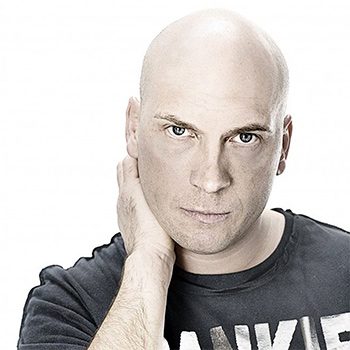
Da Hool — is the stage name of German DJ and music producer Frank Tomiczek, one of the figures associated with the early German techno and rave scenes. He was born on 30 December 1968 in Bottrop, North Rhine-Westphalia. Before adopting the name Da Hool, Tomiczek released music and performed as DJ Hooligan, while also taking part in several studio projects including Central Bass, Central Love, Hool’s Experience and An Active Trip.
The defining recording in his catalogue is Meet Her at the Love Parade. First released independently in the mid-1990s, the track became an international club hit after a wider release in 1997, entered national charts in several countries and, decades later, continued to receive official remakes and new versions with Tiësto, Joel Corry, Maddix, Dimitri Vegas & Like Mike, Cassian and YOTTO. Tomiczek’s professional career, however, began much earlier, during the formative years of German rave culture in the late 1980s and early 1990s.
Bottrop and the first years behind the decks
Frank Tomiczek’s interest in music developed during the 1980s. According to his own recollections, he spent a large part of his pocket money on records and a great deal of time in local record shops. He later became interested in DJing itself.
Tomiczek trained professionally as a technical draughtsman. During his apprenticeship, he was offered work as a DJ at a local disco in Bottrop. He later recalled playing there up to four nights a week. His original repertoire reflected the typical disco music of the late 1980s, but the arrival of Chicago house and European techno gradually changed his musical interests. Around the same time, he began learning music production on his own.
His move towards electronic music coincided with the rapid development of Germany’s club infrastructure. By the early 1990s, techno was no longer limited to small underground clubs: large-scale raves, Mayday and Love Parade had appeared, while independent labels, specialist record shops and a professional DJ circuit were taking shape.
It was in this environment that DJ Hooligan emerged.
DJ Hooligan and the first releases
Tomiczek’s first official recordings as DJ Hooligan date from 1992. The German label No Respect Records released the Harder ’N Deeper EP, featuring Harder ’N Deeper, Get Hard, Mayday-Day and It’s a Dream Song.
The early No Respect Records catalogue also includes Space Girl and B.O.T.T.R.O.P.. Space Girl was released under catalogue number NRR 009, while B.O.T.T.R.O.P. also appears among the early DJ Hooligan recordings. These tracks therefore do not belong to Dance Ecstasy 2001, as is sometimes stated in unofficial discographies.
B.O.T.T.R.O.P. directly references the musician’s home city. Frank Tomiczek and Ingo Kays are credited as the track’s writers. It was later included on the first Thunderdome — F**k Mellow, This Is Hardcore From Hell compilation, connecting DJ Hooligan’s early material with the rapidly expanding European hardcore and rave audience.
Early DJ Hooligan sounded considerably harder than Da Hool’s best-known recordings from the end of the decade. The music incorporated techno, early rave, hardcore and early forms of trance. It was designed primarily for raves and DJ sets rather than radio.
In 1993, the discography expanded with Imagination of House and The Culture, as well as the An Active Trip project. Tomiczek began appearing regularly at major German raves. In interviews, he recalled that other DJs started playing his records after the first releases, while bookings for Mayday and Love Parade helped make the DJ Hooligan name known within the scene.
Central Bass and other studio projects
Alongside his solo releases, Tomiczek participated in several parallel projects. These included Central Love, Hool’s Experience, An Active Trip and Central Bass.
Central Bass was created by Frank Tomiczek together with German musician and producer Jürgen Pluta. In the mid-1990s, they worked on material positioned between trance, progressive dance and club techno. Releases from the project include The Summer and Motherland, issued through B-Sides and Kosmo Records.
Central Bass demonstrates that even before Da Hool’s international breakthrough, Tomiczek was working not only as the solo act DJ Hooligan but also as a studio collaborator, creating music under different names for various parts of the German club scene.
Rave Nation and the EastWest contract
The first significant commercial success arrived in 1994 with the single Rave Nation.
By this point, major record companies were already actively working with electronic music, and Tomiczek signed with EastWest, part of the Warner structure. Rave Nation reached number 16 on the official German chart. The producer later said that more than 200,000 copies had been sold.
After this, DJ Hooligan was no longer exclusively an underground artist. His music entered the commercial charts while remaining present on the rave scene.
Sueño Futuro (Wake Up and Dream) and I Want You followed Rave Nation. In Germany, they reached numbers 51 and 94 respectively.
At the same time, Tomiczek was also active as a remixer. His first-half-of-the-1990s catalogue includes official versions of tracks by Marusha, Mark’Oh, Genlog and other artists from the European electronic scene.
Creating B-Sides and the emergence of Da Hool
In the mid-1990s, Tomiczek decided to gain greater control over the release of his own music. In 1996, he established Hool-Productions and the B-Sides label.
He later explained the decision in practical terms: constantly sending demos to major companies meant long waiting periods and dependence on A&R decisions. Having his own label allowed him to release material independently.
It was around this period that Da Hool became his principal stage name.
Meet Her at the Love Parade became one of the first key releases on the new label, although it did not carry the catalogue number B-Sides 001. The original pressing is known as B-Sides #005. Releasing it independently through his own operation allowed Tomiczek to bring the track to market after a major company had failed to recognise its commercial potential.
Meet Her at the Love Parade
Meet Her at the Love Parade was created in the mid-1990s. According to Tomiczek, he offered the track to his record company at the time, but they did not consider it a potential hit. The producer released it himself on B-Sides, and in 1997 it received a much wider release through Kosmo Records.
In Germany, the single entered the official chart on 18 August 1997, peaked at number 4 and remained on the chart for 15 weeks. Frank Tomiczek is credited as the writer and producer.
For the UK market, the recording was licensed to Manifesto Records, Mercury’s dance division. The British release, based on the Nalin & Kane remix, appeared in early 1998, reached number 15 on the UK Singles Chart and topped the UK Dance Singles Chart.
The Manifesto licence became an important part of the track’s international history: through the British edition, the composition received a full commercial release in one of Europe’s largest music markets.
Connection with Love Parade
The title directly referred to Love Parade, the Berlin electronic music parade closely connected with Tomiczek’s early career as a touring DJ. The musician himself said that the idea for the track came after one of his visits to the Berlin event.
However, Meet Her at the Love Parade was not the official anthem of Love Parade 1997. The official track was Sunshine, recorded by Dr. Motte and WestBam and associated with that year’s slogan, Let the Sunshine in Your Heart.
Nevertheless, Da Hool’s commercial success and the track’s title meant that Meet Her at the Love Parade gradually became one of the most recognisable musical symbols associated with Love Parade 1997 and is frequently linked with that edition of the parade on an unofficial basis.
Why the track mattered
Meet Her at the Love Parade is almost entirely devoid of a traditional song structure. Its foundation is a straight beat and a short synthesiser phrase functioning as the central hook.
The melodic design is extremely economical: the repeated, sharp lead changes mainly through filtering, dynamics and its interaction with the rhythm section. This structure allowed the track to work equally well as a practical tool for club mixing and as an instantly recognisable piece outside a DJ context.
A similar use of a short, strongly defined synthesiser hook later became common in hard house, progressive dance, euro-trance and other European dance styles of the late 1990s and early 2000s. At the same time, there is insufficient reliable primary evidence to identify with certainty the exact synthesiser model used for the original lead sound.
The track received numerous official remixes. One of the most important early versions was the remix by German duo Nalin & Kane, which played a significant role in the single’s success in the UK.
Bora Bora
Da Hool’s next major single was Bora Bora.
The track was released in 1997 and was connected with the club venue of the same name in Ibiza. DJ Gee Moore, one of the key DJs at Bora Bora Ibiza during that period, later recalled meeting Frank and noted that the subsequent track Bora Bora was dedicated to the venue.
In Germany, Bora Bora reached number 21, while in the UK it peaked at number 35. On the UK Dance chart, however, the single reached number one.
Musically, Bora Bora continued the approach of Meet Her at the Love Parade: an instrumental club track built around a clear synthesiser motif and an extended DJ-oriented arrangement.
Here Comes Da Hool
Following the success of the first singles, the debut album Here Comes Da Hool was released by Kosmo Records in 1997–1998.
It included Bora Bora, Meet Her at the Love Parade, Freakstyle, The Green Flag, Future Dreams, Get Funky, Return of the Dirty Beats, Hard Time Tango and other material. The release shows a broader side of the producer than his two best-known singles, combining techno, trance, house and the extended club arrangements characteristic of the late 1990s.
Unlike many dance albums of the period, the record was not built around vocal pop material. Its foundation remained predominantly instrumental production aimed at a club audience.
Hypochonda, Mama Sweet and Wankers on Duty
After Bora Bora, Da Hool continued to appear regularly on the German singles chart.
Hypochonda reached number 49 in 1998.
Mama Sweet reached number 68 in 1999.
Wankers on Duty climbed to number 38 later the same year.
These releases did not match the scale of Meet Her at the Love Parade, but they demonstrate that Da Hool’s success was not limited to a single track. At the end of the 1990s, he maintained a regular presence in both German club music and commercial electronic music.
During this period, his production gradually moved away from the harder early rave sound of DJ Hooligan towards more groove-driven techno and house.
Eichelrück
In 2000, Da Hool released the single Eichelrück, which reached number 61 in Germany. In the UK, the release charted under the title Eichelruck and peaked at number 82.
The track belongs to the transitional period between the techno sound of the 1990s and Tomiczek’s more house-oriented work at the beginning of the new decade.
The return of Meet Her at the Love Parade in 2001
In 2001, the track received a new series of official remixes.
Meet Her at the Love Parade 2001 proved particularly successful in the UK: the new version reached number 11 on the UK Singles Chart and once again topped the British dance chart. In Germany, the release reached number 67.
This came several years after the original’s initial success and further established the track within the canon of late-1990s European club music.
Work in the 2000s
During the 2000s, Da Hool was no longer tied to a single style. He released techno and house, worked under several variations of the Hooligan name and produced remixes for other artists.
One of Tomiczek’s notable remix productions was Armand Van Helden — The Funk Phenomena (Da Hool Remix). Contrary to occasional claims that date it to the early 2000s, the original release of the remix appeared on 20 September 1996 through Henry Street Music as part of The Funk Phenomena (The Remixes). The version was reissued and returned to club catalogues in later years, which explains why some discographies give later dates.
His work from the 2000s includes Hool pres. Freakstylaz — Sip by Sip, Hool vs. Bruckheimer — In the Beginning, as well as his own singles Hazy Crazy, Bow Down, Streetlife and Hold On. During this period, his music appeared on Hooj Choons, Subliminal, Toolroom, Kosmo, PIAS and other club labels.
This period clearly demonstrates the evolution of Tomiczek’s musical language. While DJ Hooligan in the early 1990s was directly associated with early rave and hardcore techno, by the 2000s his catalogue had moved much closer to house, tribal house, tech house and more broadly accessible club electronics.
Light My Fire album
In 2008, Da Hool released his second full-length album, Light My Fire.
The material from this period differs significantly from his debut album. Da Hool did not attempt to recreate the sound of late-1990s European rave literally: house, electro and vocal-based forms became much more prominent.
The title track Light My Fire, Hold On and other recordings from the second half of the 2000s reflect his move towards the contemporary club production styles of the period.
Work as a remixer and producer
Tomiczek’s studio career has always extended well beyond the Da Hool catalogue.
Over the years, he has released music under the names DJ Hooligan, Da Hool, Hooligan, Hool pres. The Experience and Hool pres. Freakstylaz, while also taking part in projects including Central Bass, Central Love, Hool’s Experience, An Active Trip and other studio formations.
His remix catalogue includes work for Marusha, Mark’Oh, Cevin Fisher, Armand van Helden, Schiller, Warrior and other artists. Biographical materials also mention his work with material by Sven Väth, WestBam and Paul van Dyk.
Tomiczek’s career is characterised by a distinctly producer-driven model: his own singles developed alongside remixes, aliases and collaborative studio projects.
Da Hool as a DJ
Even after the international success of Meet Her at the Love Parade, Tomiczek continued to perform actively as a DJ.
Among the events he himself has identified as especially important are his early appearances at Mayday and Love Parade. His later touring history has included Tomorrowland, Nature One, Parookaville and numerous clubs across Europe and other regions.
Tomiczek does not build his modern performances exclusively as a retro programme centred on one hit. In his sets, material from the 1990s appears alongside contemporary club music and new versions of tracks from his own catalogue.
A new life for Meet Her at the Love Parade
During the 2020s, interest in the original track increased again alongside the return of trance, rave and hard techno elements to contemporary club music.
In February 2022, British producer Joel Corry and Da Hool released The Parade on Selected. The new recording used Frank Tomiczek’s original material and transferred its recognisable musical theme into contemporary house production.
On 24 November 2023, the official collaboration Tiësto vs. Da Hool — Meet Her was released on NITRON Music.
On 17 May 2024, Dimitri Vegas & Like Mike, Maddix and Da Hool released a new version of Meet Her at the Love Parade featuring vocals by Kiki Solvej. In the official credits, Frank Tomiczek is listed as the writer of the original material, while Da Hool is credited as one of the producers of the recording.
The track therefore ceased to exist solely as an archival 1997 hit and became material for official collaborative releases with artists from several later generations of the electronic scene.
2025 releases
In March 2025, Da Hool teamed up with German producer DJ Quicksilver, whose real name is Orhan Terzi, for the single Don’t Believe the Hype. The track was released on 28 March through Playbox Music / Kontor Records, with Frank Tomiczek and Orhan Terzi credited as writers.
On 15 August, Bass In Your Face, a collaborative hard techno release by Da Hool and WINSON, appeared on Barong Family.
On 29 August, Timmy Trumpet, W&W and Da Hool released Madhouse featuring vocalist RANI. In the official credits, Tomiczek is listed among the songwriters and studio contributors.
On 19 September 2025, Afterlife released Love Parade, created by Cassian, YOTTO and Da Hool. The track appeared on the compilation Quantum Echoes, Pt. I.
These releases demonstrate that Da Hool continues to use his own musical catalogue not only through archival reissues, but also through new studio collaborations with artists working in house, melodic techno, mainstage techno and hard techno.
Musical style
It would be inaccurate to describe Da Hool solely as a trance artist or solely as a techno producer.
Early DJ Hooligan is associated with techno, rave, hardcore and early trance. Harder ’N Deeper, B.O.T.T.R.O.P., Space Girl and other material from the early 1990s reflect the rougher and faster side of the German rave scene.
During the Da Hool period of the second half of the 1990s, the music became more minimal and melodically recognisable. Meet Her at the Love Parade is built almost entirely around a single central synthesiser theme, a straight kick drum and gradually shifting tension. Bora Bora follows a similar principle.
During the 2000s, his catalogue incorporated more house, tribal and tech house, while later work also introduced electro and contemporary forms of techno.
What unites these periods is not one specific genre but a club-oriented structure: a significant part of Tomiczek’s music is created specifically to function within a DJ set.
Why Meet Her at the Love Parade remains recognisable
Much of Da Hool’s legacy is inevitably viewed through Meet Her at the Love Parade, and this is largely explained by the construction of the track itself.
The central synthesiser phrase is simple enough for the track to remain instantly identifiable even when the tempo, drums and bass line are changed. There is no complex melodic development: its recognisability comes from a short repeating pattern and distinctive filter processing.
This made the original theme comparatively easy to adapt to different eras of club music — from trance and hard house to contemporary house, melodic techno and peak-time techno.
The history of official versions confirms this: the original single charted in 1997–1998, the 2001 version returned to the UK Top 20, and more than two decades later the musical theme was used by Joel Corry, Tiësto, Maddix, Dimitri Vegas & Like Mike, Cassian and YOTTO.
Main Da Hool discography
Albums
Here Comes Da Hool — 1997/1998
Light My Fire — 2008
Key singles from the DJ Hooligan period
Harder ’N Deeper
It’s a Dream Song
Space Girl
B.O.T.T.R.O.P.
Imagination of House
The Culture
Rave Nation
Sueño Futuro (Wake Up and Dream)
I Want You
Key Da Hool releases
Meet Her at the Love Parade
Bora Bora
Hypochonda
Mama Sweet
Wankers on Duty
Eichelrück
Hazy Crazy
Bow Down
Streetlife
Hold On
Light My Fire
Later collaborations
The Parade — with Joel Corry, 2022
Meet Her — with Tiësto, 2023
Meet Her at the Love Parade — with Dimitri Vegas & Like Mike, Maddix and Kiki Solvej, 2024
Don’t Believe the Hype — with DJ Quicksilver, 2025
Bass In Your Face — with WINSON, 2025
Madhouse — with Timmy Trumpet, W&W and RANI, 2025
Love Parade — with Cassian and YOTTO, 2025
Da Hool’s place in the history of European electronic music
Frank Tomiczek’s career spans several distinctly different stages of German club culture.
As DJ Hooligan, he began releasing records in the early 1990s, when techno, trance, rave and hardcore were building their own infrastructure in Germany. Rave Nation brought him into the national commercial chart before the Da Hool name even appeared. At the same time, Tomiczek worked on collaborative studio projects including Central Bass with Jürgen Pluta.
Creating his own B-Sides label allowed him to release Meet Her at the Love Parade independently after a major company rejected it. The B-Sides #005 pressing became the starting point for its later release through Kosmo Records, while the Manifesto Records licence secured a full commercial launch in the UK market.
His later discography shows a gradual movement from rave and trance towards house and more contemporary forms of club-oriented electronic music. At the same time, Tomiczek never abandoned DJing and did not reduce his career to nostalgic performances of material from the 1990s.
The modern status of Meet Her at the Love Parade is particularly revealing. Although the track was never the official Love Parade anthem, it became one of the recordings most consistently associated with the Berlin parade of the late 1990s. Almost three decades after its original success, its musical theme continues to appear in official versions created with Frank Tomiczek himself and artists from newer generations of the electronic scene.