 Мари Краймбрери
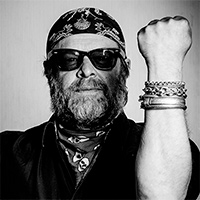
Boris Borisovich Grebenshchikov, widely known as BG, is a Soviet and Russian poet, musician, composer, singer and guitarist, born on November 27, 1953, in Leningrad. In 1972, together with Anatoly Gunitsky, he founded the band “Aquarium” and throughout its history has remained its central songwriter, vocalist and only permanent member. Grebenshchikov is one of the key figures in the development of Russian-language rock music: his work has evolved from the Leningrad underground and apartment concerts to major venues, international recordings and a decades-long musical project freely combining rock, folk, reggae, blues, electronic music, Celtic traditions, Indian music and Russian traditional music.
Dozens of songs associated with Grebenshchikov have become part of the history of Russian rock: “Rock 'n' Roll Is Dead,” “Electric Dog,” “Sitting on a Beautiful Hill,” “212-85-06,” “Adelaide,” “Train on Fire,” “Don't Drink Wine, Gertrude,” “Garçon No. 2,” “Ancient Russian Melancholy,” “Mom, I Can't Drink Anymore,” “Northern Flower”. A special place belongs to the song “City”, performed by Aquarium and widely known as “Golden City,” which gained enormous popularity after appearing in Sergei Solovyov’s film Assa. In his own Greatest Hits compilation, Grebenshchikov included these recordings among the most significant works from different periods of his career.
Childhood, Leningrad and the first songs
Boris Grebenshchikov grew up in Leningrad. In 1971, he graduated from the renowned Physics and Mathematics School No. 239 and then entered the Faculty of Applied Mathematics and Control Processes at Leningrad State University. He graduated in 1977 and worked for some time at a research institute, combining an ordinary job with the activity of a rock musician that was practically illegal by Soviet standards.
Grebenshchikov became interested in music while still at school. Western rock culture had an enormous influence on him, above all The Beatles, Bob Dylan, Marc Bolan, and later Bob Marley, as well as British and American rock of the 1960s and 1970s. His first songs were written in English, but he soon turned to Russian lyrics, which eventually became the main instrument of his own musical language.
Grebenshchikov’s poetry developed from the beginning in a way that differed sharply from traditional Soviet popular song. Instead of straightforward everyday narratives, he used cultural references, absurdity, religious and philosophical imagery, conversational speech, unexpected shifts in meaning and deliberately ambiguous metaphors. This approach later became one of the reasons Aquarium’s lyrics were perceived not simply as words set to music, but as an independent part of Russian rock poetry.
The creation of Aquarium
In the summer of 1972, Grebenshchikov founded Aquarium together with his school friend, poet and playwright Anatoly Gunitsky. At first it was more of a free-form musical and poetic project than a band in the modern sense. The lineup changed constantly, while musicians who played an important role in shaping the early sound gradually gathered around BG: Andrei “Dyusha” Romanov, Mikhail Feinstein, Vsevolod Gakkel, Alexander Lyapin, and later Alexander Titov, Pyotr Troshchenkov, Sergei Kuryokhin and others. Aquarium’s official archive dates the band’s first historical period to 1972–1991.
The early recordings were made in conditions where the Soviet recording industry effectively offered rock musicians no normal access to studios. This period includes “The Temptation of the Holy Aquarium,” “Parables of Count Diffusor” and “From the Other Side of the Looking Glass.” In 1978, Grebenshchikov recorded the acoustic album “All Brothers Are Sisters” with Mike Naumenko, the future leader of Zoopark. The official discography classifies these works as belonging to the early, pre-studio era of BG and Aquarium.
Apartment concerts and the Leningrad rock underground
During the 1970s, Aquarium existed outside the official concert system. The musicians performed at small informal shows, student events and the famous apartment concerts. This intimate environment strongly influenced Grebenshchikov’s music: voice, acoustic guitar and the text itself could be more important than the power of a full instrumental band, while songs spread among listeners through copied reel-to-reel and cassette recordings.
In 1977, Grebenshchikov also took part in the creation of the samizdat music magazine Roxy. For the Leningrad rock community, publications like this were almost the only way to discuss new music and their own scene independently of the official press.
Tbilisi-80 and the break with ordinary life
A turning point came with Aquarium’s performance at the festival “Spring Rhythms. Tbilisi-80”. The band’s unconventional stage behavior provoked a harsh reaction from part of the official jury. After returning to Leningrad, Grebenshchikov lost his job at the research institute and was expelled from the Komsomol. He later recalled the episode as an unexpected liberation from the need to combine music with a scientific career.
At almost the same time, sound engineer Andrei Tropillo entered Aquarium’s life. The opportunity to work in his studio at the House of Young Technicians radically changed the group’s situation. Over a relatively short period, Aquarium recorded “The Blue Album,” “Triangle,” “Acoustics” and “Electricity.” Grebenshchikov later directly associated the beginning of a new life for Aquarium with this studio cycle.
“The Blue Album” and Aquarium’s own musical language
“The Blue Album” from 1981 became the first major studio work by the classic Aquarium lineup. It already contains traits that would repeatedly change and return in later years: the influence of Bob Dylan, reggae, acoustic singer-songwriter music and rock bands, a free approach to genre boundaries, and a poetics unusual for Soviet song. Among the album’s central tracks are “Railway Water,” “Electric Dog,” “Tea” and “The Only Home.”
The following album, “Triangle,” revealed a completely different side of BG: absurdist, theatrical and playful. Even the early studio discography demonstrated the principle Grebenshchikov would follow for decades: the next album does not have to reproduce the sound of the previous one.
After the opening of the Leningrad Rock Club, Aquarium became one of its key participants. A new period began for the band: it still remained far removed from the state-controlled entertainment system, but now had a relatively permanent venue, festivals and the opportunity to exist within the developing Leningrad rock scene.
“Taboo” and Sergei Kuryokhin
The album “Taboo” was recorded in the summer of 1982. One of the most important figures of this period was composer and pianist Sergei Kuryokhin. His avant-garde thinking matched Grebenshchikov’s desire to break conventional song forms. The official history of the album directly emphasizes Kuryokhin’s role in the arrangements and in selecting some of the musicians.
The collaboration between BG and Kuryokhin was not limited to Aquarium. They participated in separate experimental recordings and later released joint material under the title “Mad Nightingales of the Russian Forest.” Through this connection, Grebenshchikov’s work became directly linked not only with Russian rock but also with the Leningrad musical avant-garde.
“Radio Africa” and “Rock 'n' Roll Is Dead”
One of the high points of the early period was the album “Radio Africa,” recorded in 1983. It was already much more than simply a rock record: reggae, new wave, art rock, electronic experiments, saxophone, Kuryokhin’s keyboards and an almost radio-drama-like structure collide within it. This is where “Rock 'n' Roll Is Dead” appeared, one of BG’s most famous songs, whose title became an independent cultural phrase. The official archive confirms that recording continued from late winter until July 1983, with the final mix completed later.
The meaning of “Rock 'n' Roll Is Dead,” however, is much broader than a literal statement about the death of a genre. For Grebenshchikov, rock was always first and foremost a form of inner freedom, so the song is more about the danger of living art turning into a familiar set of gestures and rules. This conflict between genuine movement and frozen form runs through many of his later works.
“Day of Silver” and “Children of December”
On “Day of Silver” from 1984, Aquarium’s music became significantly more spacious and serious. In addition to the usual guitars and rhythm section, the recording featured cello, flute, violin, trumpet and saxophone. The key songs include “Sitting on a Beautiful Hill,” “Ivan Bodhidharma,” “The Case of Master Bo” and “She Doesn't Know That These Are Dreams.”
It was followed by “Children of December,” recorded in 1985 and early 1986. On this album, Aquarium’s ability to exist simultaneously as a rock band, chamber ensemble and free association of musicians became fully established. It includes “212-85-06,” “She Can Move” and other characteristic songs of the period.
“City,” Assa and the emergence from the underground
In 1986, the live album “Ten Arrows” appeared, including a studio recording of the song “City.” It was Aquarium’s performance that made the song widely known. After being used in Sergei Solovyov’s film Assa, it became one of the most recognizable musical themes of the late Soviet era. Aquarium’s music was also used in Solovyov’s later films.
By this point, the situation surrounding Soviet rock itself was changing rapidly. In 1986, the double compilation Red Wave: 4 Underground Bands from the USSR, assembled by Joanna Stingray, was released in the United States. The record featured Aquarium, Kino, Alisa and Strannye Igry. It was one of the first major releases of Leningrad underground rock in the United States and an important step toward international recognition of the scene.
At the same time, Aquarium began appearing more frequently on television and at large concert venues. Music that only a few years earlier had existed mainly on duplicated tape recordings became part of mass culture.
“Equinox” and the end of the first Aquarium
“Equinox” became the final major studio work of Aquarium’s classic 1980s lineup. Grebenshchikov later called the album the “swan song” of that version of the band: the musicians had developed too many different interests and were finding it increasingly difficult to remain within a single group.
The album included “Adelaide,” while “Train on Fire,” recorded in 1988, also belongs to the same general era. The latter became one of Grebenshchikov’s best-known socially charged songs and was later placed by the author himself as the opening track on his Greatest Hits compilation.
Radio Silence and the attempt to enter the global market
At the end of the 1980s, Boris Grebenshchikov received the opportunity to record a full-scale international album. Radio Silence was created in the United States, the United Kingdom and Canada and released in June 1989 on CBS/Columbia. The producer was David A. Stewart of Eurythmics; Annie Lennox, Michael Kamen, Ray Cooper and other Western musicians participated in the recording, along with several members of Aquarium.
This was deliberately a different project rather than an English-language copy of Aquarium. Grebenshchikov later wrote that working on Radio Silence destroyed the band’s familiar idea of its own place in the world and confronted it with the realities of the international music industry. Despite high expectations, the album did not turn BG into a Western pop star, but it gave him experience working within a global studio system that was unique for a Soviet rock musician.
“Russian Album”
After the end of Aquarium’s first period, Grebenshchikov formed BG-Band. The main result of this stage was “Russian Album,” released on November 24, 1992. It differed sharply both from the Aquarium of the 1980s and from the Western-oriented Radio Silence. Acoustic instruments moved to the center, together with Russian folkloric and spiritual imagery and a sense of antiquity, anxiety and historical rupture.
“Nikita Ryazansky,” “Barge Hauler,” “Wolves and Ravens” are among the key works of this period. If earlier BG had mainly translated the language of Western rock into Russian cultural terms, here Russian musical and poetic tradition itself became the source material. This is why “Russian Album” occupies a special place even within Grebenshchikov’s exceptionally diverse discography.
The new Aquarium of the 1990s
In 1993, the name Aquarium returned, but the lineup and musical logic were already different. During the decade, the band released “Favorite Songs of Ramses IV,” “Kostroma Mon Amour,” “Navigator,” “Snow Lion,” “Hyperborea” and “Lilith.” The official discography shows how rapidly the sound of the project changed during this period.
“Kostroma Mon Amour” and “Navigator” firmly established the new form of the band, in which rock coexisted with folk, Eastern intonations and chamber instruments. The songs “Don't Drink Wine, Gertrude” and “Garçon No. 2” became some of BG’s most recognizable works of the mid-1990s.
The album “Lilith,” released on December 1, 1997, became another international Grebenshchikov project. Its musical environment combined Russian-language songs with the American roots-rock tradition.
From “Ψ” to “Fisherman’s Songs”
At the turn of the century, Aquarium continued to change its form constantly. “Ψ” became one of the most experimental works of the period, while “Sister Chaos” from 2002 returned the band to a denser and more contemporary rhythmic approach. In 2003, “Fisherman’s Songs” was released, recorded in part with reference to the Indian musical environment. AllMusic notes the jazz and world-music influences of the album, which reflect the increasingly international character of BG’s music.
This was followed by ZOOM ZOOM ZOOM in 2005, “Carefree Russian Vagabond” in 2006, “White Horse” in 2008, “Pushkinskaya, 10” in 2009 and “Arkhangelsk” in 2011. Instead of moving toward a single late-career style, the catalog continued to expand, from reggae and folk to Celtic instruments, electronic processing and chamber arrangements. The official catalog records all of these albums as successive stages in the history of BG and Aquarium.
Aerostat
A separate area of Grebenshchikov’s work became his author-hosted radio program “Aerostat,” which began airing in May 2005. For almost two decades, it was an important part of his public image: instead of promoting his own music, BG spoke about recordings he considered significant, ranging from 1960s rock and reggae to folk, classical music, avant-garde works and music from different peoples of the world. From May 2005 to May 2022, the program aired on Radio Russia and Radio Kultura before continuing online. In 2026, Aerostat remains a weekly program.
Aerostat is important for understanding Grebenshchikov himself: his own music has always been built from an enormous number of sources, and the radio program effectively reveals the author’s cultural library, from The Beatles and Bob Dylan to Indian classical music, Irish traditional music and little-known contemporary performers.
“Aquarium +,” “Salt” and “Time N”
In 2013, the album “Aquarium +” was released, produced by Mitchell Froom. The project featured musicians from different generations of Aquarium as well as international performers.
The next album, “Salt,” appeared on November 1, 2014. It was recorded in Los Angeles, London and St. Petersburg, with guest musicians including Richard Thompson, Ian Anderson, Andrew Bird and others. The album included “Harvest Festival at the Palace of Labor,” “Came to Drink Water,” “Governor” and “Love in a Time of War.”
In 2018, “Time N” was released. The album was recorded in several countries and once again demonstrated the international working system characteristic of later BG: the songs are fundamentally created by one author, but their sonic environment is shaped by musicians from different cultural traditions.
“Sign of Fire” and “Thor”
In June 2020, “Sign of Fire” appeared. The album combined reggae, folk, ethnic instruments, orchestral passages and contemporary studio processing. Among those who took part in the recording were the legendary Jamaican rhythm section Sly & Robbie, along with British and Russian musicians.
On December 31 of the same year, “Thor” was released. The recording featured Steve Gadd, Brian Finnegan, Alexander Titov, Andrei Surotdinov and other musicians. The album once again confirmed the central principle of late-period Aquarium: for BG, there is effectively no fixed instrumental lineup or single genre.
BG+ and music after 2022
Since February 24, 2022, the official website has referred to the active concert ensemble as BG+. Alongside Grebenshchikov, its current or recent lineup has included Alexander Titov, Brian Finnegan, Liam Bradley, Konstantin Tumanov, Andrei Surotdinov and Gleb Grebenshchikov. At the same time, Aquarium’s historical catalog continues to exist as a unified musical legacy.
In September 2022, the large-scale album “House of All Saints” was released. An international team was assembled once again: alongside the core lineup, the sessions featured Sly & Robbie, Krishna Das, Sheema Mukherjee, Eliza Carthy and other performers, as well as an orchestra and choir.
In 2023, BG+ released the EP “BOGRUKINOG” and the spiritually oriented project Songs of Clear Light, recorded with Krishna Das, Indian musicians and an international choir. In May 2024, the EP “New Silk Road” followed.
“Strange News from a Distant Star”
The new full-length album “Strange News from a Distant Star” appeared on Bandcamp on January 15, 2026, and on other digital platforms on February 18. The recording featured Alexander Titov, Konstantin Tumanov, Brian Finnegan, Liam Bradley, Andrei Surotdinov, Gleb Grebenshchikov and numerous guest musicians; the producers were BG and Chris Kimsey.
The album continues Grebenshchikov’s late-career direction, in which rock exists only as one component of a much broader musical language. Brass, strings, church organ, banjo, uilleann pipes and other instruments are used, while BG’s familiar philosophical and absurdist imagery coexists with direct reactions to the present. The very fact that such a major work appeared more than half a century after the creation of Aquarium underlines the unusual longevity of his songwriting career.
Boris Grebenshchikov’s musical style
It is virtually impossible to define Grebenshchikov’s music through a single genre. At different times, its foundations have included rock, folk rock, reggae, new wave, blues, art rock, electronic music, Russian romance, Celtic folk and Indian traditions. Yet the music remains recognizable through his songwriting, BG’s voice and the distinctive dramatic structure of his songs.
One of the most enduring influences remains Bob Dylan, above all the idea of the singer-songwriter for whom the text is an equal part of the composition. By the 1980s, however, Grebenshchikov had already created his own system incorporating Zen Buddhist imagery, Christian symbolism, Hindu philosophy, Russian literature, urban folklore and absurdity. The historical commentary on “The Blue Album” directly notes the combination of Dylan’s influence, reggae and an interest in Zen.
Another distinctive feature of BG is his ability to borrow not simply the external style of another musical culture but its underlying principle. Reggae in Aquarium does not become an imitation of Jamaica; Irish instruments do not turn the band into a traditional Celtic ensemble; and the elements of Russian song on “Russian Album” are not reduced to folkloric reconstruction. Grebenshchikov uses these languages as parts of his own system.
Poetry and lyrics
Boris Grebenshchikov’s lyrics are one of the main foundations of his influence. They are characterized by the absence of a single obligatory interpretation. An everyday detail, a religious symbol, a literary quotation and a deliberately absurd phrase can all coexist in the same song. This is why many of his lines continue to exist outside their original musical context.
At the same time, his poetry changed noticeably over the years. Early BG often used surreal urban language and irony; by the mid-1980s, the lyrics had become more metaphysical; “Russian Album” moved closer to the intonation of spiritual verse and folklore; and later works freely combine contemporary vocabulary, sacred imagery and satire.
Grebenshchikov has repeatedly emphasized that he does not seek to explain the final meaning of his own songs in advance. For him, it is more important that the text continue to reveal itself to the listener in different situations. This multiplicity of meanings became one of the defining features of the entire school of Russian rock poetry that emerged in the 1980s.
Grebenshchikov and other musicians
BG’s history is closely intertwined with the development of the entire Leningrad rock scene. In addition to collaborating with Mike Naumenko and Sergei Kuryokhin, he played a role in the development of the young “Kino” and in 1982 helped Viktor Tsoi during the recording of the band’s first album, “45.”
In later decades, the circle of collaborators became international. Musicians involved in BG’s studio projects have included David A. Stewart, Annie Lennox, members of The Band, Ian Anderson, Richard Thompson, Sly & Robbie, Brian Finnegan, Krishna Das and many performers of traditional music from different countries. The official discography shows that such connections are not isolated exceptions but a permanent principle of his work.
The significance of Boris Grebenshchikov
Grebenshchikov’s role in Russian music is defined not only by the age of Aquarium or the number of famous songs. He belonged to a generation that effectively had to create Russian-language rock culture without a developed independent music industry, legal clubs or free access to studios. This is why the history of Aquarium is also the history of Russian rock’s transition from apartment concerts and tape copies to professional albums and the international stage. AllMusic describes the biography of Grebenshchikov and Aquarium as the history of Russian rock ’n’ roll in miniature.
BG’s creative longevity is equally important. He did not remain an author associated with only one historical period: after the classic albums of the 1980s came “Russian Album,” the new version of Aquarium in the 1990s, international projects, “Salt,” “Time N,” later Aquarium recordings and BG+. Each of these stages has its own sound and its own audience.
Main albums by Aquarium and Boris Grebenshchikov
BG’s discography is unusually complex: some recordings were released as Aquarium, others under the name Boris Grebenshchikov, BG-Band or BG+; there are collaborative projects, early tape albums, anthologies and live recordings. The official catalog brings them together into a single creative history.
- “The Temptation of the Holy Aquarium” — 1973;
- “Parables of Count Diffusor” — 1974;
- “From the Other Side of the Looking Glass” — 1976;
- “All Brothers Are Sisters” — 1978, Boris Grebenshchikov and Mike Naumenko;
- “The Blue Album” — 1981;
- “Triangle” — 1981;
- “Electricity” — 1981;
- “Acoustics” — 1982;
- “Taboo” — 1982;
- “Radio Africa” — 1983;
- “Day of Silver” — 1984;
- “Children of December” — 1985/1986;
- “Ten Arrows” — 1986;
- “Equinox” — 1987;
- Radio Silence — 1989, solo English-language album;
- “Russian Album” — 1992;
- “Favorite Songs of Ramses IV” — 1993;
- “Kostroma Mon Amour” — 1994;
- “Navigator” — 1995;
- “Snow Lion” — 1996;
- “Lilith” — 1997;
- “Ψ” — 1999;
- “Sister Chaos” — 2002;
- “Fisherman’s Songs” — 2003;
- ZOOM ZOOM ZOOM — 2005;
- “Carefree Russian Vagabond” — 2006;
- “White Horse” — 2008;
- “Pushkinskaya, 10” — 2009;
- “Arkhangelsk” — 2011;
- “Aquarium +” — 2013;
- “Salt” — 2014;
- “Time N” — 2018;
- “Sign of Fire” — 2020;
- “Thor” — 2020;
- “House of All Saints” — 2022;
- “BOGRUKINOG” — 2023, BG+ EP;
- Songs of Clear Light — 2023;
- “New Silk Road” — 2024, BG+ EP;
- “Strange News from a Distant Star” — 2026.
Boris Grebenshchikov remains a rare example of a songwriter whose creative biography spans more than half a century without being reduced to performances of a classic repertoire. From Aquarium’s earliest tape recordings to the contemporary work of BG+, he has consistently changed lineups, recording methods and musical languages while preserving the most recognizable element of all: his own approach to the song as a space where rock can freely meet literature, folklore, religion, world musical traditions and personal experience.