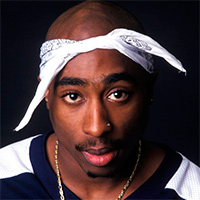
Tupac Amaru Shakur (2Pac, also known as Makaveli; born Lesane Parish Crooks; June 16, 1971, New York City — September 13, 1996, Las Vegas) was an American rapper, songwriter, actor and poet, and one of the key figures in hip-hop of the 1990s. His work combined social and political lyrics with deeply personal songs, gangsta rap and material about life in African American communities in the United States.
Among 2Pac’s best-known songs are «Keep Ya Head Up», «I Get Around», «Dear Mama», «So Many Tears», «California Love», «How Do U Want It», «Ambitionz Az a Ridah» and «Hit 'Em Up». After his death, archival recordings continued to be released, while All Eyez on Me and the compilation Greatest Hits received diamond certifications in the United States. In 2017, Tupac Shakur was inducted into the Rock and Roll Hall of Fame.
Family and childhood
The future musician was born on June 16, 1971, in East Harlem, New York City. At birth he was named Lesane Parish Crooks. When he was about one year old, his mother changed his name to Tupac Amaru Shakur — in honor of Túpac Amaru II, the leader of an Indigenous uprising in Peru against Spanish colonial rule in the 18th century.
His mother, Afeni Shakur, was a member of the Black Panther Party. In 1969, she became one of the defendants in the so-called «Panther 21» case, but in May 1971 she and the other defendants were acquitted. Tupac was born about a month after the trial ended.
Shakur’s biological father was Billy Garland, who was also connected with the Black Panthers. Tupac had little contact with him during childhood. Much of the family’s circle consisted of people involved in radical African American political movements, so issues of racial inequality, poverty, police violence and political struggle were present in his life long before he began his music career.
Baltimore School for the Arts
The family moved frequently. In the mid-1980s, Shakur settled in Baltimore and enrolled at the Baltimore School for the Arts. He studied acting, poetry, jazz and ballet and took part in theatrical productions.
At school, Tupac met future actress Jada Pinkett, with whom he maintained a close friendship. During this period, he also became seriously interested in rap and performed for a time under the name MC New York.
His artistic education later became clearly visible in his work. Shakur did not limit himself to rap: he wrote poetry, acted in films and treated songs as a form of dramatic storytelling.
Move to California and Digital Underground
In 1988, the family moved to California. Shakur lived in Marin City near San Francisco and continued writing poetry and music.
In 1990, he joined the hip-hop group Digital Underground. He initially worked as part of the touring crew and as a dancer, but soon began rapping. His first notable appearance on an official recording came on «Same Song», included on Digital Underground’s release This Is an EP Release and featured in the film Nothing but Trouble.
Working with Digital Underground gave Shakur his first professional experience of touring and studio recording and helped him secure a contract with Interscope Records.
2Pacalypse Now
On November 12, 1991, his debut solo album 2Pacalypse Now was released. Unlike Shakur’s later material, it was dominated by social themes: police violence, poverty, teenage pregnancy, racial discrimination and life in disadvantaged neighborhoods.
The album included «Brenda's Got a Baby», «Trapped» and «If My Homie Calls». It was not the biggest commercial success of his career, but it established 2Pac’s early image as a politically engaged rapper.
The material also generated serious controversy. U.S. Vice President Dan Quayle publicly criticized 2Pacalypse Now, saying that recordings of this kind had no place in American society. The controversy only increased attention around the young artist.
Film and Strictly 4 My N.I.G.G.A.Z.
Shakur’s acting career developed in parallel. In 1992, he played Roland Bishop in the crime drama Juice. In 1993, Tupac appeared alongside Janet Jackson in Poetic Justice, and in 1994 he played one of the central roles in the basketball drama Above the Rim.
In February 1993, his second studio album, Strictly 4 My N.I.G.G.A.Z..., was released. It retained the political focus of his early songs but was noticeably more accessible to a mainstream audience.
Its key tracks were «Keep Ya Head Up» and «I Get Around». The first addressed the position of women, poverty and male responsibility, while the second presented a lighter and more self-confident side of 2Pac’s persona.
Thug Life
In the first half of the 1990s, Shakur formed the group Thug Life. Its lineup included 2Pac, Big Syke, Mopreme Shakur, Macadoshis and The Rated R.
On September 26, 1994, the group released its only studio album, Thug Life: Volume 1. Its tracks included «Bury Me a G», «Cradle to the Grave», «Pour Out a Little Liquor» and «How Long Will They Mourn Me?».
The concept of Thug Life held a special place in Shakur’s worldview and was used by him far beyond the name of the group. It became part of his public image and lyrics in the mid-1990s.
Trial, New York shooting and prison
During this period, Shakur’s personal life was accompanied by numerous legal proceedings. The most serious case was connected with events in November 1993 at the Parker Meridien hotel in New York.
On December 1, 1994, a jury found Shakur guilty on three counts of first-degree sexual abuse. He was acquitted of the more serious charges of sodomy and unlawful possession of a weapon. The rapper denied forcing the woman to engage in sexual acts. In February 1995, he was sentenced to between one and a half and four and a half years in prison.
One day before the verdict, on November 30, 1994, Shakur was attacked inside Quad Recording Studios in Manhattan. He suffered multiple gunshot wounds and was robbed but survived.
After the shooting, Tupac’s relationships with several New York rappers deteriorated sharply. Shakur began to suspect that people associated with The Notorious B.I.G. and Sean Combs may have known about the planned attack. These suspicions were never proven, but they became one of the factors behind the later public conflict between figures associated with the East Coast and West Coast hip-hop scenes.
Me Against the World
While Shakur was in prison, his third studio album, Me Against the World, was released on March 14, 1995.
It differed significantly from the more aggressive recordings of the period that followed. The songs focused on death, loneliness, family, fear and his own mistakes. The album included «So Many Tears», «Temptations», «Me Against the World» and «Dear Mama» — a tribute to Afeni Shakur.
Me Against the World debuted at number one on the Billboard 200. The album’s success was especially unusual because its creator was in prison at the time.
Death Row Records
In the fall of 1995, Death Row Records co-founder Suge Knight arranged for $1.4 million bail to be posted, allowing Shakur to leave prison while his appeal was being considered. In return, the rapper signed with Death Row.
After his release, he returned to the studio almost immediately. The following months became one of the most productive periods of his life.
Working with Death Row also changed the artist’s public image. The socially focused rap of his early years did not disappear entirely, but gangsta rap, rivalry, wealth, street reputation and life in California occupied an increasingly prominent place.
All Eyez on Me
On February 13, 1996, the double album All Eyez on Me was released. It became the final 2Pac studio album issued during his lifetime and the biggest commercial success of his career.
The recording featured Dr. Dre, Snoop Dogg, Nate Dogg, Method Man, Redman, George Clinton, K-Ci & JoJo and other artists. Its major tracks included «California Love», «How Do U Want It», «Ambitionz Az a Ridah», «I Ain't Mad at Cha» and «All About U».
The album presented a very different 2Pac from the artist heard on 2Pacalypse Now: instead of predominantly political storytelling, it combined club tracks, hard gangsta rap, reflections on betrayal and more personal material.
Conflict with The Notorious B.I.G.
After joining Death Row, Tupac’s conflict with The Notorious B.I.G. and the Bad Boy Records circle developed from a personal dispute into one of the most famous rivalries in American hip-hop.
The harshest recording of this period was the diss track «Hit 'Em Up», aimed primarily at Biggie and Bad Boy. The song was released in the summer of 1996.
The rivalry was often described as an «East Coast vs. West Coast war», although the reality was more complicated. Many musicians from both scenes were not involved in the conflict, while the public rhetoric of artists, labels and the music press significantly amplified the perception of a broader feud.
Makaveli and The 7 Day Theory
During the final months of his life, Shakur began using the alias Makaveli, derived from the surname of Italian thinker Niccolò Machiavelli, whose works he read while in prison.
In August 1996, the material for the album The Don Killuminati: The 7 Day Theory was recorded in a very short period of time. Shakur did not live to see its release: the album appeared on November 5, 1996, under the name Makaveli.
It included «Hail Mary», «To Live & Die in L.A.», «Toss It Up» and «Against All Odds». Its darker atmosphere, repeated references to death and the new alias later generated numerous conspiracy theories that had no factual support.
Las Vegas shooting
On September 7, 1996, Tupac Shakur was in Las Vegas with Suge Knight, where they attended the Mike Tyson vs. Bruce Seldon boxing match at the MGM Grand.
After the fight, Shakur, Knight and members of their entourage became involved in a fight at the hotel with Orlando Anderson, who was associated with the South Side Compton Crips.
Later that evening, Tupac was riding as a passenger in a BMW driven by Suge Knight. At an intersection, a white Cadillac pulled up alongside the car and shots were fired. Shakur suffered multiple gunshot wounds. Knight was also injured, but his wounds were not life-threatening.
Tupac was taken to University Medical Center of Southern Nevada. He died on September 13, 1996, at the age of 25.
Murder investigation
For decades, the criminal case did not result in a conviction. The situation changed after investigators focused on Duane «Keffe D» Davis — a former leader of the South Side Compton Crips who had repeatedly spoken in interviews and memoirs about the events of that night.
In 2023, Davis was charged with murder. Prosecutors alleged that after the fight involving his nephew Orlando Anderson, Davis organized the retaliatory attack, supplied the weapon and was inside the Cadillac from which shots were fired at Shakur’s vehicle.
On August 31, 2026, a Nevada jury found Duane Davis guilty of first-degree murder with the use of a firearm. Investigators and the court did not claim that Davis himself pulled the trigger: the prosecution’s case was based on his role in organizing the attack. The identity of the person who actually fired the shots was not established in the court ruling.
Posthumous releases
Shakur recorded music at an exceptionally fast pace and left behind a large archive of unfinished and unreleased material. As a result, his discography continued to expand for many years after his death.
After The Don Killuminati: The 7 Day Theory, the albums R U Still Down? (Remember Me), Still I Rise with Outlawz, Until the End of Time, Better Dayz, Loyal to the Game and Pac's Life were released. In 1998, the compilation Greatest Hits appeared, including the posthumously completed tracks «Changes» and «Unconditional Love».
Tupac Shakur in film
Alongside music, Shakur also established an independent acting career. His filmography includes Juice, Poetic Justice, Above the Rim, Bullet, Gridlock'd and Gang Related.
The final two films were released after Shakur’s death. His acting roles demonstrated a wider range than his stage persona as a rapper: from the aggressive Bishop in Juice to the drug-addicted jazz musician Spoon in Gridlock'd.
Poetry
Shakur wrote poetry before beginning his professional music career. After his death, some of these works were published in the collection The Rose That Grew from Concrete.
The poetic side of his work is directly connected to his rap lyrics. Even in his hardest-edged songs, he repeatedly returned to family, loneliness, his own mortality, social injustice and the contradictions between his public image and personal vulnerability.
Legacy and influence
After Shakur’s death, interest in his music extended far beyond archival releases. His work influenced several generations of rappers, while the combination of social and political lyrics, emotional openness and gangsta rap became a reference point for artists across different branches of hip-hop.
In 2005, a bronze statue of Tupac was installed in the Peace Garden at the Tupac Amaru Shakur Center for the Arts in Stone Mountain, Georgia. The arts center later closed, and the original statue was removed from the site.
In 2017, 2Pac was inducted into the Rock and Roll Hall of Fame. On June 7, 2023, his star was unveiled on the Hollywood Walk of Fame in the Recording category. His younger sister Sekyiwa Shakur accepted the star on behalf of the family.
During his short career, Tupac Shakur created a body of work that combined political protest, street aggression, family memory, fear of death, romantic lyrics and self-analysis. It was this combination of different themes and emotional tones that made his catalog one of the most recognizable in hip-hop history.