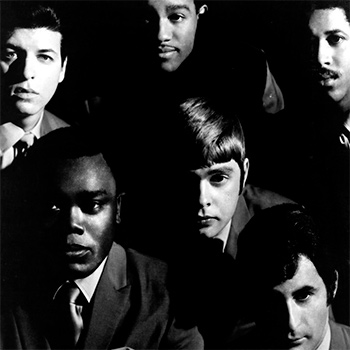
The Winstons hold a truly unique place in music history. They are one of those rare groups whose name remained in the shadows for decades despite having an enormous impact on global culture. In the late 1960s, The Winstons were simply another American soul/funk band performing across the Southern United States, but decades later it became clear that their music had laid the foundation for hip-hop, jungle, drum and bass, breakbeat, and a huge portion of the modern electronic music scene. The reason for this is the legendary “Amen Break”, a 6-second drum passage from the track “Amen, Brother”, which later became the most famous and most sampled rhythm in music history.
The Winstons were formed in Washington, D.C. in the late 1960s. The group was led by saxophonist and vocalist Richard Lewis Spencer. The original lineup also included drummer Gregory C. Coleman, organist Phil Tolotta, guitarist Quincy Mattison, bassist Sonny Peckrol, and saxophonist Ray Maritano. The band stood out not only for its powerful fusion of soul, funk, and gospel influences, but also because it was a multiracial group — something that posed serious challenges in the American South during the late 1960s. Despite the musicians’ talent, promoters and venues often refused to work with the band for that very reason.
Before achieving success on their own, The Winstons worked as a backing band for various artists, including the legendary The Impressions. That experience heavily shaped the group’s musical identity: their sound featured gospel harmonies, rhythm and blues sensibilities, and early funk in the style of Curtis Mayfield. According to Richard Spencer, it was Mayfield who once played a guitar riff that would later inspire the foundation of “Amen, Brother.”
The band’s true breakthrough came in 1969 with the release of the single “Color Him Father”. The song stood out sharply against the typical romantic soul ballads of the era. It was an emotional composition about a stepfather and family devotion — a subject rarely explored in popular music at the time. The track became a major hit, climbed the Billboard charts, and sold over a million copies. In 1970, the song won a Grammy Award in the category of Best Rhythm & Blues Song.
However, history decided that the real source of The Winstons’ immortality would not be the single’s A-side, but its B-side — the instrumental composition “Amen, Brother.” The track was recorded almost spontaneously. According to Spencer’s recollections, the band urgently needed material for the other side of the record, and the entire composition was created in roughly twenty minutes. It was built around a reworked traditional gospel motif called “Amen,” enhanced with a funky groove and musical improvisation.
At approximately the 1:26 mark, the rest of the instruments suddenly drop out, leaving drummer Gregory Coleman playing alone. The next few seconds became what is now known as the “Amen Break.” Technically, the fragment is a four-bar drum break with remarkably organic dynamics. Coleman performs a tight groove filled with characteristic ghost notes, subtle snare delays, and an accented crash hit at the end. It was precisely the imperfections of the performance — microscopic timing fluctuations, natural tape compression, and the “dirty” drum sound — that made the break feel so raw, human, and alive.
Genres Shaped by the Influence of the Amen Break
In the 1980s, the break found a second life thanks to the iconic DJ compilation series Ultimate Breaks and Beats. Hip-hop producers began cutting the drum fragment directly from vinyl records and looping it on turntables. Before long, the Amen Break became a cornerstone of early rap music and later the foundation of the entire British rave scene of the early 1990s. Jungle and drum and bass were essentially born from endless manipulations of this rhythm: producers sped it up, chopped it into pieces, rearranged drum hits, altered the pitch, and built entirely new rhythmic structures from it.
The Amen Break is believed to have been used in thousands of tracks — from N.W.A and Rob Base & DJ E-Z Rock to Oasis and Amy Winehouse. Its influence extended far beyond electronic music. The break can be heard in commercials, films, video games, television intros, and even mainstream sound design. Many music historians and producers describe the Amen Break as the “DNA of modern rhythmic music.”
Ironically, The Winstons themselves earned almost nothing from their legacy. Neither Gregory Coleman nor Richard Spencer received royalties for the widespread use of the break. Due to the legal realities and sampling culture of the early years, the musicians went decades without compensation despite the global reach of their recording. Richard Spencer later admitted that he initially viewed the situation as outright theft, although over time he became more philosophical about the break’s popularity.
The story of Gregory Coleman became one of the most tragic in music industry history. The man who performed the most influential drum break of the twentieth century died in poverty and near obscurity in 2006. His story is frequently cited as an example of the music industry’s injustices and the complex ethical questions surrounding sampling culture. In the mid-2010s, British drum and bass fans organized a fundraiser for Richard Spencer, collecting tens of thousands of dollars as a gesture of gratitude for The Winstons’ contribution to music.
After the group disbanded in 1970, its members largely disappeared from the mainstream music world. Yet the influence of The Winstons only continued to grow. While the band was once considered simply a strong soul/funk act in the late 1960s, today their name is permanently embedded in history as one of the cornerstones of modern electronic music. Without “Amen, Brother,” it would be impossible to imagine the evolution of breakbeat culture, British rave music, the golden age of hip-hop, and even the modern EDM scene.
The musical legacy of The Winstons is a rare example of a single short recording becoming more important than an entire discography. Their work became a bridge between the analog soul era of the 1960s and the digital music revolution of the twenty-first century. And although the musicians themselves never fully witnessed the scale of their influence, The Winstons are now regarded not merely as a cult group, but as true architects of modern rhythmic music.