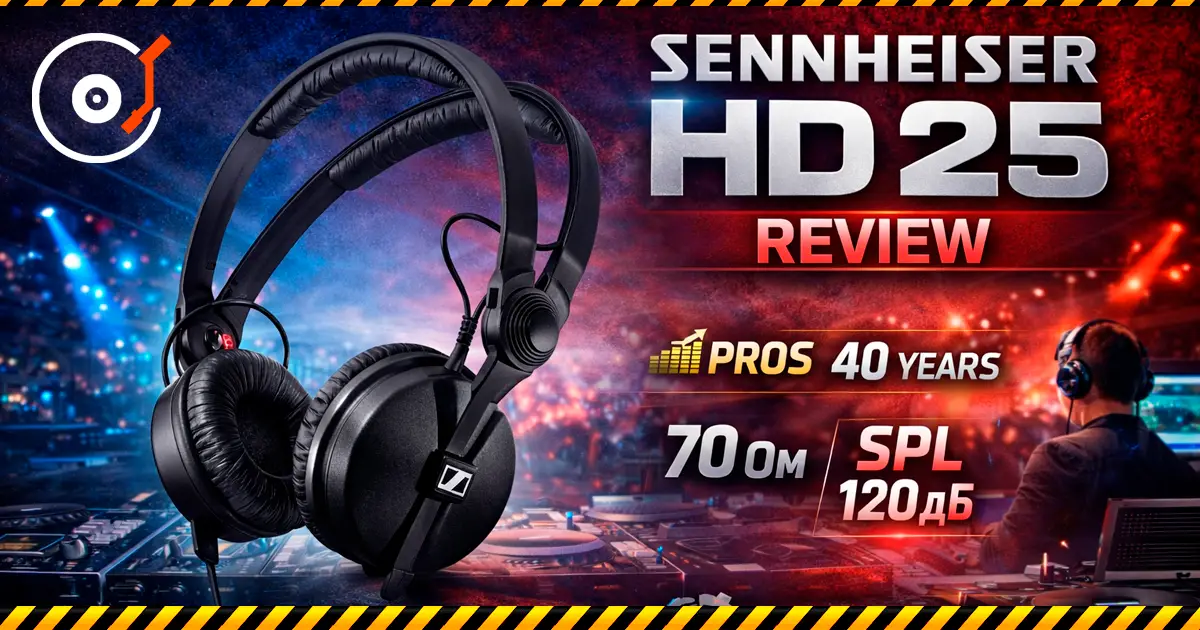
Discover the secret behind the popularity of Sennheiser HD 25. Field-tested experience by Victor PROG, a breakdown of the modular design, and the Standard, Plus, and Light versions. Why have professionals been choosing the HD 25 for 40 years?
There are headphones that are “good-looking,” there are “fashionable” ones—and then there are tools.
Sennheiser HD 25 are exactly that: a tool. They are not bought for looks or for “wow bass.” They are chosen when you need sound control in environments where everything else gives up: clubs, stages, broadcasts, field reporting, noisy studios.
This article is not about dry specifications. Below is real-world experience from DJ Victor PROG, engineering logic, and the reasons why the HD 25 have remained an industry standard for decades.
The Phenomenon of “Unattractive” Headphones
At first glance, the HD 25 look like a model from the late ’80s: plastic, minimal design, no gloss. And yet—you’ll find them in almost every DJ shop in the world.
Why?
Because this is not an accessory. It’s a working tool, like a hammer for a carpenter or a scalpel for a surgeon. Looks are secondary here—what matters is durability, sound intelligibility, and control.
From Aviation to Dancefloors: The Right Origin Story
The HD 25 were originally developed not for DJs. They were designed as monitoring headphones for work in extremely noisy environments, including aviation.
If headphones can provide clear monitoring in an aircraft cockpit, where the background is a constant engine roar, then a nightclub’s noise is a working condition for them—not a stress test.
This is where the following come from:
- exceptional passive noise isolation;
- high headroom for loudness without distortion;
- secure, firm fit on the head.
The Numbers That Actually Matter
This is where the details begin—the ones that separate professionals from “just users.”
High SPL (up to ~120 dB)
The HD 25 can operate at very high volume without audible distortion.
This is critical in a club where:
- stage monitors are blasting;
- subwoofers hit you physically;
- the DJ needs to hear transients, not mush.
70 Ohm Impedance — The Perfect Balance
The classic 70-ohm version is the sweet spot:
- works perfectly with DJ consoles and mixers;
- does not require a dedicated amplifier;
- retains control and dynamics.
Frequency Response Character: “Honest” Sound
The HD 25 do not make music sound “prettier.”
Their presentation is analytical:
Thanks to the emphasis in the upper mids, the HD 25 let you clearly hear the kick drum click, snare attack, and phase issues—even in extreme noise.
This is why:
- mixing mistakes are heard immediately;
- clipping is not masked;
- the mix does not “fall apart” at high volume.
“Lego” Construction: The Immortality of the HD 25
This is one of the main reasons for their cult status.
Absolute Modularity
In the HD 25, everything is replaceable:
- the cable;
- the ear pads;
- the headband;
- even an individual driver (capsule).
All of this—without a soldering iron, in just a few minutes.
For a professional, this means:
You buy the headphones once for 10–15 years, not every couple of seasons.
Split Headband
The signature dual headband:
- secures the headphones reliably;
- does not slip during active movement;
- evenly distributes pressure.
Why DJs and Sound Engineers Choose Them
The HD 25 didn’t become a standard by accident.
Weight — Only ~140 g
After a 4–5 hour set: no neck pain, no pressure fatigue—the headphones simply “disappear.”
Swiveling Ear Cup
The left ear cup swivels back—one-ear monitoring, a classic DJ workflow.
Passive Noise Isolation
So effective that active noise cancelling (ANC) is simply unnecessary. And most importantly—no phase artifacts that often interfere with ANC models.
HD 25 Versions: Don’t Mix Them Up
Brief and to the point:
- HD 25 (Standard)
The classic: split headband, straight 1.5 m cable, 70 ohms. - HD 25 Plus
The same, but includes:- coiled cable;
- velour ear pads;
- carrying pouch.
- HD 25 Light
Simplified headband, slightly different sound character.
A budget option, but not the reference.
Pro Tips
Things stores rarely mention:
- Velour ear pads
More comfortable for long sets, but slightly reduce low-end compared to leather pads. - Burn-in
Many users note that after ~50 hours of use, the sound becomes smoother and more cohesive. - Cable connector
The two-pin connector must be inserted until it clicks—otherwise signal dropouts may occur.
Are the Sennheiser HD 25 Worth the Money in 2026?
Short answer—yes, if you need a working tool.
The HD 25 are:
- an investment, not an impulse buy;
- a standard that has remained unchanged for nearly 40 years;
- a rare case where the industry has not invented a replacement—only alternatives.
And that is probably the strongest argument.
Final Verdict
Sennheiser HD 25 are a rare example of gear that became a standard not because of marketing, but because they simply do the job better.
If the global community of DJs and sound engineers has been making the same choice for decades, there are reasons for it.