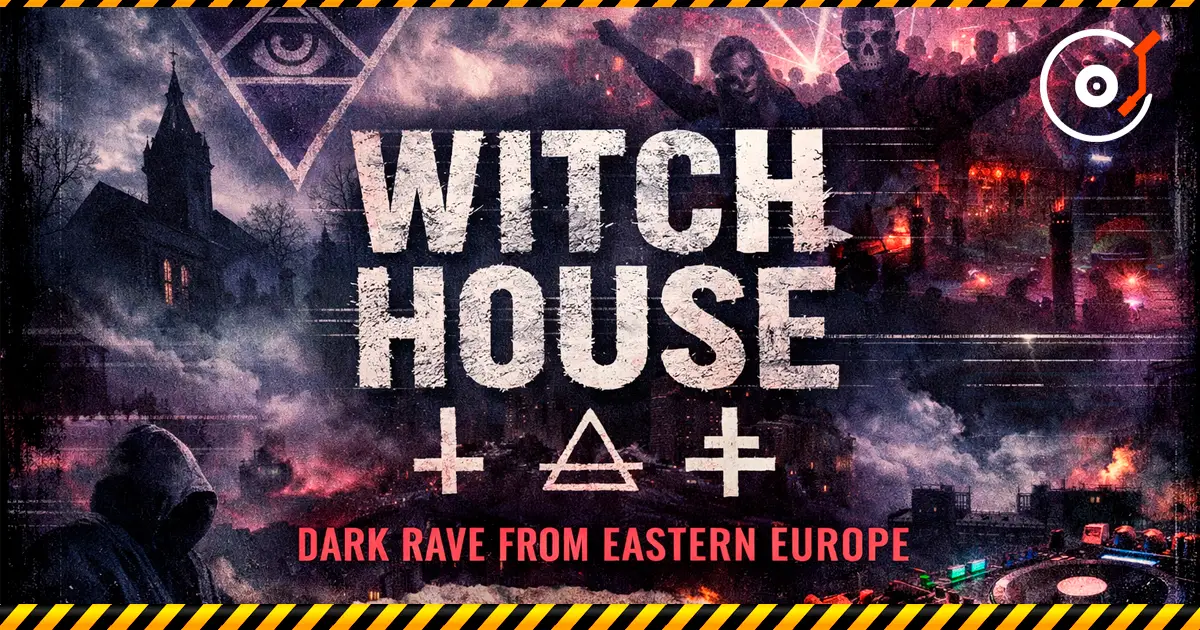
How did an encrypted genre with triangles in its names become the foundation of modern dark electronic music? Read the history of Witch House: from Salem’s canonical album to the powerful wave of Ukrainian raves.
The Witch House genre has long moved beyond the status of an internet curiosity or an aesthetic joke. Today it is a multi-layered musical phenomenon that has traveled a long path—from the American underground of the late 2000s to a powerful Eastern European rave wave that effectively prevented the genre from disappearing.
Origins of the genre: from a joke to a cult
Witch House took shape in the late 2000s – early 2010s as a reaction to the glossy and predictable electronic music of that era. The term itself was coined by the artist Pictureplane—initially in an ironic sense, without any intention of defining a fully fledged genre.
However, the name quickly became associated with a distinct sound and aesthetic. Witch House developed not through clubs, but through online platforms, DIY labels, and visual culture. It was a genre of the Tumblr, Bandcamp, and early YouTube era—closed, strange, and deliberately “uncomfortable.”
Sound and atmosphere: Drag, darkness, and stretched time
In its early phase, Witch House was often described by the term Drag—from the verb to drag. This word precisely captures the essence of the genre: the music seems to stretch time, immersing the listener in a viscous, hypnotic state.
Key sonic characteristics include:
-
slowed-down rhythms influenced by chopped & screwed and Southern hip-hop
-
dull, muted drums, often lacking sharp attack
-
distorted vocals: pitch-shifting, slowing, whispering
-
dark synthesizers, drones, ambient layers
-
elements of darkwave, industrial, noise, ambient
This is not dance music in the classical sense, but rather ritual listening—music of a state, not a moment.
VHS aesthetics and occultism: the visual code of the genre
Witch House became one of the first genres where visual identity was just as important as sound.
Characteristic elements include:
-
occult symbolism, ritual signs, pseudo-esotericism
-
VHS noise, glitch, grain, blurred shadows
-
dark, deliberately “broken” cover art
-
Unicode symbols in project names
It is important to emphasize that the use of symbols such as †, ▲, ‡, ✝ had a practical purpose. It was an “anti-search” strategy—artists deliberately made themselves difficult for algorithms and mass audiences to find.
Projects such as Ritualz or ▲Ṓ▲ existed as encrypted entities, reinforcing the feeling of a closed cult.
Genre classics: Salem and the “Bible” of Witch House
When discussing the formation of the genre, it is impossible not to mention Salem.
Their album King Night (2010) is considered the canonical Witch House release—essentially the genre’s “Bible.” It was here that the following elements crystallized:
-
slow, viscous rhythm
-
dark hip-hop groove
-
ritualistic atmosphere
-
an aesthetic of anxious detachment
Other important names of the classic wave include:
-
oOoOO
-
White Ring
-
Crim3s
The Eastern European phenomenon: the genre’s second life
By the mid-2010s, Witch House in the United States and Western Europe had noticeably faded.
And this is where a key chapter in the genre’s history begins.
Ukraine and the post-Soviet space: when Witch House became a rave
In Eastern Europe, Witch House didn’t just survive—it evolved.
Producers from Ukraine, Russia, and other post-Soviet countries brought into the genre:
-
a hard rave punch
-
club energy and a sound-system-oriented approach
Labels such as Witching Hour, local festivals, and raves (“Witch-out”, Skot) transformed Witch House from a meditative soundtrack into a dark, aggressive nocturnal ritual.
It is precisely this scene that continues to keep the genre alive, shaping its modern sound.
The modern phase: Witch House, Phonk, and Wave
In the 2020s, Witch House increasingly intersects with new genres:
-
dark phonk
-
wave
-
atmospheric trap
-
post-trance electronics
Many modern listeners arrive at Witch House via Phonk and Wave, discovering it as their dark source.
One notable contemporary project is Ships in the Night—an example of how the genre can be melodic and cinematic while still preserving its witchy atmosphere. This is no longer “anti-music,” but mature dark electronic sound.
Why Witch House is relevant again
Witch House has proven to be surprisingly resilient:
-
it does not depend on trends
-
it is not tied to algorithms
-
it easily adapts to new genres
Today it is not just a style, but an aesthetic ecosystem that unites sound, visuals, and a sense of mystery.
Witch House is no longer a joke genre or an internet artifact.
It is a dark line of electronic music that continues to develop—slowly, viscously, and stubbornly, exactly as true Drag sound should.