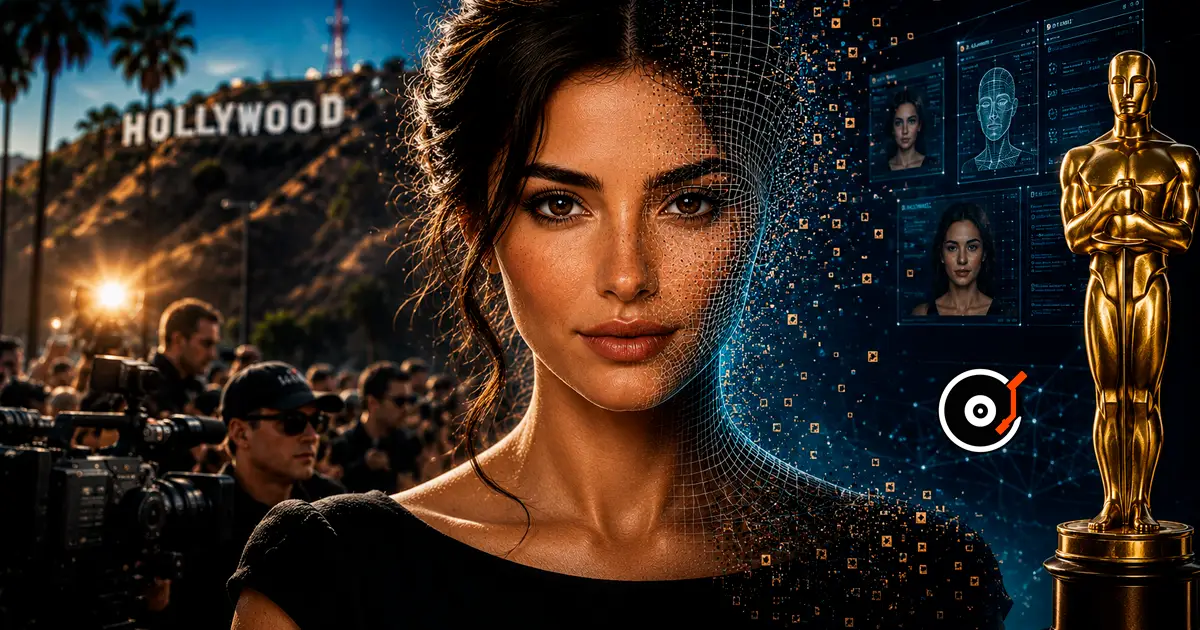
The first wave of AI actresses is already transforming Hollywood. How virtual stars, neural networks, and digital avatars are reshaping cinema, actors, the Oscars, and the future of the entertainment industry.
On May 6, debate over the future of the film industry erupted once again across the media landscape. The reason was Tilly Norwood — a fully AI-generated “actress” whom her creators are already calling the next future star of Hollywood. Some see the project as a technological breakthrough, while others view it as a threat to the acting profession and even to the very concept of art itself.
Who Is Tilly Norwood and Why Is the Entire World Talking About Her?
Tilly Norwood is a digital character created using generative artificial intelligence. She has the appearance of a young brunette with a “perfect” smile, her own social media accounts, music videos, interviews, and even ambitions to win an Oscar. The only problem is that Tilly does not actually exist.
The project was created by Xicoia, a studio owned by Particle6, founded by Dutch actress and comedian Eline Van der Velden. According to the creators, Tilly is not just an experiment, but a fully fledged next-generation media product.
Modern neural network systems for image generation, video synthesis, facial animation, voice cloning, and motion rendering were used to create the character. Virtually all content featuring Tilly — from photographs to video clips — is generated by AI.
The creators emphasize that developing the digital actress required months of work, countless iterations, and extensive model training. They compare the process to writing a literary character or crafting a cinematic persona.
The Illusion of a Real Celebrity
Tilly’s uniqueness lies not only in the technology itself, but also in the presentation. Her social media accounts are designed to make her appear like a real Hollywood celebrity. She “walks” through major cities, posts behind-the-scenes photos, shares her thoughts, and teases upcoming projects.
Within just a few months, her Instagram following grew from several tens of thousands to more than 150,000 followers. At the same time, the audience fully understands that she is an artificially created character.
However, that is precisely what makes the experiment so fascinating: the boundary between a real person and a digital persona is intentionally blurred.
Despite the impressive level of realism, viewers still regularly notice typical flaws associated with AI-generated video:
- slight lip-sync delays;
- unnatural facial expressions;
- “plastic-like” emotional delivery;
- strange eye movements;
- anatomical inconsistencies in complex scenes.
Yet even these flaws are far less noticeable today than they were just two years ago. And it is precisely the speed of technological progress that frightens the industry the most.
Why Hollywood Sees Tilly as a Threat
The film industry’s biggest fear is connected not to the character herself, but to what she represents.
Tilly Norwood is the first major attempt to present AI not as a visual effect or CGI enhancement, but as an independent commercial entity capable of replacing a human actor.
That is exactly what has angered unions and many Hollywood stars.
The position of SAG-AFTRA, America’s largest actors’ union, has been especially harsh. The union stated that Tilly cannot be considered an actress because she was created using data trained on the work of thousands of real performers without their consent or compensation.
In reality, the industry fears several things at once:
- mass replacement of actors;
- the devaluation of human performance;
- the unauthorized use of faces and voices;
- the disappearance of cinema’s emotional uniqueness;
- reduced production costs through digital avatars.
The issue has become especially sensitive following the historic 2023 SAG-AFTRA strike, where AI was one of the central causes of conflict between actors and studios.
Actors React: “This Is Truly Terrifying”
One of the strongest reactions came from Emily Blunt. When journalists showed her images of Tilly Norwood, the actress appeared genuinely horrified:
“That’s AI? Oh God, we’re doomed. This is genuinely terrifying.”
Blunt reacted particularly sharply when Tilly was compared to Scarlett Johansson:
“But we already have Scarlett Johansson.”
That sentence perfectly captures the essence of the conflict. For actors, the issue is not just technology — it is the possibility that studios may eventually decide they no longer need real people.
Whoopi Goldberg also expressed skepticism toward the project, although she believes AI still cannot fully replicate human physicality, emotion, and presence.
But Haven’t Digital Characters Existed for Years?
Tilly’s creators like to call her the “first AI actress,” although that is not entirely accurate.
In reality, the entertainment industry has been moving toward virtual characters for decades.
Hatsune Miku and the Culture of Virtual Stars
Japan has embraced virtual idols since the early 2000s. The most famous example is Hatsune Miku.
She performs in front of thousands of fans as a 3D hologram, sells merchandise, appears in advertising campaigns, and has achieved cult status.
In China, virtual streamers and VTuber personalities have become massively popular on platforms such as Bilibili.
What makes Tilly different is that she is specifically trying to enter traditional Hollywood — an industry built around human personality and celebrity.
CGI Has Been “Resurrecting” Actors for Years
Hollywood has long relied on digital technologies to create characters.
For example:
- in Rogue One: A Star Wars Story, Lucasfilm used CGI to digitally recreate the late Peter Cushing;
- in Furious 7, technology helped complete scenes featuring Paul Walker after his death;
- modern blockbusters regularly use de-aging technology, deepfakes, and CGI enhancements.
However, until now, the technology remained merely a tool. Tilly, by contrast, is being positioned as a standalone star.
Why Studios Are Still Interested in AI
Despite public criticism, major studios continue investing heavily in AI technologies.
The reason is simple: money.
AI can:
- reduce production costs;
- accelerate pre-production workflows;
- generate concept art;
- create digital crowds;
- automatically dub scenes;
- translate films into multiple languages;
- digitally de-age actors;
- synthesize voice performances.
Some analysts are already comparing the current moment to the CGI revolution of the 1990s.
Back then, many people also claimed that computer graphics would “destroy cinema.” Instead, CGI became an industry standard.
Can AI Really Replace Actors?
For now — no. But it can already partially replace them.
The main limitation of modern AI characters is the absence of genuine human experience. Even the most advanced systems merely imitate emotions.
Human acting relies not only on facial expressions, but also on:
- micro-movements;
- internal emotional experience;
- personal trauma;
- intonation;
- the energy of physical presence;
- improvisation;
- chemistry between performers.
At the moment, AI reproduces only the external shell.
However, technology is evolving so rapidly that even skeptics admit the situation could change dramatically within the next five to ten years.
Why the Situation Is Especially Dangerous Right Now
Modern generative AI is already capable of:
- creating photorealistic faces;
- synthesizing voices;
- replicating speech patterns;
- generating video;
- animating emotions;
- creating near real-time deepfakes.
The biggest turning point came between 2024 and 2026, when video generation quality improved dramatically thanks to models such as Sora, Runway, Pika, Kling, and other next-generation systems.
Where AI-generated content once looked obviously artificial, audiences are now increasingly experiencing the so-called “uncanny realism effect,” where fake content is no longer immediately recognizable.
Why the Academy Has Already Stepped In
Following heated debate, the Academy of Motion Picture Arts and Sciences officially introduced rules limiting AI participation in major Oscar categories.
Under the new rules:
- acting categories are reserved exclusively for humans;
- screenplays must be written by people;
- AI cannot be recognized as a legitimate performer.
In effect, the Academy has already closed the door on projects like Tilly Norwood winning an Oscar.
However, this does not mean AI is banned from filmmaking. On the contrary, studios are expected to continue adopting these technologies even more aggressively.
The Most Interesting Part: Tilly Is Already a Successful Marketing Project
Regardless of public opinion, Tilly Norwood has already achieved her primary objective — capturing the attention of the entire world.
Every new video sparks:
- discussion;
- controversy;
- hate;
- admiration;
- viral reactions.
And in today’s internet economy, attention is the ultimate currency.
Tilly’s creators clearly understand how social media works. They deliberately provoke the industry, publish ironic videos, and even play with people’s fears.
In one viral clip, Tilly deliberately fails a CAPTCHA test — a system designed to distinguish humans from bots.
In another post, following a joke announcement about her “shutdown,” the character declares:
“You won’t get rid of me that easily — I exist on everyone’s hard drive.”
That sentence may be the perfect description of the era we are now entering.
What Happens Next?
Most likely, the future will not involve replacing humans entirely, but rather the rise of a hybrid industry model.
Human actors will remain the foundation of major cinema for a very long time. But alongside them, we will increasingly see:
- digital doubles;
- AI avatars;
- virtual influencers;
- synthetic hosts;
- fully digital characters.
And the first people to feel the impact will not be Hollywood superstars, but rather:
- background actors;
- stunt doubles;
- advertising models;
- voice actors;
- supporting performers;
- localization specialists.
These are the sectors AI is already beginning to replace.
The Main Question Is No Longer About Technology
Technology will almost certainly continue evolving. The real question now is whether audiences are emotionally prepared to accept digital actors.
Because cinema is not just about visuals. It is about emotional connection.
And as long as audiences still want to see genuine emotions, real faces, and authentic human stories, Hollywood does not yet need to fear the complete disappearance of actors.
But after the emergence of Tilly Norwood, one thing has become absolutely clear: the era in which artificial intelligence existed merely as a behind-the-scenes tool is officially over.