Detailed overview of Eurovision 2026: how the contest took place in Vienna, why Bulgaria’s DARA won, how many points Bangaranga scored and what made the final memorable.
Eurovision 2026 became one of the most symbolic editions of the contest in recent years. The 70th anniversary Eurovision Song Contest took place in Vienna, at the Wiener Stadthalle, where the Grand Final was held on May 16. For the Austrian capital, this was already the third Eurovision after the contests of 1967 and 2015, with ORF serving as the host broadcaster. The three live shows were hosted by Victoria Swarovski and Michael Ostrowski.
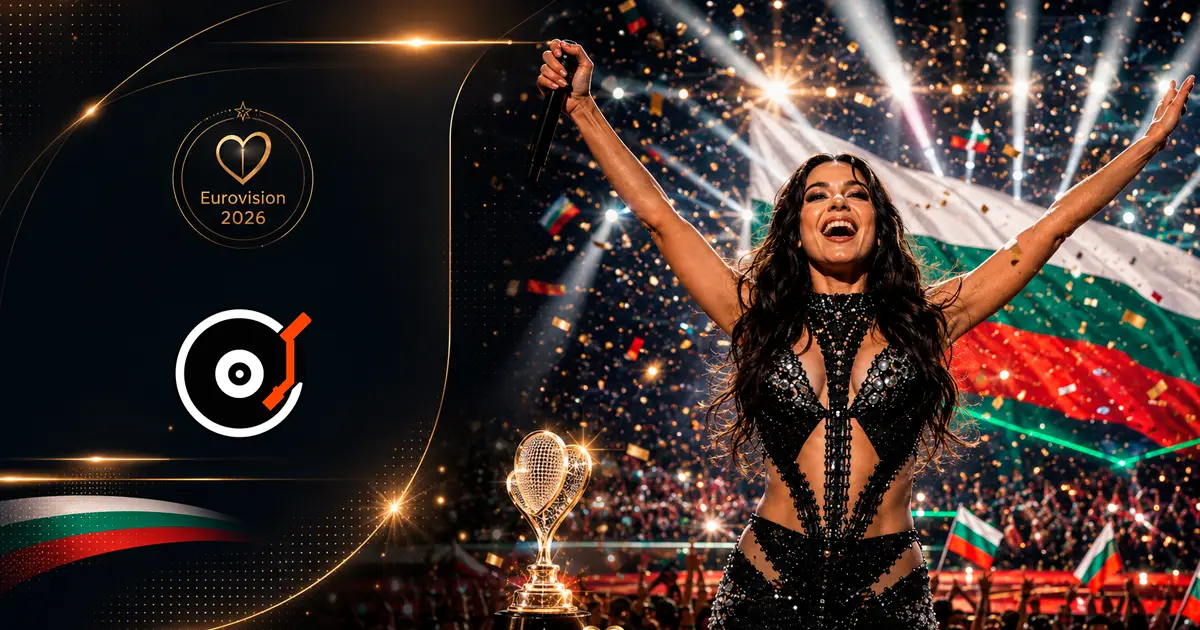
The final ended with a historic victory for Bulgaria: singer DARA won with the song “Bangaranga”, scoring 516 points and bringing the country its first-ever Eurovision trophy. The victory was especially powerful because Bulgaria returned to Eurovision after a break, having missed the contests in 2023, 2024 and 2025. The comeback was not simply successful, but record-breaking — DARA won both the jury vote and the public vote.
According to official data, “Bangaranga” received 204 points from the juries and 312 points from the viewers. It was the first time in almost a decade that the juries and the public had chosen the same winner: the last such coincidence happened in Kyiv in 2017. Moreover, DARA’s lead over second place was 173 points — the largest winning margin in Eurovision history, surpassing the previous record set by Alexander Rybak with “Fairytale” in 2009.
Israel finished second: Noam Bettan performed the song “Michelle” and scored 343 points. Romania, which also returned to the contest in 2026, came third with Alexandra Căpitănescu and her song “Choke Me”. Australia and Italy also entered the top five. For Romania, the bronze result repeated the country’s best-ever Eurovision placing, while for Australia, fourth place was its strongest result since 2016.
DARA won not only because of a strong song, but also thanks to a complete stage concept. “Bangaranga” is not just a dance-pop track, but a performance in which club energy is combined with Bulgarian cultural code, sharp choreography and visual dramaturgy. Associated Press noted that DARA herself linked the song to the theme of inner strength and liberation from the mask of perfectionism, as well as to the Bulgarian kukeri — traditional ritual figures who, in folk culture, drive away evil spirits.
For the artist herself, the victory became a moment of international breakthrough. DARA has long been considered one of the notable figures of the modern Bulgarian pop scene: she has a powerful voice, vivid stage presence, successful radio hits and experience as a mentor on The Voice of Bulgaria. The official Eurovision website emphasizes that her songs and music videos have generated more than 80 million combined streams and views, while the album “ADHDARA”, released in 2025, marked her transition from a local pop star to an artist with a more clearly defined international identity.
Vienna 2026 was, in general, a contest of comebacks. A total of 35 broadcasters took part, while 25 countries performed in the final. Alongside Bulgaria, Moldova and Romania also returned — and all three countries ultimately finished in the top 10. At the same time, five countries — Iceland, Ireland, the Netherlands, Slovenia and Spain — did not participate; AP linked this to a boycott over Israel’s participation.
The political backdrop around the contest nevertheless remained visible. Before the final, protests against Israel’s participation took place in Vienna, and during the contest week there were reports of attempts to disrupt one of the performances. AP wrote that four people were removed for trying to interfere with Noam Bettan’s semi-final performance, while hundreds of protesters marched near the arena before the final.
Another major controversy erupted after the contest in Moldova. According to Reuters, public outrage was triggered by the Moldovan jury vote: it gave Romania only 3 points despite the close cultural and linguistic ties between the two countries, while Moldovan viewers awarded Romania the maximum score. Against the background of public reaction, the head of Moldova’s public radio and television broadcaster, Vlad Țurcanu, announced his resignation.
Musically, Eurovision 2026 looked extremely diverse. Organizers noted in advance that a record number of languages — 25 — would be heard in the contest, including dialects and borrowed linguistic elements. English remained the most prominent language, but 12 countries completely avoided it in their competing songs. This is an important trend: Eurovision is increasingly bringing national languages and local musical identity back into focus.
One interesting feature of the year was the dominance of solo female artists. In 2026, as many as 15 countries sent solo female performers to the contest, and DARA ultimately confirmed that a bright female pop performance can be not only spectacular, but also convincing for professional juries. At the same time, the contest preserved its familiar eclecticism: from techno-pop and R&B to rock entries, folk elements, dance-pop and theatrical staging.
From a technical perspective, Vienna 2026 became one of the most large-scale Eurovision editions ever. The venue used 28 live cameras, including RF cameras, Steadicams, handheld cameras, aerial systems, railcam and large camera cranes. The production involved around 38 kilometers of cable, more than 80 network switches and a data flow of around 4.2 terabytes per second. The lighting system was equally impressive: more than 3,100 lighting fixtures, almost 50 million LED pixels and a fully energy-efficient LED/laser-based lighting rig.
Rule changes also deserve special mention. In 2026, 50% jury voting was returned to the semi-finals, while the number of members in each national jury was increased from five to seven. At least two jury members also had to be between the ages of 18 and 25 — a move reflecting the contest’s desire to take younger audiences and their musical tastes into account.
The 2026 final also became a jubilee show of memory and continuity. In a special interval act dedicated to the 70th edition of the contest, recognizable names from Eurovision history returned to the stage: Alexander Rybak, Lordi, Ruslana, Verka Serduchka, Kristian Kostov, Erika Vikman, Max Mutzke and other artists. This underlined Eurovision’s greatest strength: the contest can be both an archive of European pop culture and a platform for new stars.
DARA’s victory is important not only for Bulgaria, but for the entire Balkan pop scene. It shows that a regional artist with a strong individuality, a local cultural foundation and a modern international sound can win Europe’s biggest televised music competition. “Bangaranga” worked as a complete pop product: song, voice, movement, choreography, symbolism and camera direction were brought together into one clear stage impact.
Minatrix.FM editorial opinion: We are glad to see that in recent years Eurovision has increasingly returned to evaluating artistry, vocals, songwriting and stage ideas. Of course, the political background around the contest has not disappeared completely — and 2026 showed that as well. But DARA’s victory looks exactly like the case where the main arguments were talent, energy, professional staging and the artist’s ability to convince both the juries and the viewers. For a music contest, this is the right signal: it should not be an agenda that wins, but a strong song and a real artist.