 Макsим
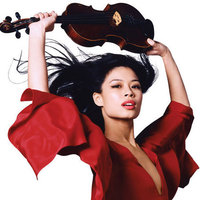
Vanessa-Mae, full name Vanessa-Mae Vanakorn Nicholson (born October 27, 1978, Singapore), is a British violinist and one of the best-known representatives of classical crossover of the 1990s and 2000s. She received a classical education and performed with orchestras from childhood, but gained worldwide popularity by combining the violin with electronic music, pop, rock and dance rhythms.
The artist herself described her approach as Violin Techno-Acoustic Fusion. It was most clearly expressed on the 1995 album The Violin Player, where works by Bach and other classical themes appeared alongside electronic rhythm sections, synthesizers and electric violin. The record turned the sixteen-year-old performer into an international star and became the defining release of her career.
Singapore, London and musical education
Vanessa-Mae was born in Singapore to a Singaporean mother of Chinese descent and a Thai father. After her mother married Briton Graham Nicholson, the future musician moved to London and took her stepfather’s surname.
She began studying music at a very early age. In Singapore, Vanessa learned piano, and after moving to the United Kingdom she took up the violin. Her official biography states that at the age of eight she underwent intensive training with Professor Lin Yaoji in Beijing, after which she continued her education in London.
At the age of 11, Vanessa-Mae was admitted to the Royal College of Music in London and became its youngest student at the time. By that age, she was already performing with professional orchestras. Her first major concert appearances took place in the late 1980s, including performances with the Philharmonia Orchestra, and in 1991 she went on an Asian tour with the London Mozart Players.
Early classical recordings and Guinness record
Before the appearance of her pop hits, Vanessa-Mae had already built a substantial early classical discography.
In 1990, shortly before her twelfth birthday, she recorded the album Violin with the London Mozart Players. It was released in 1991 and included works by Sarasate, Kabalevsky, Mozart and Wieniawski. The same early period also produced Kids' Classics and a recording of the violin concertos by Tchaikovsky and Beethoven.
It was the latter project that brought her an officially recognized Guinness World Records achievement: Vanessa-Mae is considered the youngest soloist to record both the Tchaikovsky and Beethoven violin concertos. She was 13 at the time of the recording.
Her later move into popular music therefore came after a full classical training rather than as an attempt to replace academic technique with a striking stage image.
The Violin Player and the move into crossover
The turning point came after she signed with EMI. Instead of continuing exclusively as a classical soloist, Vanessa-Mae decided to combine the violin with contemporary studio production.
The result was The Violin Player, released in 1995. In the United Kingdom, the album first entered the chart in February 1995 and peaked at No. 11 on the Official Albums Chart.
One of its central tracks was an electronic version of Bach’s Toccata and Fugue in D Minor. The album also included Contradanza, Classical Gas, Red Hot, Widescreen and other pieces that combined acoustic and electric violin with programmed rhythms and contemporary studio processing.
Vanessa-Mae used the term Violin Techno-Acoustic Fusion to describe precisely this approach: classical technique remained the foundation of her playing, while the musical environment could incorporate pop, rock, dance, jazz and electronic elements.
The commercial impact was far greater than that of her early classical recordings. By 1997, the British press was already reporting sales of more than three million copies of The Violin Player.
Electric violin and a new stage image
One of Vanessa-Mae’s visual and sonic trademarks became the Zeta electric violin. Alongside it, she also used a traditional acoustic violin made by Giovanni Battista Guadagnini in 1761.
The electric instrument allowed greater freedom with amplification, processing and effects and was better suited to concerts featuring drums, synthesizers and a full pop band.
Her stage presentation also differed markedly from a traditional classical concert. Lighting, choreography, video projections and modern clothing became part of the performance. This approach drew criticism from more conservative parts of the classical establishment, but at the same time allowed instrumental music to reach audiences that had little interest in conventional violin concerts.
The Classical Album and two parallel careers
The move into crossover did not mean abandoning the classical repertoire.
In 1996, she released The Classical Album 1, recorded in part with the London Symphony Orchestra. The program included Bach, Brahms, Beethoven and Max Bruch’s Scottish Fantasy.
This established a model characteristic of Vanessa-Mae’s career: commercially oriented electronic albums existed alongside more traditional classical projects.
The success of this strategy was unusual for an instrumental performer. In 1996, Vanessa-Mae received a BRIT Awards nomination in the British Female Solo Artist category, competing in one of the main pop categories despite remaining primarily a violinist.
China Girl and Hong Kong
Her next classical project was China Girl: The Classical Album 2, released in 1997.
Its program emphasized the performer’s connection with Asian culture. The famous Chinese Butterfly Lovers Violin Concerto occupied a central place, while the album also included Violin Fantasy on Puccini's Turandot and Happy Valley — The 1997 Re-unification Overture.
That same year, Vanessa-Mae performed in Hong Kong during events marking the transfer of the territory from the United Kingdom to China. According to her official biography, she was invited to perform at midnight at the Happy Valley racecourse.
This performance should not be confused with Tan Dun’s separate Symphony 1997: Heaven Earth Mankind, in which the principal solo part was performed by cellist Yo-Yo Ma. The concert programs were connected to the same historic event but represented different projects.
Storm: Vanessa-Mae’s most electronic side
If The Violin Player introduced the very idea of techno-acoustic fusion, Storm developed it in the direction of even more explicit pop and dance music.
The album appeared in the United Kingdom in 1997 and reached No. 27 on the Official Albums Chart. In some countries, its release and promotion continued into 1998, which is why both dates appear in catalogs.
One of the central compositions was Storm, based on musical material by Vivaldi. The album also included a version of Donna Summer’s disco song I Feel Love, demonstrating how far Vanessa-Mae was willing to move away from traditional ideas of the classical violin.
The period of The Violin Player — China Girl — Storm most fully shaped Vanessa-Mae’s public image: a classically trained violinist who simultaneously existed within electronic and pop culture.
World Music Award and commercial success
In 1997, Vanessa-Mae received the World Music Award as World's Best-Selling Classical Artist. At the time, The Classical Album 1 was also described as one of the fastest-selling solo classical recordings of its period.
The artist’s current official biography gives total catalog sales of more than 10 million albums. This figure refers to her entire international discography and includes both crossover releases and classical recordings.
At the same time, Vanessa-Mae’s Guinness connection is not related to a sales record, as some biographies claim, but to her early recording of the Beethoven and Tchaikovsky concertos.
The Original Four Seasons
For her next major classical project, Vanessa-Mae turned to one of the best-known works in the violin repertoire — Antonio Vivaldi’s The Four Seasons.
The album The Original Four Seasons and The Devil's Trill Sonata appeared on the international market in 1998–1999; the artist’s current official catalog dates it to February 25, 1999. In addition to Vivaldi’s cycle, the record included Giuseppe Tartini’s famous Devil’s Trill Sonata.
This release clearly shows that even at the height of her pop fame, Vanessa-Mae did not abandon large-scale classical works.
Subject to Change
In 2001, Vanessa-Mae released Subject to Change, continuing the electronic side of her work.
Here, the violin appeared alongside house, European pop, ethnic instruments and vocal elements. Among the best-known tracks from this period are Destiny, White Bird and Yantra. AllMusic classifies the album simultaneously under pop/rock, classical, jazz, classical crossover, Euro-pop and house, which accurately reflects the absence of strict genre boundaries in Vanessa-Mae’s music.
Choreography and music from different cultures
In 2004, she released Choreography — to date, the last major studio album of original material in Vanessa-Mae’s main discography.
The project was conceived as a journey through different musical traditions and included elements of Indian, Middle Eastern, European and contemporary orchestral music. Recording took place in several studios, including Abbey Road and Panchathan Record Inn in Chennai.
A special place was given to Roxane's Veil, written by Vangelis. It was later connected with the music for Oliver Stone’s film Alexander.
After Choreography, no new full-length studio albums appeared in Vanessa-Mae’s official catalog, although her earlier recordings continued to be reissued on digital platforms. In 2025, Warner Classics separately released the digital title Toccata & Fugue, containing both the album and single versions of her famous reworking of Bach.
Collaborations outside her solo discography
Over the course of her career, Vanessa-Mae has appeared on projects by artists with very different musical backgrounds.
She played on the title track of The Velvet Rope by Janet Jackson, participated in material connected with Prince, worked with the Japanese group GLAY, and also took part in film-related projects. Her official biography separately mentions her collaboration with Disney on music connected with the animated film Mulan.
Such work was consistent with the overall logic of her career: for Vanessa-Mae, the violin was never limited exclusively to the symphony hall and could exist within pop, rock, electronic music and film.
Alpine skiing and the Sochi Olympics
Vanessa-Mae’s second major passion is alpine skiing.
Using her biological father’s surname, she competed in sporting events as Vanessa Vanakorn and qualified to represent Thailand at the 2014 Winter Olympics in Sochi.
On February 18, 2014, she competed in the women’s giant slalom. According to the official results of the International Ski Federation, Vanakorn finished 67th, last among the athletes who completed both runs.
The story, however, continued after the Olympics.
FIS concluded that several qualifying competitions in Slovenia, which had allowed Vanakorn to earn the necessary ranking points, were conducted with irregularities and initially imposed a four-year ban on the athlete.
In 2015, the Court of Arbitration for Sport (CAS) overturned the personal four-year suspension, ruling that there was insufficient evidence that Vanakorn herself had knowingly participated in the manipulation. At the same time, the court upheld the annulment of the disputed competitions and confirmed that, as a result, she did not meet the qualification requirements for participation in the 2014 Olympics.
Vanessa-Mae’s sporting history therefore became legally unusual. CAS confirmed that after the disputed qualifying events were annulled, she formally did not meet the eligibility requirements for the Games, but found insufficient evidence of her personal involvement in manipulation and overturned the four-year suspension. In January 2016, the International Olympic Committee decided not to annul her result from Sochi. In the official Olympic statistics, Vanessa Vanakorn retained 67th place in the giant slalom, and FIS later apologized to her.
Musical style
The most accurate description of Vanessa-Mae’s music is classical crossover, although her most characteristic recordings go far beyond simply performing classical music in modern arrangements.
Her music includes:
- classical violin technique;
- classical works and their reinterpretations;
- electric violin;
- synthesizers and electronic processing;
- dance and house rhythms;
- pop and rock;
- orchestral music;
- Asian and other ethnic elements.
At the same time, Vanessa-Mae was not always the direct composer of every piece. A significant part of her crossover catalog was created jointly with composers, arrangers and producers. Vanessa-Mae herself participated in the development of violin parts, musical ideas and a number of original works. For this reason, the description “violinist and classical crossover performer” more accurately defines her primary role than simply calling her a “composer.”
Main discography
- Violin — 1991;
- Kids' Classics — 1991;
- Tchaikovsky & Beethoven Violin Concertos — 1991;
- The Violin Player — 1995;
- The Classical Album 1 — 1996;
- China Girl: The Classical Album 2 — 1997;
- Storm — 1997/1998;
- The Original Four Seasons and The Devil's Trill Sonata — 1998/1999;
- Subject to Change — 2001;
- Choreography — 2004.
Separate compilations included The Best of Vanessa-Mae, The Ultimate Vanessa-Mae, The Classical Collection and other reissues. The current official catalog identifies The Violin Player, The Classical Album, China Girl, Storm, The Original Four Seasons and The Devil's Trill Sonata, Subject to Change and Choreography as the main releases from the EMI period and subsequent years.
Main awards and achievements
- Guinness World Record — youngest soloist to record both the Tchaikovsky and Beethoven violin concertos;
- BRIT Awards — nomination for British Female Solo Artist in 1996;
- ECHO Klassik — awards connected with the success of The Violin Player;
- World Music Award — World's Best-Selling Classical Artist, 1997;
- more than 10 million albums according to the artist’s official biography.
At the same time, claims found in some biographies about a separate “MTV Europe Recognition” award or a Guinness record specifically for worldwide sales are not among Vanessa-Mae’s reliably confirmed key achievements and are not necessary for a professional biography.
Vanessa-Mae’s significance
Vanessa-Mae’s main contribution was not the invention of classical crossover itself — combinations of classical and popular music had existed long before her. Her distinction lay elsewhere: in the mid-1990s, she turned the solo violin into a fully-fledged instrument of international pop culture.
The Violin Player appeared at a time when electronic dance music, large-scale music videos and global television were rapidly changing the music market. Vanessa-Mae brought into this environment an instrument that mass audiences had previously associated primarily with the classical concert hall.
Behind the stage image, however, was an unusually early classical training: the Royal College of Music, performances with orchestras, three classical recordings by the age of thirteen and a documented Guinness record.
It is precisely the combination of these two biographies — a classical violin prodigy and an international crossover performer — that distinguishes Vanessa-Mae from many later artists who used the electric violin in pop and electronic music.
Her most important period is associated with The Violin Player, The Classical Album, China Girl and Storm: these recordings showed that the violin could exist just as naturally with a symphony orchestra as with an electronic rhythm section, pop arrangement and large-scale concert show. This is why Vanessa-Mae remains one of the most recognizable figures in the history of modern crossover violin.