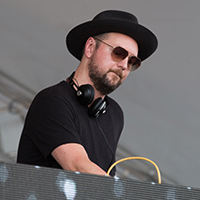
Kölsch (real name — Rune Reilly Kølsch; born February 9, 1977) is a Danish DJ, composer and music producer from Copenhagen, and one of the most prominent representatives of European melodic techno and house. His music combines the firm rhythmic foundation of club electronics with piano, strings, extended synthesizer passages and melodies built around gradual emotional development. His best-known tracks include Loreley, Opa, Der Alte, All That Matters, Cassiopeia, DerDieDas, Grey, Push, Goodbye, Hal and The Lights, while the albums 1977, 1983, 1989, Now Here No Where, Isopolis, I Talk To Water and KINEMA form the core of his discography.
Kölsch's career began long before the emergence of the Kölsch name. During the 1990s and 2000s, he released house and techno under various aliases, worked in projects such as Artificial Funk, Ink & Needle and Enur, and under the name Rune created the instrumental track Calabria — one of the most recognisable dance melodies of its era. Only after years of experience in both commercial and underground electronic music did the producer focus on Kölsch, a project in which personal memories and family history became direct material for his music.
Childhood in Christiania
Rune Reilly Kølsch was born in Christiania, the autonomous district of Copenhagen established in the early 1970s on the site of former military barracks. His parents were connected with Christiania's original community, so the future musician spent his earliest years in an unusual environment shaped by communal living, alternative culture and distrust of traditional social institutions.
When Rune was around seven years old, the family left Christiania and moved to another communal settlement in northern Denmark. His childhood later became a recurring source of musical imagery for Kölsch. Particularly important were his relationship with his parents, trips through Germany and other European countries, the music his father listened to and the feeling of growing up under the influence of several cultures at once.
His father, Patrick Reilly, played guitar, wrote songs and travelled and performed during the 1960s and 1970s, including in the Middle East, but ultimately chose family life over a professional music career. Many years later, his surviving recordings became part of one of his son's most personal albums, I Talk To Water.
From hip-hop to house and techno
Rune became involved with music while still a child. At the youth club he attended during his skateboarding years, there was also a disco, a radio studio and a breakdancing scene. Around 1989–1990, he began experimenting as a DJ. During the same period, he formed his first teenage group, Rune And The Motherfuckers, in which he sang and performed his own versions of rap and Prince songs.
Kölsch later took up drums. While trying to reproduce the sound of hip-hop records, he became interested in sampling and in the way old funk tracks could become the foundation of new music. After getting an Amiga 500 computer, Rune began assembling his first electronic compositions on his own.
Discovering house music proved decisive. Among the records that influenced his transition from hip-hop to electronic dance music, Kölsch himself has recalled The Goodmen and DJ Pierre. He became increasingly attracted not to the song structure of rap, but to the possibility of building music from rhythm, repetition and the gradual transformation of a small number of elements.
His first officially released record appeared in 1995 on Multiplex. At the same time, Rune began performing at underground techno parties in Copenhagen. Even then, his musical reference points included Detroit techno and Chicago house, with Derrick May having a particularly strong influence on him.
Artificial Funk and early projects
In the late 1990s and early 2000s, Kölsch worked under several different names at once. One of the most notable projects of this period was Artificial Funk. Later came Rune, Rune RK, Heavy Rock, Rude RKade, Ink & Needle and other aliases that allowed him to separate different directions of his music.
This use of multiple names was common in the electronic scene of the era: a single producer could simultaneously release accessible vocal house, instrumental club music and more experimental recordings for different record companies. In Kölsch's case, the period proved especially important because it allowed him to work both with mainstream dance music and with much harder forms of techno.
In the mid-2000s, he developed Ink & Needle — a series of more minimal and experimental releases associated with Tattoorecs. These records received support from DJs including Richie Hawtin, Sven Väth and Ricardo Villalobos, revealing another side of a producer whom much of the wider audience already knew through far more accessible music.
In 2006, Kölsch performed for the first time at Berlin's Berghain, underlining his connection with the European techno scene long before the Kölsch name achieved international recognition.
Calabria
The major commercial work of his early period was Calabria, released in 2003 under the name Rune. The instrumental house track was built around an instantly recognisable saxophone line and over time received numerous new versions.
In 2007, Kölsch returned to the music through the project Enur. The new version, Calabria 2007, was recorded with Danish singer Natasja Saad and combined the original dance foundation with her vocals and elements of dancehall. The track achieved international success and reached number one on Billboard's US dance radio chart.
The story of Calabria is important to Kölsch's biography not only because of its commercial success. It shows that even before the creation of his main project, he already possessed a rare ability to build an electronic composition around one very simple and recognisable melodic element. That principle would later appear in Loreley, Opa, Grey and other tracks, although the aesthetic would become considerably deeper and closer to techno.
The emergence of the Kölsch name
By the end of the 2000s, Kölsch increasingly wanted to stop dividing his work between commercial dance projects and the music he personally considered most meaningful. In 2009, he fully established Kölsch as an independent project.
A key role was played by Michael Mayer, one of the founders of Cologne record label Kompakt. The collaboration with Kompakt allowed the musician to combine melody, years of experience creating accessible dance music and his interest in techno under a single name.
The first track of the new period was Loreley, released in the Speicher series. The title refers to the famous Lorelei rock on the Rhine and at the same time to Kölsch's memories of Germany. It was followed by Silberpfeil, Opa and Der Alte. Their titles were also connected with German culture and the producer's childhood memories.
These releases fully established the Kölsch approach. Instead of minimal techno, where change is deliberately reduced to a minimum, he offered large melodic themes, emotional crescendos and an almost song-like dramatic structure — while still preserving the duration, rhythmic construction and dynamics required for club performance.
1977
Kölsch's first album, 1977, was released by Kompakt on June 24, 2013. The title corresponds to the musician's year of birth and established the autobiographical principle that would continue across two more albums.
The record collected the already familiar Loreley, Opa, Der Alte and All That Matters with Troels Abrahamsen, alongside new compositions including Goldfisch, Bappedekkel, Basshund, Oma, Wasserschutz and others.
1977 was not simply a collection of successful club tracks. The titles and moods of individual pieces were connected with specific memories. Opa means “grandfather” in German, Der Alte refers to a German television series, while Silberpfeil points to the famous German racing cars known as the “Silver Arrows”. Family memory was therefore built directly into the club music.
All That Matters occupies a particularly important place. Troels Abrahamsen's vocals and the gradually expanding harmony made the track one of Kölsch's most characteristic works: the rhythm does not overpower the melody, but instead creates space for it to develop.
The success of 1977 established Kölsch firmly within the Kompakt catalogue and effectively determined the direction of his future career. What had previously existed as one of Rune Kølsch's many projects became his principal creative identity.
1983
The second album, 1983, appeared in 2015. While 1977 was primarily connected with origins and family memories, the next record was built around childhood journeys across Europe.
Kölsch recalled how, in 1983, his family drove from Denmark to the south of France while his father's favourite records played in the car. Later, Rune received his own cassette player, and early electro and hip-hop were added to his parents' musical collection. Travelling through different European countries became, for him, a sequence of musical and visual memories.
This idea defined the character of 1983. The album is structured as a movement between calm episodes and large club climaxes. Central tracks include DerDieDas, Two Birds, Moonface, Unterwegs, Pacer, Die Anderen, E45, Talbot, The Road and Cassiopeia. Composer and arranger Gregor Schwellenbach contributed to several pieces, adding orchestral elements to the electronic sound.
On 1983, it became especially clear that Kölsch's music went beyond the standard division between house and techno. Strings, piano and extended harmonic transitions could carry as much weight as the bass drum and synthesizer sequence.
Grey and 1989
One of Kölsch's best-known instrumental tracks is Grey, released in 2016. The composition is built around a short repeating theme that gradually opens up through the addition of new harmonic layers. Pete Tong described Grey as one of the major dance records of that period; its success led to suggestions that vocals should be added to make it more accessible to a mainstream audience, but Kölsch kept it instrumental.
In 2017, Grey was included on the third album in the autobiographical series, 1989. The record was released by Kompakt on September 22. Other key tracks include Push, Goodbye, Grå, Grau, Liath, Serij and In Bottles, recorded with Norwegian singer AURORA.
On 1989, the autobiographical narrative reached the period when Rune himself began DJing. The title points back to the end of his childhood and his first independent musical discoveries. The opening miniature 1989 is also connected with the family theme and was recorded with Ludwig Kölsch.
The three albums — 1977, 1983 and 1989 — later came to be viewed as a unified cycle. Kompakt described them as a kind of sonic diary in which the producer successively returned to the early years of his own life.
Performance at the Eiffel Tower
One of Kölsch's best-known performances took place on October 16, 2017 at the Eiffel Tower in Paris as part of the Cercle project. The DJ set lasted more than an hour and was later officially released as Cercle: Kölsch at Tour Eiffel in Paris, France.
The setting was particularly well suited to Kölsch's music: the vast open urban landscape emphasised the large-scale melodic structures that had by then become the defining feature of his work.
At the same time, Kölsch regularly performed at major festivals and clubs, maintaining an unusual position between two sides of the electronic scene. His music could work both at large open-air events and in programmes focused primarily on techno and house. He had developed this ability to connect with very different audiences during the period when he was simultaneously involved in commercial and underground projects.
Remixes and collaborations with other musicians
Kölsch also became known for his reinterpretations of other artists' music. He worked with tracks by Coldplay, The Chemical Brothers, London Grammar, Sven Väth and a number of other artists. Among the best known are his version of Coldplay's A Sky Full of Stars and his rework of Wide Open by The Chemical Brothers featuring Beck.
At the same time, his own discography increasingly included direct collaborations. Kölsch released music with Tiga, Sasha, Dubfire, Michael Mayer, Beacon, Magit Cacoon and other figures from the electronic scene. Apple Music highlights his collaborations with Tiga, Sasha and Michael Mayer as an important part of the period following the original album trilogy.
In 2018 came Hal, created with Tiga. In 2019, Kölsch and Sasha recorded The Lights. Later collaboration with Dubfire led to Louisiana and ULM, while Waste My Time was released with CamelPhat.
IPSO and Fabric Presents Kölsch
Expanding his creative independence, Kölsch created the record imprint IPSO, which became a platform for his own projects and collaborations. His relationship with Kompakt nevertheless continued: many of his most personal albums were still released through the Cologne label.
In 2019, Fabric Presents Kölsch was released. It was not another studio album in the traditional sense, but a continuous artist-curated programme for the famous series associated with London's Fabric club. Kölsch constructed a unified musical narrative from his own material, preserving the principle that his tracks should be experienced not only individually but also as parts of a longer dramatic arc.
Now Here No Where
After the trilogy of memories, Kölsch deliberately changed direction. The album Now Here No Where, released by Kompakt on September 25, 2020, was no longer about the past but about the present.
While 1977, 1983 and 1989 allowed him to look at events years after they had happened, the new record asked a different question: is it possible to turn into music the feelings a person is experiencing right now?
The album includes Great Escape, Shoulder Of Giants, Remind You, Sleeper Must Awaken, Traumfabrik, Fandango, Glypto, Romtech User Manual and the title track Now Here No Where. The American duo Beacon appears on Time and Pause.
Strings and melodic lines became even more important here, but the album retained its connection with the dancefloor. Kölsch linked it to uncertainty, social tension, environmental concerns and his own emotional changes. The central theme, however, remained hope rather than simply documenting crisis.
Isopolis
In 2021, Isopolis appeared on IPSO — one of the most unusual works in the Kölsch catalogue. The album was conceived as a sonic diary of a city during isolation and moved noticeably away from conventional club form.
Here, space, silence and atmosphere are often more important than direct dance rhythm. Isopolis demonstrated that Kölsch's melodic side could exist separately from a functional club structure. If his earlier work tried to unite emotion and the dancefloor, this record allowed the first of those elements to move into the foreground.
I Talk To Water
In 2023, Kölsch returned to Kompakt with the album I Talk To Water. Its central theme was the death of his father Patrick Reilly, who passed away in 2003, and the way grief continues to affect a person decades after the loss itself.
During the pandemic, Kölsch returned to an archive of his father's recordings. Instead of simply using them as samples, he built several compositions in such a way that it sounded as though father and son were recording music together.
Patrick Reilly's guitar appears on Grape, his music became the basis of Tell Me, while the closing It Ends Where It Began almost entirely preserves the space of a recording made by his father in 1996. According to Kölsch himself, this material had originally been intended for an early album that was never released.
The title track I Talk To Water features Perry Farrell, vocalist of Jane's Addiction and Porno for Pyros. His performance strengthens the album's central theme — the attempt to find a way of speaking with memory and to experience the absence of a loved one not as a completed event, but as a continuing part of one's own life.
I Talk To Water naturally continues the autobiographical principle of Kölsch's early albums, but does so much more directly. While 1977 or 1983 encoded memories in titles and instrumental melodies, here real family recordings become part of the sound recording itself.
KINEMA and Kölsch and the Machine
The next full-length album, KINEMA, was released in 2025 on IPSO. The standard edition contains ten tracks, with an expanded edition arriving later.
The title comes from a Greek word associated with movement. Musically, Kölsch consciously broadened his familiar melodic techno framework: while making the album, he drew on influences from soul, opera, folk and shoegaze and placed greater emphasis on songwriting.
The album includes All Week, Kinema, Home, Hands of Mine, a new orchestral interpretation of All That Matters and other works. At the same time, the record was created with more than club playback in mind. It was important to Kölsch that the music could function equally well during quiet listening at home and on a large sound system.
In parallel, the live project Kölsch and the Machine emerged. In it, the musician brought part of his studio system, including modular synthesizers, onto the stage and structured the performance so that pre-prepared compositions could be altered directly during the show. The new programme premiered during Amsterdam Dance Event.
This development fits naturally with Kölsch's entire history. He began with DJing, later became a studio producer, but never fully separated creating music from performing it before an audience. Kölsch and the Machine effectively brings the two sides together: the compositions retain the structure of authored works while leaving room for improvisation.
Kölsch's musical style
Kölsch's music is most often described as techno, melodic techno and house, although genre labels only partially capture it. The main distinction in his work lies not in the instruments he uses, but in the way the compositions are constructed.
Kölsch often begins with a small musical idea — a few piano chords, a synthesizer sequence or a short melody. It then changes gradually as new harmonies and rhythmic elements are added around it. As a result, the climax does not feel like a sudden transition between sections, but rather as the culmination of a long development.
One characteristic feature of Kölsch is the use within techno of principles more commonly associated with other musical forms. Strings can perform a full dramatic function, the voice is not necessarily the centre of the composition but one instrument among others, and a repeating electronic sequence can function like a theme in instrumental music.
For this reason, Kölsch's emotional effect rarely depends on making arrangements more complicated. On the contrary, his best-known tracks are often built on very simple motifs. Loreley, Opa, All That Matters and especially Grey demonstrate how much development can be created around only a few notes.
Another defining feature is autobiography. The titles of Kölsch's albums and tracks are rarely accidental. Geographical names, German words, dates, family memories and real archival recordings form a system through which a significant part of his discography can be understood as a musical autobiography.
Kölsch discography
Studio albums
- 1977 — 2013
- 1983 — 2015
- 1989 — 2017
- Now Here No Where — 2020
- Isopolis — 2021
- I Talk To Water — 2023
- KINEMA — 2025
- KINEMA (Deluxe Edition) — 2026, expanded edition of the album
Artist-curated mixes
- Fabric Presents Kölsch — 2019
- Cercle: Kölsch at Tour Eiffel in Paris, France — 2017 — officially released recording of the DJ performance
Key tracks
Among Kölsch's most significant works are Loreley, Silberpfeil, Opa, Der Alte, All That Matters, Goldfisch, Cassiopeia, DerDieDas, Two Birds, Grey, Push, Goodbye, In Bottles, Left Eye Left, Hal, The Lights, Shoulder Of Giants, Time, Louisiana, ULM, I Talk To Water, Waste My Time, All Week and Kinema.
Calabria occupies a separate place in his creative biography. It was created before the Kölsch project emerged and was first released in 2003 under the name Rune. Its international story continued through Enur's Calabria 2007, but Kölsch's later career moved in a completely different direction — from a mainstream dance hit toward an individual form of melodic techno.
Kölsch belongs to the group of electronic musicians for whom a club track became a way of telling a personal story without having to turn it into a traditional song. From childhood memories on 1977 and family journeys on 1983 to his father's archival recordings on I Talk To Water and the freer combination of electronic and instrumental music on KINEMA, his catalogue follows one consistent principle: technology is not an end in itself, but a means of conveying melody, memory and emotional movement. This continuity has shaped Kölsch's recognisable musical language and allowed his work to exist simultaneously in techno clubs, festival programmes and outside the dancefloor.