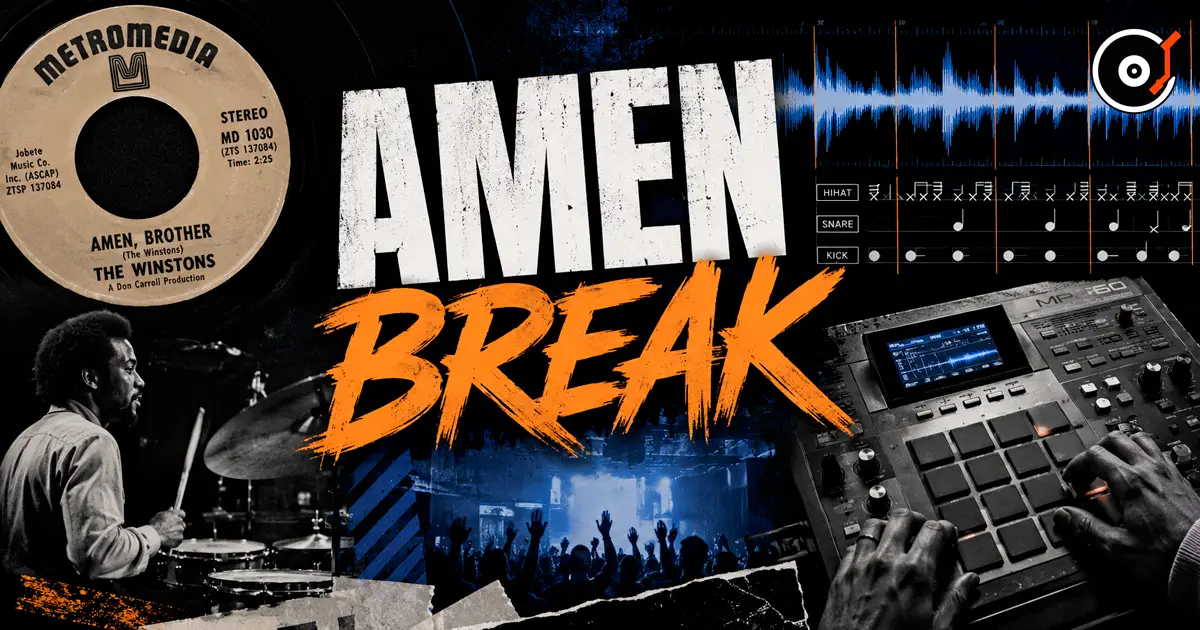
Amen Break is a legendary drum sample from 1969 that became the foundation of hip-hop, jungle, and drum & bass, and the most sampled break in music history.
Amen Break is a drum break from the composition “Amen, Brother” by The Winstons, recorded in 1969. Within this track lies a short drum solo lasting approximately 5.2 seconds, performed by drummer Gregory Coleman.
From a music history perspective, this is one of the most paradoxical phenomena ever: a fragment of a secondary soul composition became a foundational building block of hip-hop, jungle, drum & bass, and breakcore.
It is important to understand the scale — this is not a catchy riff or a vocal phrase, but a purely rhythmic fragment that has been used for decades as a fundamental element in constructing entirely new tracks.
Historical context: from 60s soul to the digital era
The original recording of “Amen, Brother” was released as the B-side to “Color Him Father” in the late 1960s. It is a typical soul arrangement of its era, where drums play a supporting role. However, in the middle of the track, a short drum fill occurs — a moment that would later become more significant than the rest of the song.
From a technical standpoint, this is a live analog recording without digital processing. There is no quantization, no modern post-production, and the entire sound is shaped purely by the musicians’ performance and studio acoustics. This is precisely what made the break suitable for its “second life.”
Anatomy of the Amen Break: what makes it unique
From a modern production perspective, the value of the Amen Break lies not in the pattern itself, but in the details of its performance.
First is micro-timing. Snare and hi-hat hits do not land perfectly on the grid. Some events slightly rush, others lag behind. This creates a “floating” groove that is extremely difficult to reproduce via MIDI without losing its character.
Second are ghost notes — quiet intermediate hits that form the internal structure of the rhythm. They create a sense of continuous motion even when primary accents are absent. In digital drum programming, these nuances are often lost or become too sterile.
Third is dynamics. The Amen Break was recorded in an era without heavy compression. The difference between the softest and loudest hits is enormous by modern standards. This gives the break a natural, three-dimensional feel even under extreme processing.
Sound engineering and frequency structure
From a spectral analysis perspective, the Amen Break is almost a perfect study case.
The kick occupies a dense low-frequency range around 60–110 Hz, creating a physical impact. The snare has body around 180–250 Hz and a sharp attack extending up to ~5 kHz. Hi-hats form an airy layer between 7–12 kHz.
Analog tape recording adds subtle saturation, smooths transients, and slightly softens peaks compared to digital samples. This is why producers later tried to recreate it using tape emulation plugins and saturation modeling.
Why Amen Break became perfect for jungle and drum & bass
The true explosion of the Amen Break occurred in the early 1990s in the UK rave scene, when producers began heavily experimenting with speeding up old drum breaks.
Amen was ideal for several reasons. It can be easily sliced into individual hits while remaining readable even at high speeds. Its structure allows almost infinite reconfiguration into new rhythmic patterns.
In jungle, it became the foundation of the rolling rhythm — dense, continuous drum motion. In drum & bass, it evolved into a universal building block for complex rhythmic structures. In breakcore, it was chopped into microscopic fragments, turning into chaotic digital textures.
Technical transformation: from loop to instrument
One of the key stages in the evolution of the Amen Break was the introduction of slicing techniques. Producers began cutting the break at transients and rearranging hits in any order, effectively turning a single sample into a full drum kit.
Later came pitch shifting and time stretching. Increasing tempo to 170–180 BPM did not destroy the structure — it amplified its energy. This is a rare case where extreme processing enhances rather than damages the original sound.
Distortion, clipping, and parallel processing further defined the modern sound of jungle and drum & bass.
Cultural impact and industry effect
The Amen Break became more than a sample — it became a way of thinking about rhythm in electronic music. It shifted drums from a supporting role to a central compositional element.
Its influence can be traced from early hip-hop to modern experimental producers such as Aphex Twin and Venetian Snares. In the drum & bass scene, it has been used by thousands of producers, including those associated with labels connected to LTJ Bukem.
The paradox of authorship and late recognition
The story of the Amen Break is both inspiring and tragic. Despite becoming the foundation of entire genres, its creators received little to no royalties.
Gregory Coleman died in 2006 in poverty, and The Winstons never became financial beneficiaries of their own legacy.
Only in 2015 did the electronic music community organize a crowdfunding campaign for Richard Spencer, raising over £24,000 as a symbolic acknowledgment of The Winstons’ contribution to music history.
Conclusion: why the Amen Break still works
The Amen Break has survived for decades not because it is the most complex or “correct” technically, but because of its combination of human imperfection, dynamics, and rhythmic density that cannot be fully synthesized algorithmically.
Today it continues to be used as a production study example, a foundation for sample packs, and a testing tool for drum processing. In many ways, it is not just a sample of the past, but an instrument that still shapes the sound of the future.
You can listen to the Amen Break sample on Minatrix.FM radio here: https://minatrix.fm/en/mp3/id71147