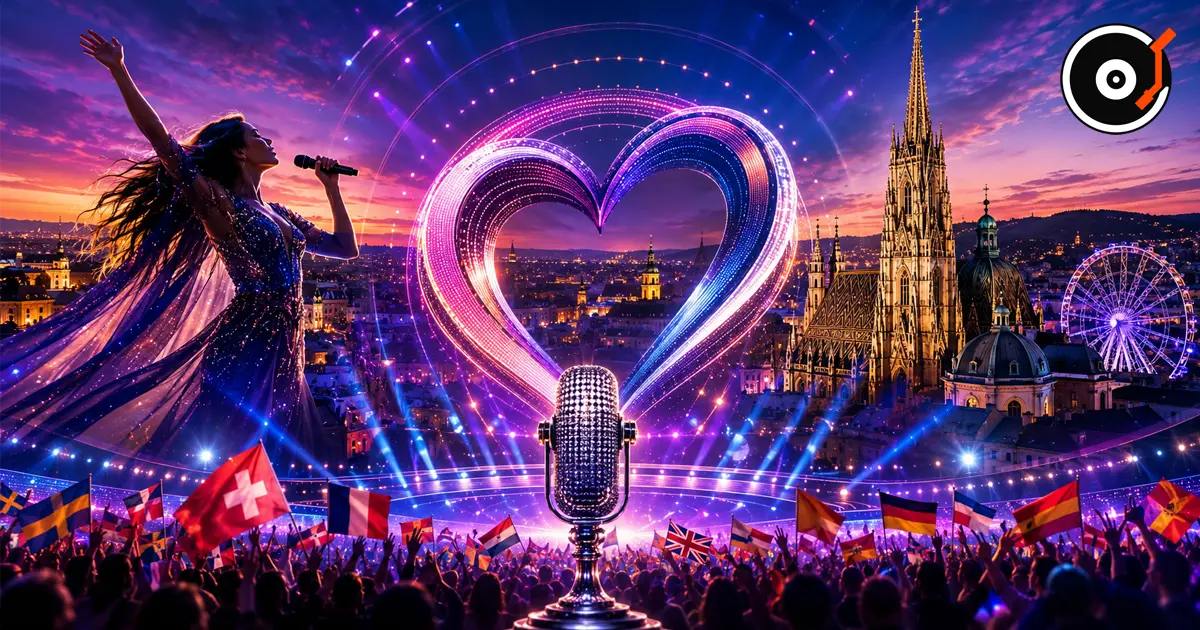
Eurovision 2026 in Vienna: all the details about the anniversary contest, bookmakers’ favorites, Ukraine at Eurovision, country boycotts, scandals, participants, and the biggest intrigues of the show.
With just days left before Eurovision 2026 begins, it already feels like the entire continent is talking about it. And at this point, it’s about far more than just music.
The 70th edition of Eurovision arrives surrounded by controversy, drama, political tensions, returning countries, boycotts, and — somewhat surprisingly — massive public interest. Social media is exploding with discussions, bookmakers are updating their odds almost daily, and fans are already calling this the most unpredictable Eurovision season in over a decade.
And honestly, Eurovision finally feels like the show millions originally fell in love with again — chaotic, emotional, bizarre, colorful, and completely unpredictable.
Where Eurovision 2026 Will Take Place
This year, Austria hosts the contest following JJ’s victory with the track “Wasted Love” at Eurovision 2025.
The main venue will be Vienna’s Wiener Stadthalle — one of Europe’s most iconic concert arenas. Eurovision was previously held there in 2015 after Conchita Wurst won the competition.
The semi-finals are scheduled for May 12 and May 14, while the grand final will take place on May 16, 2026.
Interesting fact: Austria has hosted Eurovision only twice before in its entire history — in 1967 and 2015. Both editions are still considered among the most stylish and visually impressive contests ever produced.
That’s exactly why expectations for Vienna are incredibly high this year.
Eurovision 2026 Is Already Making History Before It Even Starts
The biggest reason is the ongoing political controversy surrounding Israel’s participation.
Following recent events in the Middle East, several countries decided to withdraw from the competition, including:
- Spain
- Ireland
- The Netherlands
- Iceland
- Slovenia
For Eurovision, this is an almost unprecedented situation. Even during previous periods of political tension, the contest usually managed to remain a space supposedly “outside politics.”
But in 2026, separating music from the global political climate has proven nearly impossible.
Even within the Eurovision fan community, opinions are sharply divided. Some support the boycotts, while others believe Eurovision should continue bringing artists together regardless of world events.
As a result, organizers have significantly tightened security measures and reviewed several rules affecting both audiences and delegations.
And judging by how things are unfolding, this is far from the last major headline Eurovision 2026 will generate.
How Many Countries Are Participating
At the moment, 35 countries have officially confirmed their participation.
That’s noticeably fewer than in recent years. However, fans also received some exciting news — several countries are returning to the contest after a long absence:
- Romania
- Bulgaria
- Moldova
Romania’s return is especially exciting. The country has consistently delivered memorable Eurovision entries over the years — from over-the-top pop performances to powerful ethnic-inspired productions and dance music.
Moldova, meanwhile, has practically become Eurovision’s unofficial meme machine. Their performances regularly go viral on TikTok, turn into internet memes, and rack up millions of YouTube views.
Sometimes it feels like Moldova treats Eurovision less like a competition and more like its own unique art form.
Ukraine at Eurovision 2026
Ukraine will be represented this year by LELÉKA with the song “Ridnym.”
It’s arguably one of Ukraine’s most atmospheric Eurovision entries in recent years. The track blends electronic music, folk influences, and a deeply emotional ethnic sound.
Many fans are already comparing the song’s impact to what Go_A achieved a few years ago — when traditional national sounds suddenly resonated with audiences all across Europe.
Interestingly, bookmakers initially ranked Ukraine quite highly, although the country’s odds have slipped slightly in recent weeks. Still, Eurovision history has shown countless times that everything can change after just one rehearsal.
Sometimes a single great stage performance can completely transform a country’s chances overnight.
Who Are the Favorites Right Now?
One of this season’s biggest surprises has been Finland.
The country quickly climbed the betting rankings and is now considered one of the strongest contenders for victory.
And there’s something symbolic about that. Finland has won Eurovision only once — back in 2006, when Lordi shocked the world with “Hard Rock Hallelujah.”
Recent years have revealed an interesting trend: audiences are increasingly tired of perfectly polished mainstream pop and are gravitating more toward performances that feel authentic, unusual, and slightly chaotic.
And Finland is absolutely thriving in that atmosphere right now.
Other countries frequently mentioned among the favorites include:
- Sweden
- Italy
- France
- Austria
Meanwhile, Sweden somehow always looks like it has been preparing for Eurovision since before Eurovision itself even existed.
What the Organizers Are Preparing
Since this year marks Eurovision’s 70th anniversary, organizers are promising plenty of surprises.
According to rumors, the interval acts could feature appearances by:
If confirmed, the final could easily become one of the most nostalgic Eurovision shows in years.
It will also be fascinating to see how Eurovision balances modern TikTok culture with the nostalgic energy of the early-2000s television era.
Because today’s Eurovision audience includes both people who watched Ruslana’s “Wild Dances” live on TV and an entirely new generation discovering Eurovision through TikTok, Spotify, and Minatrix.
Eurovision Is No Longer Just a Contest
Over the last decade, Eurovision has changed dramatically.
Many people once viewed it as a strange European TV show that only mattered for one evening. But today, Eurovision has evolved into a massive international music platform.
Contest entries now reach global charts, generate hundreds of millions of streams, and regularly go viral across social media.
For young artists, Eurovision has become an opportunity to build an international audience in a single week — something some musicians spend years trying to achieve.
And perhaps the most interesting part is that Eurovision has once again started influencing modern pop culture.
This is especially noticeable in electronic music, ethno-pop, and alternative music scenes.
Editorial Opinion
Honestly, Eurovision 2026 currently feels incredibly chaotic. There’s too much politics, too much tension, and too many controversies surrounding the contest.
But at the same time, something important has returned — genuine emotion.
In recent years, Eurovision occasionally started feeling too “safe,” too polished, and too predictable. This year, however, there’s finally a sense that literally anything could happen on stage again.
And that unpredictability is exactly why people love Eurovision.
Yes, it’s impossible to separate the contest from global events anymore. And yes, there will absolutely be more controversies and heated discussions ahead.
But if the organizers manage to maintain the balance between spectacle, music, and the incredibly complicated atmosphere surrounding this year’s contest, Eurovision 2026 could become one of the most memorable editions in a very long time.