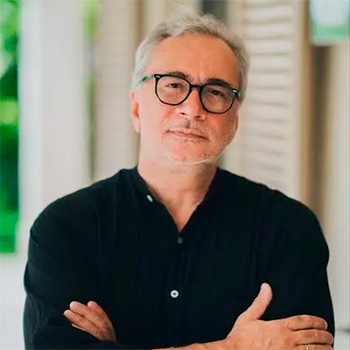
Konstantin Meladze is one of those rare composers whose influence is felt not through visibility, but through music that seems to be everywhere. His name may not always be front and center, yet he is the one building the foundation — the melody, the mood, the structure of a song. His work is marked by remarkable precision: every note is exactly where it should be, every pause serves the emotion. He is often described as a creator of “intelligent pop music” — accessible, yet far from simplistic.
Early Life and Education
He was born on May 11, 1963 in Batumi. He grew up in a typical Soviet family that valued discipline and education. Music was part of his life from an early age, but it was not initially seen as a future profession. He studied the violin, later learned piano, yet ultimately chose a technical path and enrolled at the Mykolaiv Shipbuilding Institute.
An interesting detail is that his engineering background did not simply fade into the past — it became part of his creative mindset. While many musicians rely on intuition, he approaches composition almost like engineering: structuring form, calculating dynamics, and carefully developing thematic progression.
Career Beginnings
His first serious steps in music were closely tied to his brother Valery Meladze, with whom he performed during their student years. At the time, it was more of a passion than a defined career path. Later, they entered the professional scene through the band “Dialog,” gaining experience in both studio recording and live performance.
Their early years were neither quick nor easy. It took several years to find their unique sound and define their musical language. By the mid-1990s, this search paid off — they began releasing songs that received significant airplay and set them apart from other artists of the time.
Development of Style
His style evolved gradually but eventually became instantly recognizable. At its core lies a blend of simple, almost “folk-like” melodic lines with more complex harmonic structures. This creates a dual effect: the song is immediately memorable, yet reveals deeper layers upon repeated listening.
Notably, he often rewrites his own compositions multiple times. According to those who have worked with him, a single song could go through dozens of versions before reaching its final form. He is not inclined toward compromise — if the result does not meet his standards, the work continues regardless of deadlines.
Producer Era and Work with Artists
In the early 2000s, his work expanded beyond songwriting. He began developing full-scale projects, overseeing not only the music but also the concept, image, and artistic direction of performers. One of the most notable examples is the group VIA Gra, which quickly became one of the most recognizable pop acts of its era.
The uniqueness of his production approach lies in building not just a group, but a system. Line-ups could change, yet the sound and style remained consistent. This allowed the project to sustain its popularity over a long period.
At the same time, he actively collaborated with major artists, writing songs that became hits. Importantly, he never tried to fit everyone into a single mold. Instead, he tailored the music to each performer, enhancing their individuality.
His role in these collaborations went far beyond that of a typical composer. He effectively shaped each artist’s repertoire strategy, defined the emotional range of their material, and set the direction for their sound across multiple releases. His approach can be described as “full-cycle production,” where each song becomes part of a broader artistic narrative. This is why many performers experienced significant artistic growth while working with him and received some of the strongest material in their discographies.
He has worked with Alla Pugacheva, Sofia Rotaru, Valery Meladze, Vera Brezhneva, Polina Gagarina, Ani Lorak, Grigory Leps, Svetlana Loboda, Taisiya Povaliy, Elena Temnikova, as well as projects such as MBAND, Yin-Yang, multiple line-ups of VIA Gra, and a number of less mainstream yet artistically significant performers. Across all these collaborations, one principle remains consistent: not a generic “hit for the sake of a hit,” but a precise alignment with the artist’s voice, character, and stage identity — ensuring the music remains distinctive and closely associated with the performer.
Television and New Formats
Over time, he began using television as a platform to discover and develop new talent. Participation in music shows allowed him to work with emerging artists and shape their careers from the ground up.
Interestingly, he is known in these projects as a demanding but fair mentor. He expects full commitment and attention to detail — sometimes even more than from established performers. For him, talent alone is not enough; the ability to work and evolve is equally important.
Personality and Working Approach
He remains a private individual, not inclined toward public exposure. Unlike many producers, he does not cultivate a media persona and rarely makes bold public statements. His primary focus has always been the work itself.
Among the more interesting details is his preference for working in silence and isolation. He minimizes distractions and can spend long periods in the studio, refining material to perfection. He is also known for his self-critical nature, often shelving completed songs if he feels they do not meet his standards.
Later Years and Influence
In recent years, he has adopted a quieter lifestyle and appears less frequently in public, yet his influence on music remains significant. Many contemporary producers and songwriters continue to draw inspiration from the approach he established.
When evaluating his contribution, it becomes clear that it is not merely about the number of hits. He reshaped the very idea of what pop music can be — more sophisticated, more emotional, and more thoughtfully constructed. His work continues to resonate years later, which is a rare measure of longevity in mainstream music.