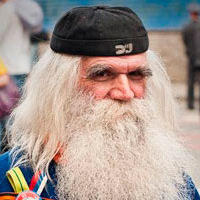
MC Vspyshkin was a cult figure of the Russian electronic scene, a symbol of Saint Petersburg rave culture of the 1990s and early 2000s, and an artist who shattered conventional ideas about age, format, and the role of an MC on the dance floor. His phenomenon goes far beyond music: Vspyshkin became a character of an era, a living embodiment of rave energy and inner freedom.
His real name was Vladimir Alexandrovich Turkov. He was born on October 31, 1936, in Leningrad, and this fact alone makes his appearance on the rave scene unique: by the time electronic music was just beginning to take shape in Russia, Turkov had already lived a full and eventful life.
Early years: music, discipline, and an engineer’s mindset
As a child, Vladimir Turkov sang in the boys’ and parents’ choir “Rodnik” at School No. 16. Music was present in his life from an early age, although he never received formal musical education. Later, Turkov would ironically describe his vocal experience as “unsuccessful,” yet his love for music stayed with him throughout his life.
After finishing school, he completed compulsory service in the Soviet Army, then earned an engineering degree and worked at the D. I. Mendeleev All-Russian Research Institute for Metrology, one of the country’s most authoritative scientific institutions. This fact is rarely mentioned, but it was precisely this engineering discipline and rationality that paradoxically coexisted with his future stage eccentricity.
A turning point came when he attended a concert by Vladimir Vysotsky at the House of Culture of Food Industry Workers on Pravda Street. According to Turkov’s recollections, it was then that he fully realized that the energy of a live performance is more important than perfect form—an idea that would later become central to his rave performances.
The Leningrad rock underground and ties to future legends
In the 1970s, Turkov became involved in the Leningrad rock scene, serving as an administrator for the band “Kochevniki” (also known as “Savoyary”). He consciously adopted both the external and internal codes of the rock underground—even stopped shaving in solidarity with the musicians.
According to Turkov himself, he witnessed the early formation of the careers of Konstantin Kinchev and Yuri Shevchuk, while Mikhail Boyarsky, who lived nearby, would come to him to learn how to play the guitar. These episodes underline an important point: Vspyshkin did not “come out of nowhere”—he had been inside the musical environment for decades, albeit outside the mainstream.
Entering rave culture: maturity as an artistic gesture
In the 1990s, amid the explosive growth of Saint Petersburg’s electronic scene, Vladimir Turkov unexpectedly appeared at raves—and instantly became a central figure. He took part in major events such as “Kolbasny Tsek”, “Vspyshka Sverhnovoy”, and Youth Day celebrations.
His image was built on sharp contrasts:
-
an elderly man in a space of youthful ecstasy
-
a strict appearance versus absolute freedom of behavior
-
laconic shouts instead of classical vocals
Vspyshkin was not an MC in the hip-hop sense of the word. He functioned as a catalyst of trance, driving the dance floor with short, almost shamanic verbal formulas.
Radio Record, “Kolbasny Tsek,” and nationwide fame
In 2000, MC Vspyshkin became the host of the show “Tsek” (“Kolbasny Tsek”) on Radio Record, alongside DJ Riga. Radio transformed him from a club phenomenon into a nationwide symbol of rave culture.
In the radio format, Vspyshkin’s voice was performed by actor Dmitry Bekoev—an interesting detail that highlights the theatrical nature of the project and its media construction.
The duet with “Nikiforovna” and the era’s main hit
In 2002–2003, at the initiative of Radio Record, a duet was formed between MC Vspyshkin and the project “Nikiforovna”. The contrast between a 19-year-old vocalist and an artist of advanced age became a deliberate artistic device.
The track “Kolbasny Tsek” (“Shishki”), featuring the chorus
“Shishki fall in the forest, I’m going for sausage”,
spent eight weeks at number one on the charts, became the anthem of the “Kolbasny Tsek 3” festival, and was included on DJ Gagarin’s album “Kolbasny Tsek 3”.
In 2004, the album Sex was released, after which the duo actively toured clubs and festivals, finally cementing Vspyshkin’s status as a folk symbol of the electronic scene.
The man beyond the stage: family, sports, and principles
Behind the onstage madness stood a man of strict principles. Vladimir Turkov was married for more than 35 years, raised three children, and actively took part in his grandchildren’s lives. He promoted sports and a healthy lifestyle, did not drink or smoke, joking that he had “quit drinking and smoking at the age of ten.”
He rollerbladed along embankments, regularly went to the gym, and, according to colleagues, in his later years could bench-press a 90-kilogram barbell. This contrast between physical discipline and stage chaos only strengthened the mythology of his image.
Death and cultural legacy
Vladimir Alexandrovich Turkov passed away on November 14, 2011, in Saint Petersburg. He left behind no extensive discography, but something far greater—a cultural code.
Today, MC Vspyshkin is:
-
a symbol of Saint Petersburg rave culture
-
proof that the stage has no age limits
-
a rare example of absolute sincerity in electronic culture
He remains in history not as a curiosity, but as a man who lived music with his body, his voice, and his character.