







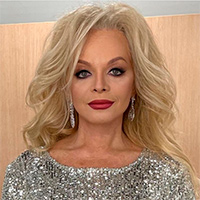
Larisa Alexandrovna Dolina (née Kudelman) is a Soviet and Russian pop and jazz singer, actress, and vocal pedagogue, People’s Artist of the Russian Federation. She is one of the few Russian vocalists who managed to unite academic training, jazz phrasing, theatrical dramaturgy, and mainstream pop into a coherent personal style.
Childhood and the Odessa school of survival
Larisa Dolina was born on September 10, 1955, in Baku (Azerbaijan SSR), into a Jewish family.
- Father — Aleksandr Markusovich Kudelman, a construction worker;
- Mother — Galina Izrailevna Dolina, a typist.
At the age of three, the family moved to Odessa — a city that became not just a place of growing up, but a true school of stage survival for the future artist. Odessa’s musical environment, with its restaurant culture, live jazz, and demanding audiences, shaped Dolina’s key quality — the ability to hold the audience’s attention under any conditions.
In her youth, she worked as a singer in Odessa restaurants — a tough practice where false notes, weak breath control, and lack of charisma were not forgiven. It was there that the foundations of her future vocal mastery and stage confidence were laid.
Musical education and early professional start
From the age of six, Dolina studied piano, early demonstrating perfect pitch and a strong sense of rhythm. In her teenage years, her interests shifted toward jazz — a genre requiring not only a voice, but musical thinking.
In 1971, her professional career began: Larisa became the soloist of the pop orchestra “We Are Odessites”, after which she worked with leading ensembles of the USSR:
- State Pop Orchestra of Armenia (Konstantin Orbelyan)
- State Pop Ensemble of Azerbaijan (Polad Bülbüloğlu)
- The orchestra “Sovremennik” under the direction of Anatoly Kroll
Her collaboration with Kroll secured her status as a top-level jazz vocalist, fluent in scat singing, complex syncopated rhythm, and improvisation.
The jazz phenomenon: technique and international recognition
Larisa Dolina is one of the few Russian singers with a declared vocal range of up to five octaves. She is distinguished by:
- exceptionally precise jazz intonation
- free and confident scat work
- powerful breath support
- seamless register control without audible breaks
Equally important is that her jazz mastery was recognized by Western musicians. Over the years, she collaborated with George Duke and other representatives of the global jazz scene — a rare case for an artist from the USSR and the post-Soviet space.
The Gnessin Academy and the “legalization” of talent
In 1984, Larisa Dolina graduated from the Gnessin Moscow Music College, specializing in pop vocals.
A crucial point: by the time she graduated, she was already a well-known artist. The diploma did not launch her career, but rather served as its institutional confirmation — a kind of “legalization” of talent within the Soviet system, where formal education was of decisive importance.
Solo career and pop success
From 1985, Dolina began an active solo career, collaborating with composer Viktor Reznikov. During this period, her stage image took shape — that of a strong, dramatic woman with emphasized vocal power.
Key concert programs:
- “Long Jump”
- “Contrasts”
- “Ice Floe”
- “A Little Woman”
Each of them was conceived as a theatrical musical statement, rather than a simple set of songs.
Theatre, musicals, and cinema
In 1990, Dolina performed the lead role in the rock opera “Giordano” together with Valery Leontiev.
A separate chapter is musical theatre:
she played Mama Morton in the musical “Chicago”, where her vocal-dramatic performance received high critical acclaim.
Film work includes:
- “We Are from Jazz”
- “Island of the Doomed Ships”
- “The Magicians”
Her vocal performances are also featured in more than 70 films and animated works, including the animated film “The Very Bluebeard”, where her voice is considered a benchmark of dramatic vocal performance in animation.
Titles and international performances
- 1991 — Radio Prestige Festival (France), audience ~20,000
- 1993 — Honored Artist of the Russian Federation
- 1998 — People’s Artist of the Russian Federation
Personal life
Larisa Dolina has been married three times:
- Anatoly Mionchinsky — daughter Angelina
- Viktor Mityazov
- Ilya Spitsyn
In 2011, her granddaughter Aleksandra was born.
Larisa Dolina — Discography
Studio albums
1980s — early period, vinyl and EPs
- 1983 — “Two Dreams”
Songs by Yuri Saulsky. First official release, EP. Recordings from 1982. - 1986 — Music for the film “Dance Floor”
Soundtrack featuring Larisa Dolina’s vocals. - 1986 — “Neptune’s Song”
Songs from the film “Dance Floor”, EP. - 1986 — “Long Jump”
One of the key early albums; some tracks were previously recorded and reissued with new arrangements. - 1988 — “House of Cards”
Songs by Viktor Reznikov. Formation of Dolina’s pop image. - 1989 — “New Day”
First full-length album released outside the USSR (Balkanton label).
1990s — peak popularity and pop classics
- 1990 — “The Yellow Devil”
Songs by Igor Kornelyuk, EP. - 1993 — “Ice Floe”
One of her most recognizable albums, cementing star status. - 1993 — “Forgive Me”
- 1994 — “Get Used to Larisa Dolina”
- 1995 — “Dolina in the Valley of Passions”
- 1996 — “Goodbye… There Is No ‘See You Later’”
- 1997 — “The Weather in the House”
The most commercially successful album of the 1990s; the title song became her calling card. - 1998 — “A Happy Fate”
- 1999 — “The Singer and the Musician”
2000s — maturity, experimentation, jazz
- 2000 — “Epigraph”
- 2000 — “Living in a New Way”
- 2002 — “Carnival of Jazz”
A jazz project that secured Dolina’s status as a jazz diva. - 2003 — “Islands of Love”
- 2004 — “Thaw”
- 2006 — “A Burned Soul”
- 2008 — “Hollywood Mood”
An English-language jazz album. - 2009 — “Carnival of Jazz-2: No Comments”
Continuation of the jazz series.
2010s — 2020s
- 2010 — “Route 55”
- 2012 — “LARISA”
- 2015 — “Let’s Take Off the Masks, Gentlemen”
Some sources continue to count early EPs and soundtracks separately; therefore, the number of “studio albums” may vary across summaries. This version presents an editorially consistent list of the main releases.
Soundtracks and film albums (selected)
- “Dance Floor” (1986)
- “The Magicians” (1982) — vocal parts
- “We Are from Jazz” (1983)
- “Island of the Doomed Ships” (1987)
- “The Man from Boulevard des Capucines” (1987)
- “The Very Bluebeard” (1979, animated film) — benchmark vocal performance
- “The Bremen Town Musicians & Co.” (2000)
Compilations
- “The Best” (official greatest hits collection)
Videography (music videos and key visual works)
- “Restaurant” (1996)
- “Angel” (1996)
- “Goodbye” (1996)
- “The Weather in the House” (1997)
- “The Wall” (1999)
- “Three Roses” (1999)
- “Didn’t Get It” (2004)
- “Flowers Under the Snow” (2006)
- “Against the Flow” (2020)
Public stance and the 2020s
In 2003, Dolina joined the United Russia party.
In 2022, she publicly supported Russia’s invasion of Ukraine, after which she was added to Ukraine’s sanctions lists in 2023.
2025 became one of the most difficult years for Larisa Dolina in recent decades. Alongside a general reputational crisis, widespread attention was drawn to the situation surrounding the apartment in Khamovniki, which ended with a court decision ordering eviction.
This episode became a symbolic finale of a difficult period in her life — a time when personal, property, and reputational issues came to the forefront, overshadowing her creative agenda.
Current status
Despite her age, criticism, and political controversy, Larisa Dolina continues to perform, participate in musical projects, and teach vocal technique. For some, she remains an icon of vocal mastery; for others, a controversial figure of her era. Yet her contribution to the development of jazz and pop vocals remains undeniable.
Editorial conclusion
Larisa Dolina is not merely a popular singer, but a unique vocal phenomenon who traveled the path from Odessa restaurants to international jazz stages. Her story is a chronicle of talent, discipline, and contradictions — without which it is impossible to imagine the musical culture of the late USSR and post-Soviet Russia.